한국어
 Bahasa Indonesia
 ไทย
 中文 (中国)
 Tiếng Việt
On 10 May, the United States raised the additional tariff on about USD 200 billion of imports from China from 10% to 25%, according to the Office of the US Trade Representative (USTR). The goods are those on the third Section 301 list, which took effect at 10% last September and includes many electronic components, sub-assemblies and electrical products. USTR has also started the process for possible tariffs on the remaining imports from China.
For factories in Vietnam, the direct effect depends on where goods are going and where they are considered to originate. The indirect effect is broader: more customers asking about production outside China, more questions about origin, and more pressure on component supply in Southeast Asia.
Who is affected
The tariff applies to goods of Chinese origin entering the United States. It does not apply to components imported from China into Vietnam. It matters to you if:
- you export finished products to the US that contain Chinese components, and the question is whether the processing in Vietnam makes the product Vietnamese;
- you supply parts or sub-assemblies to customers who build products in China for the US market;
- your customers are moving orders from Chinese suppliers to factories in Vietnam and need you to scale up.
US non-preferential origin generally follows the substantial transformation test: the processing must create a new article with a different name, character or use. Simple assembly, repacking or relabelling usually does not change origin. US Customs and Border Protection decides origin case by case and publishes rulings that can guide you, but the analysis for your own product should be done carefully and documented.
Review costs
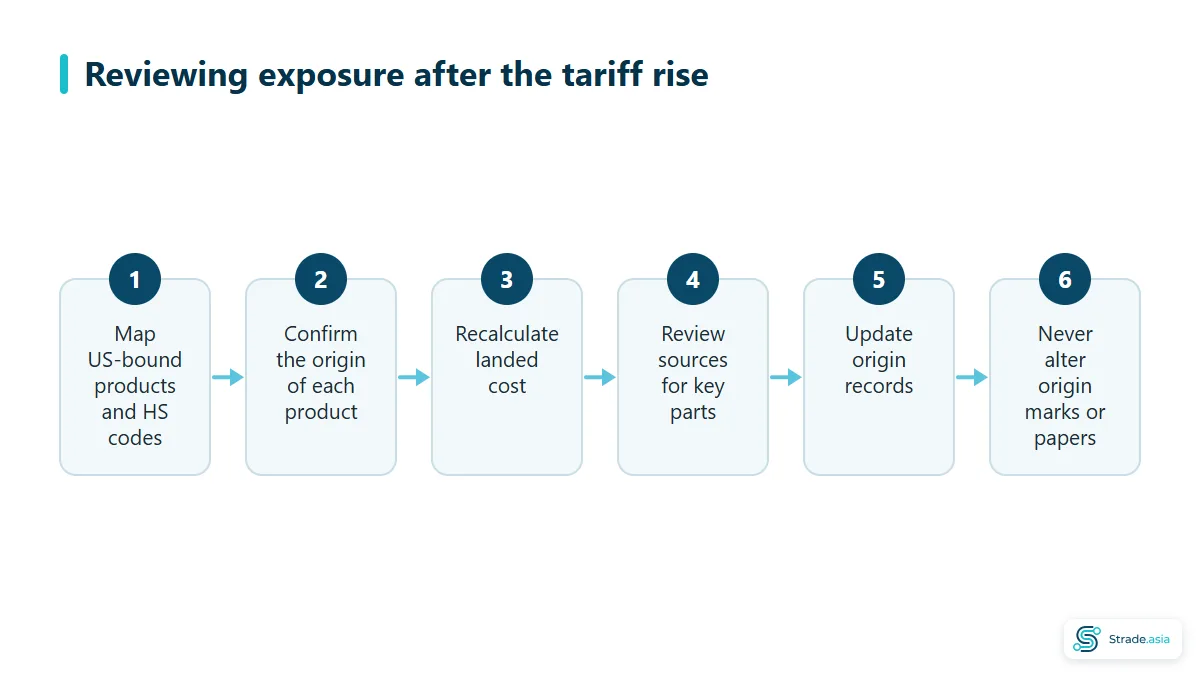
Start with a list of products and parts that are, or could be, affected:
- Identify products shipped to the US, the 8-digit US tariff codes (HTSUS) your importer declares, not only the HS codes used in Vietnam, and the origin declared today.
- Check whether each US tariff code appears on the Section 301 lists, and whether any product exclusion applies.
- Check the delivery terms, such as DDP or DAP, to see who pays the US duty, and recalculate the landed cost at the new rate where Chinese origin applies.
- For parts you sell to customers who build in China for the US, ask how they will treat the tariff and whether they plan to move production.
Check origin documents
Origin claims will receive more scrutiny, from customers and from customs. For each product you ship to the US, keep:
- the BOM with the origin of each significant input;
- a description of the manufacturing steps carried out in Vietnam;
- supplier documents for components, including the country of origin on invoices or certificates;
- any certificates of origin issued for the goods.
The same records support preferential claims in other markets, such as under CPTPP, which took effect for Vietnam in January; see CPTPP rules of origin basics. A preferential certificate of origin issued in Vietnam does not by itself settle US origin, which follows the substantial transformation test, especially where a factory only assembles boards made in China.
Look at alternative sources, carefully
Some buyers are now looking for components made outside China, or for the same part from another fab or assembly site. This can work where a manufacturer has more than one qualified site, or where an alternate from another maker meets the specification. If many buyers make the same switch at once, non-China lots of popular parts can tighten, so it pays to start early. Treat it as a qualification exercise, not only a purchasing one: compare datasheets, test samples and update your approved manufacturer list, as described in qualifying second sources.
Ask suppliers for the country of origin of each part, not just the country it shipped from. A part bought from a stock location in Singapore or Hong Kong may still have been made in China.
Never falsify origin
Higher tariffs create temptation. Relabelling Chinese goods as made in Vietnam, routing them through Vietnam with minimal processing, or altering certificates of origin is illegal. The penalties can fall on the exporter, the importer and anyone who knowingly helps, and the practice puts at risk the trade that honest manufacturers in Vietnam depend on. If a supplier offers documents that do not match the goods, decline.
How the Section 301 tariffs have widened
The first two Section 301 lists, covered in what electronics buyers should check, focused largely on industrial goods and components. The third list widened the scope, and as we noted in tariff list 3 and supply chain moves, it pushed more customers to look at Southeast Asia. The rise to 25% makes that review more urgent, and makes good records more valuable.
How Strade can help
Strade is an independent electronic component distributor with its own engineers, supplying factories in Vietnam and across Asia. We source from manufacturers, their distributors and vetted open-market suppliers, and CoC, C/O and CQ documents travel with the goods when the source issues them. Our services include origin documentation, Form E and CPTPP paperwork, and HS code review; see origin and compliance. When a part needs a different source, our engineers can propose alternates with matching specifications for your team to decide on.
To review sources and origin data for the parts on your BOM, send us your request.