한국어
 Bahasa Indonesia
 ไทย
 中文 (中国)
 Tiếng Việt
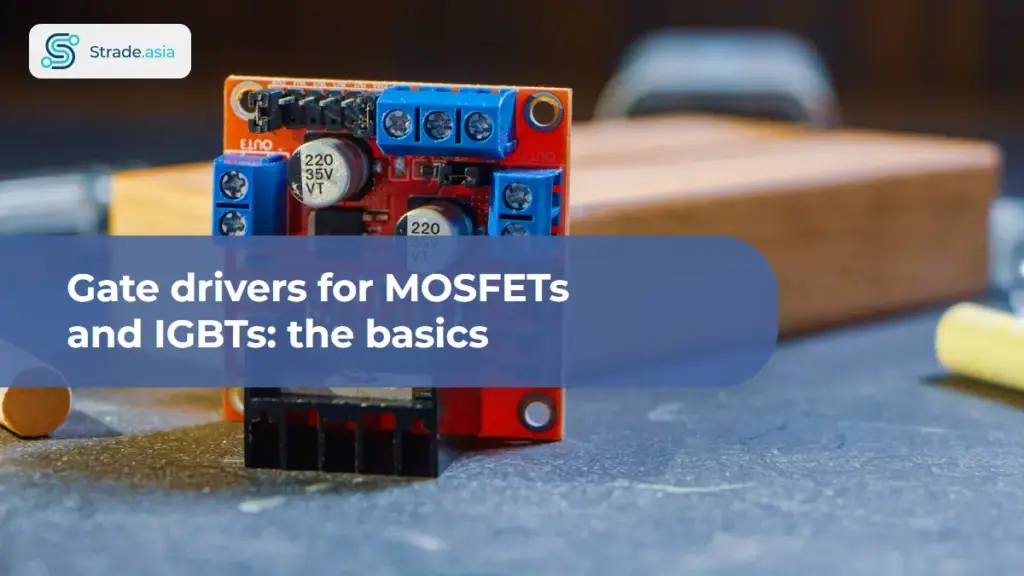
A MOSFET or IGBT is only as good as the circuit that switches it. A weak gate drive slows switching and raises losses; a poorly protected one can let a short circuit destroy the device in microseconds. Yet gate drivers are often chosen late in a design, and when a driver goes on allocation or reaches end of life, buyers discover that few parts can drop straight in.
Engineers and buyers who agree early on drive current, isolation and protection have far fewer surprises when a driver has to be sourced or replaced.
What a gate driver does
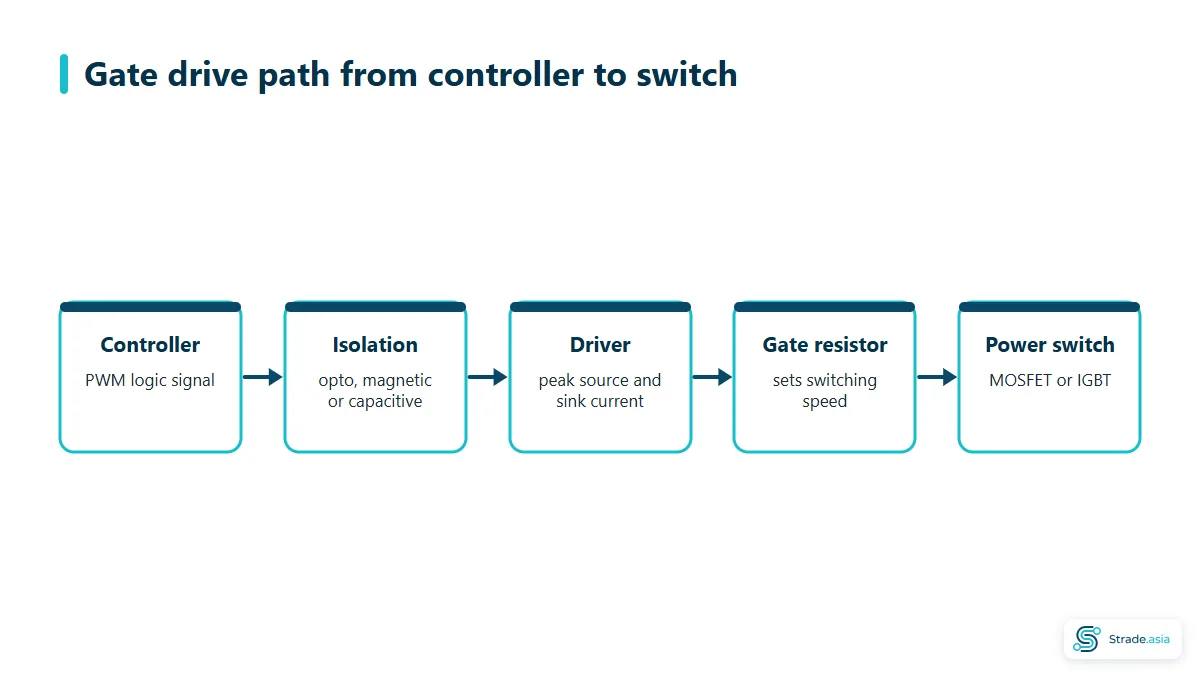
The gate of a MOSFET or IGBT behaves much like a capacitor. To turn the device on, the driver must charge that capacitance to the right voltage quickly; to turn it off, it must discharge it just as fast. A microcontroller or PWM controller output cannot supply the current or the voltage levels required, so a driver sits between them.
The key datasheet figure is total gate charge (Qg). The faster you want to switch, the higher the peak current the driver must source and sink. A gate resistor between driver and gate sets the actual switching speed, trading switching loss against EMI and voltage overshoot. Many designs use separate turn-on and turn-off resistors to tune each edge.
Low-side, high-side and isolated gate drivers
- Low-side drivers switch a device whose source or emitter is at ground. They are simple, but driver and device must share a ground reference.
- High-side drivers switch a device whose source floats, such as the upper switch of a half-bridge. A common approach is a bootstrap supply: a diode and capacitor recharged each time the low-side switch is on. Bootstrap circuits are simple but cannot hold the high-side switch on indefinitely. Half-bridge drivers combine both channels and often add dead time to prevent shoot-through.
- Isolated drivers separate the control side from the power side with an optocoupler, a transformer or a capacitive barrier. They are used where voltages are high, where safety isolation is required, or where ground noise between control and power stages would upset a non-isolated driver.
Protection features
Undervoltage lockout (UVLO). If the driver supply drops, the device would be driven only partly on, operating in its linear region and overheating quickly. UVLO holds the output off until the supply is high enough. The thresholds must suit the device: IGBTs and standard MOSFETs need a higher gate voltage than logic-level MOSFETs, so a driver chosen for one may not protect the other.
Desaturation (DESAT) detection. Used mainly with IGBTs. During a short circuit, the collector-emitter voltage rises while the gate is still on. The driver monitors this voltage and, when it crosses a threshold, turns the device off, often with a soft turn-off to limit overshoot, and reports a fault to the controller.
Active Miller clamp and negative bias. Fast voltage changes across the device can couple through the Miller capacitance and turn the gate back on. A clamp holds the gate low while the device is off, and a negative off-state voltage adds margin. Both are common in IGBT drives.
Common-mode transient immunity (CMTI). For isolated drivers, this rating shows how fast a voltage change across the barrier the driver can tolerate without errors. It matters more as switching speeds rise.
Isolation ratings and standards
An isolated driver’s datasheet lists several ratings: withstand voltage, working voltage, transient overvoltage, creepage and clearance distances, and whether the barrier is rated for basic or reinforced isolation. A driver certified only for basic isolation cannot replace one with reinforced isolation where the product relies on it for safety. Parts are certified to component standards such as UL 1577, IEC 60747-5-5 for optocouplers, and the VDE 0884 series for magnetic and capacitive isolators. The end product must also meet its own system standard, for example IEC 61800-5-1 for adjustable-speed drives or IEC 62368-1 for IT and audio-video equipment.
When comparing parts, check that the certificates cover the exact part number and package, not just the product family.
Replacing a gate driver
Gate drivers are rarely as interchangeable as they look. Before approving an alternate, compare:
- Pinout, exact package and operating temperature range; for isolated parts, narrow-body and wide-body SOIC versions give different creepage between pins.
- Peak source and sink current.
- UVLO thresholds and hysteresis.
- Propagation delay and delay matching between channels.
- Protection features: DESAT, Miller clamp, fault reporting, soft turn-off.
- Isolation ratings and certificates.
- Input type, logic thresholds and polarity: a driver with a CMOS or TTL voltage input will not drop in for an optocoupler-style driver that expects LED current at its input.
A part that matches on paper still needs testing in the circuit, because layout and gate resistors were tuned to the original. Our guide to absolute maximum ratings explains how to read datasheet limits, and approved manufacturer lists and second sources covers qualification. For the small converters that often supply isolated drivers, see isolated or non-isolated DC-DC modules.
How Strade can help
Power products are Strade’s main product group, alongside semiconductors, passive components and connectors. We are an independent electronic component distributor with our own engineers, supplying factories in Vietnam and across Asia from manufacturers, their distributors and vetted open-market suppliers. When a gate driver is short or discontinued, our engineers can propose an alternate with matching specifications, and your team decides. Browse our power products.
To check availability or alternates for the drivers and power switches on your BOM, send us a request for quotation.