한국어
 Bahasa Indonesia
 ไทย
 中文 (中国)
 Tiếng Việt
On 16 May, the US Department of Commerce added Huawei Technologies and a number of its affiliates to the Entity List. Since then, exporting, re-exporting or transferring items subject to the US Export Administration Regulations (EAR) to those companies requires a licence, and the Bureau of Industry and Security (BIS) has said applications will be reviewed with a presumption of denial. A few days later, BIS issued a temporary general licence that allows some limited activities related to existing networks and devices.
The decision has drawn attention because of the company involved, but the mechanism behind it applies to anyone who buys or sells electronic components. Factories in Vietnam handle many items subject to US export controls, often without realising it. The basics below are general information, not legal advice; for a specific case, consult a qualified trade compliance adviser.
What “subject to the EAR” means
The EAR apply to more than goods shipped from the United States. In general, they cover:
- items located in the United States;
- US-origin items wherever they are, including a US-made chip in a warehouse in Asia;
- some foreign-made items that contain more than a de minimis amount of controlled US content;
- some foreign-made items that are the direct product of certain US technology or software.
A component made in the United States and bought in Asia therefore remains subject to the EAR when it is re-exported, and the rules can also reach products it is built into. Parts that a US company makes outside the United States are not US-origin as such, but they can still be caught through US content or technology, so check the manufacturer’s export data rather than assume either way.
ECCN and EAR99
Items subject to the EAR are either listed on the Commerce Control List with an Export Control Classification Number (ECCN), or fall into the catch-all category EAR99. Many common components are EAR99 or carry an ECCN that needs a licence only for a small number of destinations. Some items, such as certain high-performance processors, programmable logic, encryption products and radiation-hardened parts, carry ECCNs that need licences for more destinations.
The Entity List works differently. For many listed parties, the licence requirement covers all items subject to the EAR, including EAR99 items. That is why screening the parties, not only classifying the parts, matters.
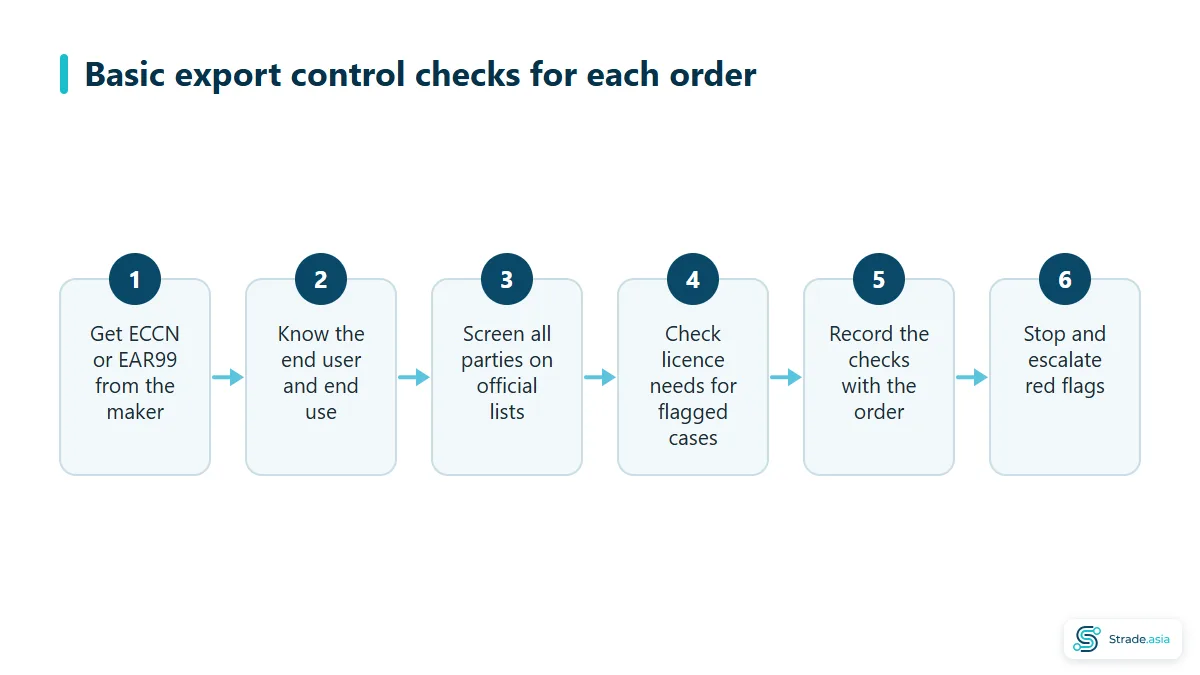
Many manufacturers publish the ECCN of each part on their websites or in their compliance data. Collect it for the parts on your BOM and keep it on file.
Restricted party screening
Screening means checking the parties in a transaction against restricted party lists. The US government publishes a Consolidated Screening List that combines lists from the Departments of Commerce, State and the Treasury, including the Entity List and the Specially Designated Nationals list. Other countries and the United Nations keep their own lists.
Good practice is to screen:
- the customer, its parent company and affiliates where known, and any consignee named on documents;
- the end user, if different;
- freight forwarders and other intermediaries;
- new suppliers, especially on the open market.
Screen again when lists change, as they did in May. Watch for red flags: an unusual delivery address, reluctance to state the end use, payment from an unrelated third party, or requests to remove labels or change documents.
What to ask suppliers
When you buy components for products that will be exported, your supplier documents should give you:
- The manufacturer part number and manufacturer name.
- The country of origin of the part.
- The ECCN or EAR99 status, from the manufacturer where available.
- Any end-use or end-user statement the supplier requires, completed honestly.
Our guide to reading component labels and barcodes covers checking manufacturer data at goods receipt. For open-market purchases, also consider where the stock has been and whether its documents make sense.
What this means for factories in Vietnam
Factories that assemble products for export already deal with tariffs and origin, as discussed after last month’s US tariff increase. Export controls ask a different question: not how much duty applies, but whether an item may go to a given party at all. The two should not be confused. Meeting CPTPP rules of origin or holding a Vietnamese certificate of origin does not change whether a US-origin chip inside the product is subject to the EAR.
Practical steps:
- Give one person ownership of export control questions.
- Keep ECCN and origin data alongside your BOMs and approved manufacturer list; our guide to approved manufacturer lists explains how to structure that list.
- Screen customers and intermediaries, and record that you did.
- When in doubt, stop and ask before shipping.
How Strade can help
Strade is an independent electronic component distributor with its own engineers, supplying factories in Vietnam and across Asia. We source from manufacturers, their distributors and vetted open-market suppliers, inspect every lot on receipt, and pass on CoC, C/O and CQ documents when the source issues them. For an overview of how we handle sourcing and delivery, see our supply chain services.
If you need manufacturer data or alternates for parts on your BOM, send us the part numbers.