한국어
 Bahasa Indonesia
 ไทย
 中文 (中国)
 Tiếng Việt
On 6 July 2018, the United States began charging an additional 25% tariff on a first list of imports from China worth about USD 34 billion, according to the Office of the US Trade Representative (USTR). The action follows the USTR’s investigation under Section 301 of the Trade Act of 1974 into China’s practices on technology transfer and intellectual property. China responded the same day with tariffs on US goods.
Many of the products on the first list are industrial machinery, electrical equipment and electronic products. USTR has also proposed further lists that would extend tariffs to a much wider range of goods. Whether you build products for the US market or only buy components that pass through China, now is the time to check your exposure.
Who the Section 301 tariffs affect
The tariff is paid by the importer of record in the US, on goods whose country of origin is China and whose US tariff code is on the list. For factories in Vietnam that has several consequences:
- If you export finished products to the US that are made in Vietnam, the tariff does not apply to them. But US customers may ask for proof of origin, and may shift orders toward suppliers outside China, which can bring new demand and new scrutiny.
- If your group ships to the US from plants in both China and Vietnam, the tariff changes the cost comparison between the two, product by product.
- If you buy components or modules from China for products sold in Vietnam or other markets, the US tariff does not apply. Indirect effects are still possible: as US buyers move orders away from China, plants elsewhere may see tighter capacity and longer lead times, and supplier pricing may change.
Origin is the key question
For US customs purposes, a product’s origin generally depends on where it was last substantially transformed into a new article with a different name, character or use. Simple assembly, testing or repacking of Chinese parts in another country may not change origin. US Customs and Border Protection decides case by case, and an importer can ask for a binding ruling where there is doubt. A Vietnamese certificate of origin does not by itself decide origin for US tariff purposes. Shipping Chinese goods through Vietnam under a false origin is illegal and carries serious penalties.
This makes origin data part of everyday purchasing. Country of origin appears on most component labels and should match the commercial documents; see reading component labels and barcodes.
Five steps to check your exposure
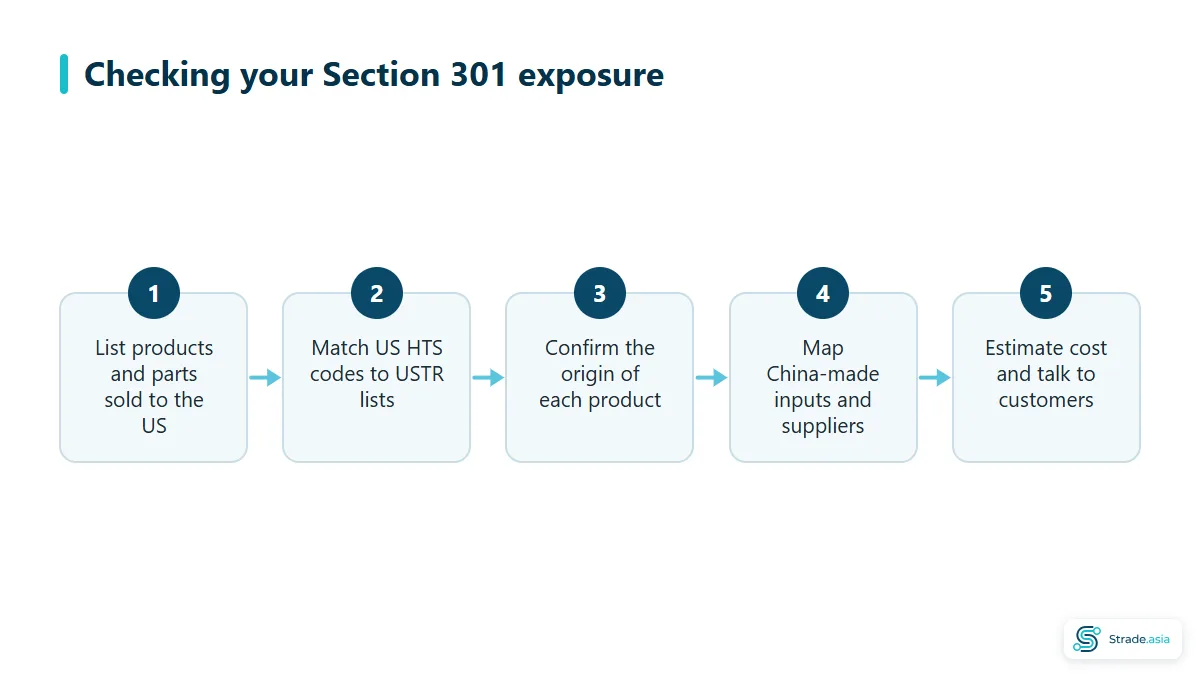
- List what you sell to the US, directly or through customers, including spare parts and sub-assemblies.
- Match US HTS codes against the lists published by USTR. The lists use eight-digit US codes, so do not rely on the six-digit international HS code alone.
- Confirm origin for each affected product. Record where the key processes take place and why the product qualifies.
- Map inputs from China. For each product, note which components and materials come from China, and which suppliers also have plants elsewhere.
- Estimate the cost and talk to customers. Who pays the tariff depends on who acts as importer of record; check your contracts and Incoterms, then talk to customers and suppliers early, before orders start to move.
USTR has also opened a process through which US importers can request exclusions for specific products. If you sell to US importers, they may ask you for technical details to support a request.
Keep second sources ready
If customers move orders or ask for supply from outside China, you may need alternates for components made only in China, or evidence that existing parts come from plants elsewhere. A qualified second source takes time; our guide to approved manufacturer lists describes the steps. Trade agreements such as the CPTPP give another reason to know exactly where each input comes from.
What not to do
- Do not change declared origin or HS codes to avoid a tariff without a sound basis. Customs authorities check, and corrections are costly.
- Do not assume a supplier’s label tells the whole story. Ask for country of origin on quotes and invoices, and keep supplier declarations on file.
- Do not make large moves on the basis of proposals alone. The lists may still change before they take effect, so track official announcements from USTR.
How Strade can help
Strade supplies electronic components to factories in Vietnam and across Asia and provides origin and export documentation services, including certificates of origin and HS code review. CoC and C/O documents travel with the goods when the source provides them, and we deliver DDP or DAP with customs documents prepared.
Send us your BOM to check sources and origin information for your parts, or read about our origin and compliance services.