
 한국어
 Bahasa Indonesia
 ไทย
 中文 (中国)
 Tiếng Việt
On 2 July 2025 the US President announced a trade framework with Vietnam. As announced, goods from Vietnam would face a 20% tariff, and goods deemed to be transshipped through Vietnam would face 40%. Two weeks later the details are still pending: there is no published legal text yet, and no official definition of what counts as transshipment or how it will be tested.
For factories in Vietnam that export to the US, or that supply parts to companies that do, the final numbers matter less than one practical question: if US Customs asks where a product really comes from, can you prove it?
Two meanings of “transshipment”
In logistics, transshipment simply means moving cargo through a port or hub on its way somewhere else. Vietnamese ports handle this every day, and it is one reason the country works well as a regional hub, as discussed in our May article on Vietnam as a transshipment hub. Goods that pass through under customs control keep their original origin and are declared that way.
In trade policy, the word means something else: goods made mostly in another country, routed through Vietnam with little or no processing, and then declared as Vietnamese to get a lower tariff. As described so far, this is the practice the higher rate targets. It is not aimed at real manufacturing in Vietnam, but a factory that cannot document its manufacturing may find it hard to show the difference.
Substantial transformation: the test that decides
For non-preferential origin, US Customs generally applies a “substantial transformation” test: a product comes from the country where it was last turned into a new and different article, with a new name, character or use. Simple operations such as repacking, relabelling, sorting or minor assembly usually do not change origin. Making a product from components through real manufacturing steps often does, but the answer depends on the product and the process, and US Customs decides case by case through its rulings.
For electronics this matters because many products assembled in Vietnam use imported components and subassemblies. Mounting components on a PCB, loading firmware, building the board into an enclosure and testing the finished unit is very different from putting an imported finished product into a new box. That difference has to be visible in your records, not only on the factory floor.
What to prepare now
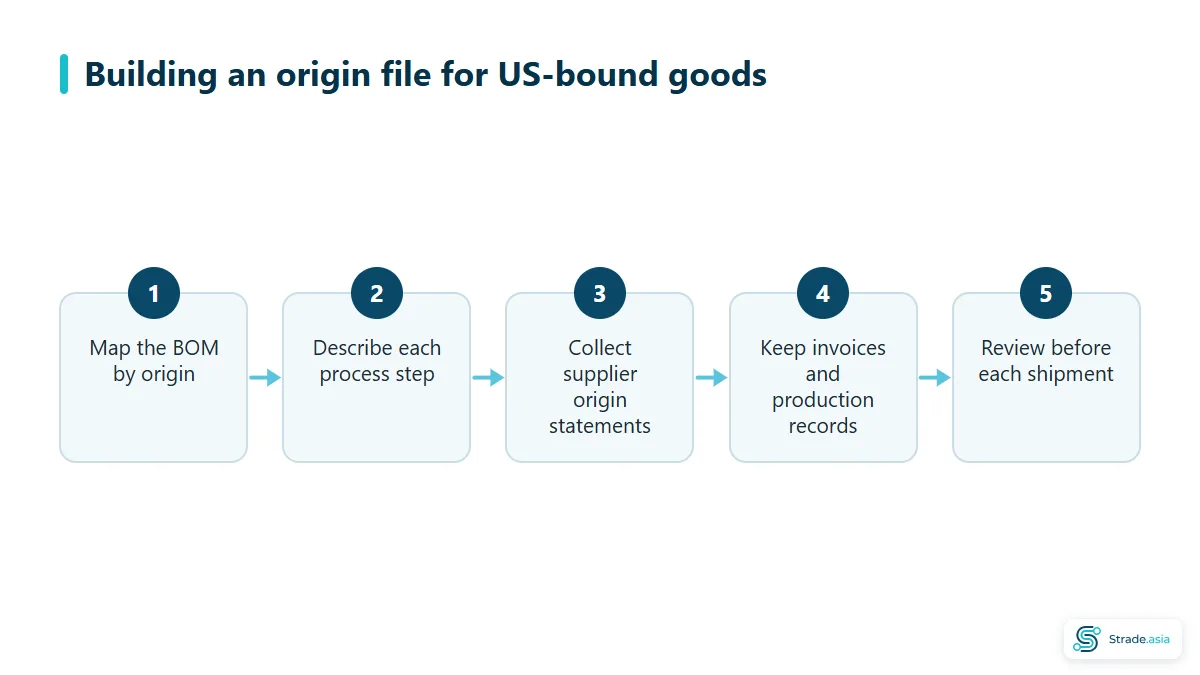
You do not need to wait for the final text to build an origin file. The same records support customs questions in the US, preferential origin claims under agreements such as RCEP, and audits by your own customers.
- BOM with origin per line. For each component, record the manufacturer, part number, country of origin as stated by the supplier, and cost. The origin printed on a reel label often reflects where the part was assembled or tested, so keep the supplier’s statement as well.
- Process description. Write down what happens in your factory: SMT, through-hole assembly, programming, final assembly and testing. Routing sheets and photos help.
- Supplier origin statements. Ask component and material suppliers to state country of origin on invoices or in a separate declaration, and file them with the purchase records.
- Production and cost records. Work orders, labour hours and the value added in Vietnam show that the work is real.
- Consistency check. HS code, origin, description and value should match across the commercial invoice, packing list, certificate of origin and your internal records.
Questions to review this month
- Which products shipped to the US contain subassemblies bought in finished or nearly finished form?
- Are there product lines where your factory only tests, packs or labels? Those carry the highest risk under any transshipment rule.
- Does each US customer expect origin data from you, and in what format?
- Who in your company owns the origin file, and how quickly could they answer a request?
Keep watching the details
The framework still has to be written into legal text, and the transshipment rules will decide how much evidence is enough. Until then, treat the announced figures as announced rather than final, and avoid moving sourcing on the basis of guesses. The wider background is covered in our April analysis of the US reciprocal tariff policy.
What does not depend on the final text is good record keeping. Factories that already hold clean BOM data, supplier statements and process records will be able to respond quickly, whatever form the rules take.
How Strade can help
Strade Asia supplies electronic components to factories in Vietnam and across Asia, with CoC, C/O and CQ supplied with the goods when the source provides them. Our services include origin files and export documents, covering Form E, RCEP, CPTPP and EVFTA, and HS code reviews. For components with clear documentation, send your BOM through our RFQ page, or read more about our origin and compliance support.


