한국어
 Bahasa Indonesia
 ไทย
 中文 (中国)
 Tiếng Việt
On 14 January, the Comprehensive and Progressive Agreement for Trans-Pacific Partnership (CPTPP) entered into force for Vietnam. It had already taken effect on 30 December 2018 for the first six countries to ratify: Australia, Canada, Japan, Mexico, New Zealand and Singapore. For factories in Vietnam that export electronics, power supplies or electrical equipment, the agreement opens lower tariffs in markets such as Canada and Mexico, where Vietnam had no free trade agreement before. With Japan, Australia, New Zealand and Singapore, it adds another option to Vietnam’s existing agreements.
Lower tariffs are not automatic, though. A product only qualifies if it meets the CPTPP rules of origin, and the claim must be backed by records. With Tet approaching and many shipments planned for the weeks after the holiday, now is a good time to check how those rules apply to your products.
What “originating” means under CPTPP
A good counts as originating if it meets one of three conditions:
- Wholly obtained or produced in one or more CPTPP countries. This rarely applies to manufactured electronics.
- Produced entirely from originating materials, where each input has itself qualified as originating.
- Produced from non-originating materials that meet the product-specific rule for the finished good’s tariff classification.
For most electronic products, the third route is the one that matters. A typical BOM contains semiconductors, passives and connectors made in China, Taiwan, Korea or Europe, none of which are CPTPP members. What counts is whether the processing in Vietnam, and in other member countries, transforms those inputs enough to meet the rule.
CPTPP also allows full cumulation: materials and processing in any country where the agreement is in force can count toward origin. A sub-assembly genuinely made in Japan or Singapore can therefore help a product finished in Vietnam qualify. A chip made in China or Taiwan that only ships from a warehouse in Singapore still counts as non-originating.
CPTPP product-specific rules for electronics
The product-specific rules are listed by HS code in an annex to the rules of origin chapter (Annex 3-D). For many electrical goods, the rule is a change in tariff classification: the non-originating inputs must be classified under a different heading or subheading from the finished product. Some lines offer a regional value content test as an alternative, calculated by one of the methods the agreement sets out, such as build-down, build-up or focused value.
Three practical points follow:
- The HS code decides the rule. A power supply, a battery charger and a complete device may sit in different headings with different rules. Confirm the classification of the finished product before you look up the rule.
- The BOM decides whether you pass. For a tariff-shift rule you need the HS code of every non-originating input. For a value test you need costs and origins you can document.
- Small amounts of non-originating material may be tolerated under the de minimis provision, but do not plan around it without checking how it applies to your product.
Certification and records
CPTPP does not prescribe a single government certificate. A certification of origin can be completed by the exporter, the producer or, in some cases, the importer, provided it contains the data elements the agreement lists. Members can phase in parts of this system. Exports from Vietnam are expected to use a certificate of origin (Form CPTPP) issued through the Ministry of Industry and Trade (MOIT) at first, with exporter self-certification later. Check with your customer’s customs broker and with MOIT which method applies to your shipments today.
Whatever the form, the claim must be supported by records: the BOM, supplier invoices, documents showing the origin of inputs, production records and cost calculations. If goods transit a non-member such as Hong Kong, keep documents showing they stayed under customs control there. Customs in the importing country can ask for verification after the goods have been cleared, and the agreement requires records to be kept for a set period.
What to do before the next shipment
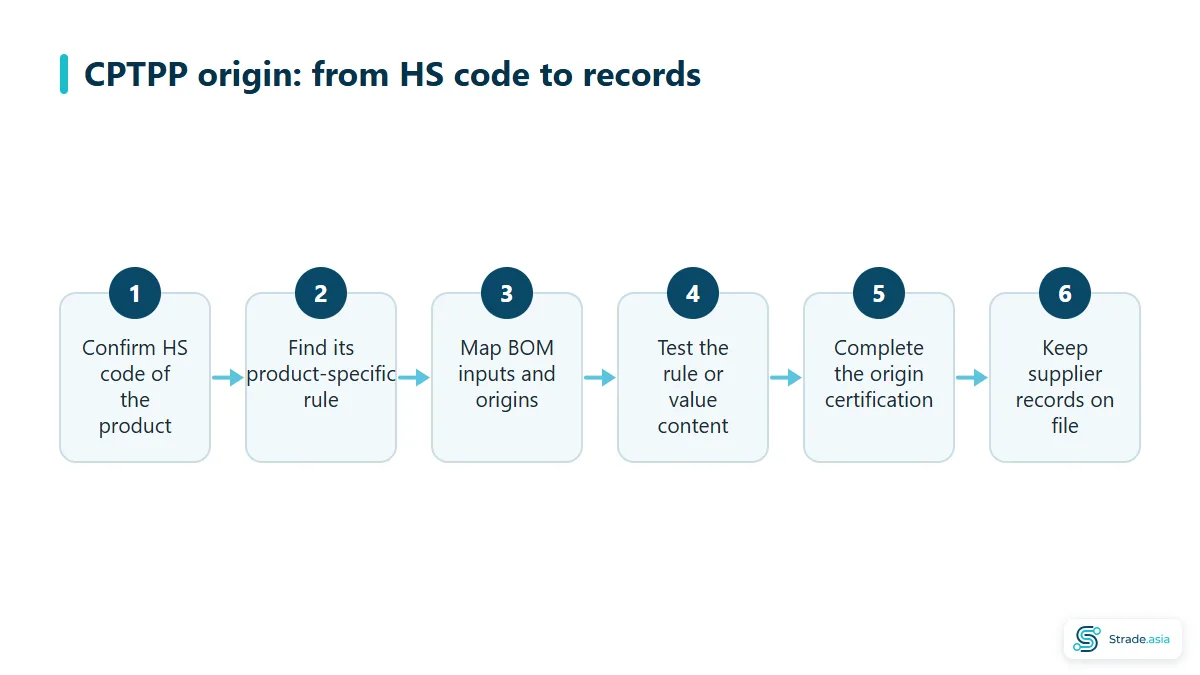
- List the products you ship, or plan to ship, to CPTPP markets, with their HS codes.
- Look up the product-specific rule for each code and note whether it is a tariff shift, a value test or both.
- Build an origin worksheet from the BOM: HS code, country of origin and cost of each input.
- Ask component suppliers for origin information on the parts that decide the result, and keep their statements on file.
- Agree with your customer whether proof of origin will be a certificate issued in Vietnam or a certification by the importer where the destination allows it, and what data it needs.
- Set up a file for each shipment, so that a verification request months later can be answered quickly.
How this connects to earlier changes
When the agreement was signed in Santiago last March, we looked at what CPTPP could mean for electronics trade. Since then, US tariffs on Chinese goods have pushed more buyers to consider production in Southeast Asia, as discussed in tariff list 3 and supply chain moves. A CPTPP claim is one more reason to keep component origin data in order. Delivery terms also decide who holds which documents; see our guide to Incoterms 2010 for component imports.
How Strade can help
Strade is an independent electronic component distributor with its own engineers, supplying factories in Vietnam and across Asia. We source from manufacturers, their distributors and vetted open-market suppliers, and CoC, C/O and CQ documents travel with the goods when the source issues them. Our services include origin documentation and export paperwork, such as Form E, CPTPP and HS code review; see origin and compliance.
If you are preparing a CPTPP claim and need component data or alternative sources, send us your BOM.