
 한국어
 Bahasa Indonesia
 ไทย
 中文 (中国)
 Tiếng Việt
When a part goes on allocation or a fab stops, the first question is whether another part can be used. In many factories the answer depends on one document: the approved manufacturer list (AML), sometimes kept together with an approved vendor list (AVL). If a BOM line has no qualified second source, purchasing has no room to move, however many equivalent parts exist on the market. The past year has given good reasons to fix this early: the Kumamoto earthquakes showed how one damaged site can stop supply, and memory buyers are now dealing with allocation.
AML and AVL: what they record
An AML lists, for each internal part number, the manufacturer part numbers that engineering has approved. An AVL lists the approved suppliers, meaning the companies you buy from: manufacturers, their distributors or other vetted sources. Some factories keep both in one table; others keep the AVL in purchasing and the AML in engineering. Either way, the internal part number should describe the function and key ratings, and every approved manufacturer part should meet them.
Contract manufacturers often work to their customer’s AML. In that case only the customer can add a source, and the request must come with evidence.
Why single-source lines persist
- The designer picked one part and nobody added a second.
- The part is genuinely unique: a microcontroller with its firmware, a custom ASIC, a special connector.
- Qualification looked expensive compared with the risk, until the risk arrived.
- Mergers have turned two approved sources into one company, or two brands turn out to rely on the same fab or assembly site, as discussed in what mergers mean for your BOM.
Review the BOM with purchasing and engineering together, mark every single-source line, and rank the lines by annual spend, lead time and the cost of a stoppage. Start at the top of that list.
How to qualify a second source
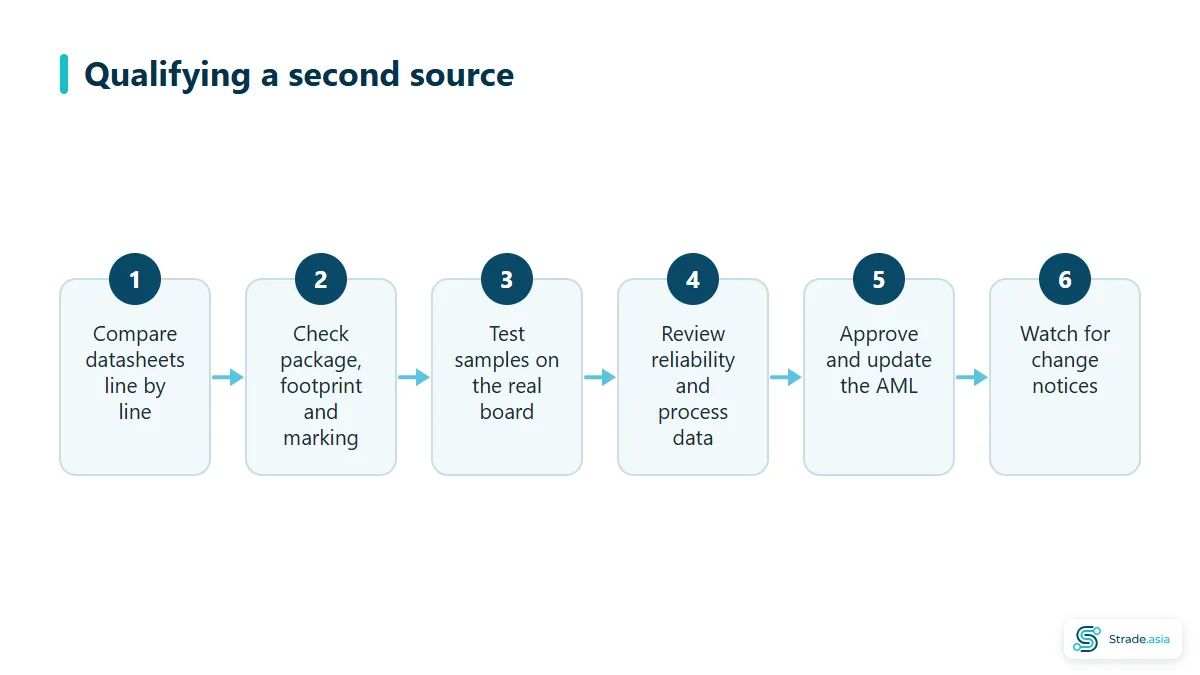
- Compare datasheets line by line. Check absolute maximum ratings, electrical characteristics under your operating conditions, temperature range and timing, not only the headline values, and confirm lifecycle status, lead time and minimum order quantity before you order samples. Our guide to absolute maximum ratings explains why the test conditions behind each figure matter.
- Check the mechanical fit. Package outline, footprint, pin functions, height, marking, lead finish, packaging format and pin 1 orientation in the tape must all suit your board and your line.
- Test samples on the real board. Tests in the actual circuit reveal differences that a datasheet hides: start-up behaviour, noise, EMC and thermal performance. For passive parts, check behaviour under real bias and temperature.
- Review reliability and process data. Ask the manufacturer for qualification reports, and confirm moisture sensitivity level, reflow temperature limits and RoHS status. For automotive or other demanding uses, check the relevant qualification, such as AEC-Q100 for ICs, AEC-Q101 for discrete semiconductors or AEC-Q200 for passive parts.
- Approve and document. Record the new manufacturer part number in the AML with the test evidence, the person who approved it and any limits, such as “board revision C only”.
- Watch for change notices. Both sources must be monitored after approval. A product change notice (PCN) about a fab, a die or a material can change a part you qualified.
The depth of testing should follow the risk. A standard chip resistor from a well-known maker needs little more than a datasheet check; a power MOSFET in a switching stage or an oscillator in a timing circuit needs real tests.
Make the AML a working document
- Approve alternates before shortages. A qualification done in calm conditions is cheaper and more careful than one done while the line waits.
- Keep the evidence. When customers audit, they ask how a source was approved. A test report linked to the AML entry answers the question.
- Agree a route with your customer. If you build to a customer’s design, agree a fast way to approve alternates and the data it needs.
- Review once a year. Remove obsolete sources, add new ones and check that lifecycle data is current.
How Strade can help
Strade is an independent electronic component distributor with its own engineers, supplying factories in Vietnam and across Asia. When a part is short or reaching end of life, our engineers propose alternates with matching specifications, with the datasheet comparison your team needs, and you decide whether to approve them. Send us your BOM and we will mark the single-source lines and suggest possible second sources.


