한국어
 Bahasa Indonesia
 ไทย
 中文 (中国)
 Tiếng Việt
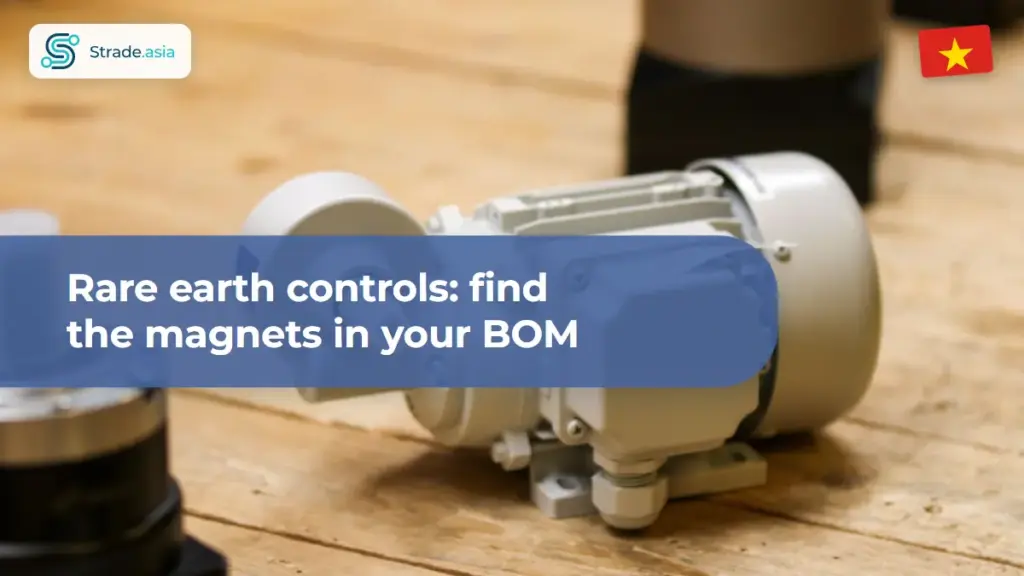
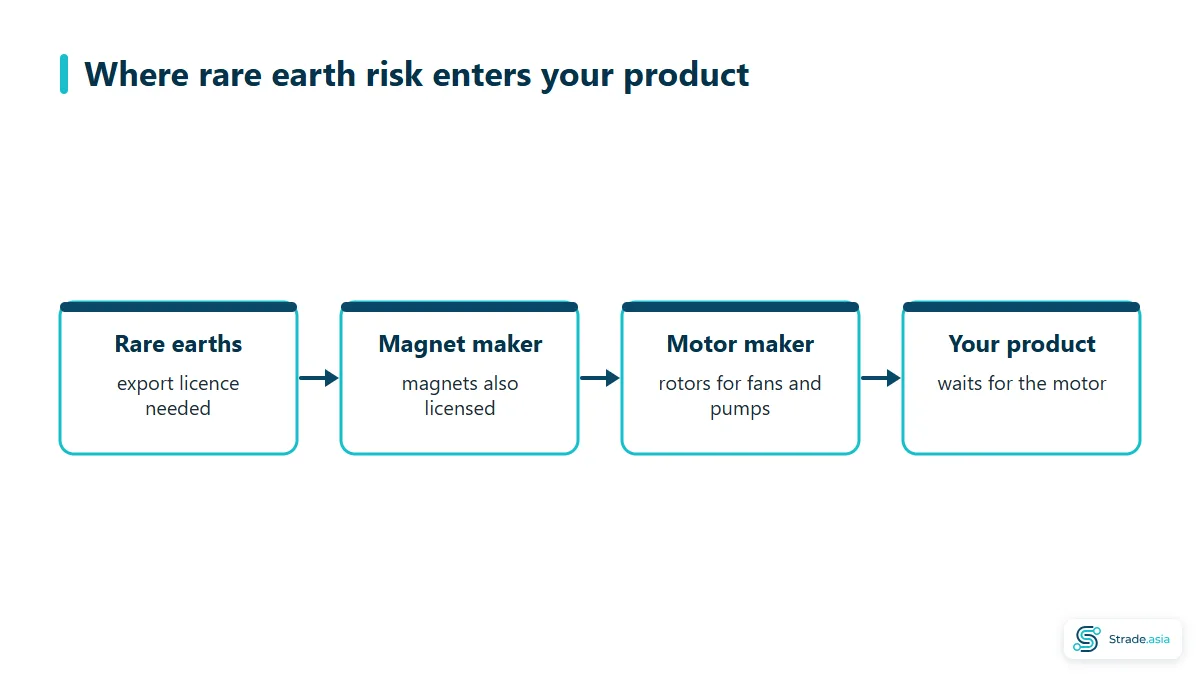
On 4 April 2025, China introduced export licensing for seven medium and heavy rare earth elements (samarium, gadolinium, terbium, dysprosium, lutetium, scandium and yttrium) and for related products, including magnets that contain them. Each export now needs a licence, and approvals take time. In the months that followed, carmakers and motor makers in several countries reported supply problems with magnets, and some warned that production could be disrupted.
For electronics factories in Vietnam this can look like a problem for carmakers and wind turbine makers only. It is broader than that. Rare earth magnets sit inside many parts that factories buy as finished components, and buyers often do not know they are there.
Why these elements matter
Most high-performance permanent magnets are neodymium-iron-boron (NdFeB). To keep their strength at high temperature, many grades add dysprosium or terbium, two of the controlled elements. Samarium-cobalt magnets, used where temperature stability matters most, depend on samarium, which is also on the list. China dominates the processing of rare earths and the production of sintered magnets, especially for the heavy elements, so alternative supply cannot be built quickly.
Where magnets hide in an electronics BOM
- Brushless DC fans and blowers that cool power supplies, cabinets, inverters and chargers.
- Stepper and servo motors in automation equipment and machinery.
- Pumps and actuators, such as valves, small gear motors and locking mechanisms.
- Vibration motors, speakers and buzzers in handheld and consumer products.
- Magnetic sensing, where a magnet is the target for a Hall-effect sensor, an encoder or a reed switch.
- Motors inside purchased modules, such as printers, drives or air handling units, where the magnet sits two or three tiers away from you.
Not every one of these uses a controlled element. Many small fans use ferrite magnets, which are not affected. The point is to find out rather than assume.
What buyers and engineers can do
- Map the exposure. List every motor, fan, actuator and magnetic sensor in active BOMs. Ask each supplier what magnet material is used and where the magnet is made.
- Ask about licences and stock. For suppliers that depend on magnets from China, ask whether their magnet maker has received export licences, how much stock they hold, and how long it covers at your forecast.
- Consider other materials. Ferrite magnets are larger and weaker but contain no rare earths. For some fans and low-power motors a ferrite design may be acceptable. Some magnet makers also offer grades with less heavy rare earth content. Any change needs testing for torque, speed, temperature rise and noise.
- Qualify a second source. Prefer a second motor or fan source whose magnet supply is different, not only a different brand with the same magnet maker behind it.
- Adjust buffer stock. For parts with a long requalification time, a buffer stock is cheaper than a stopped line. Agree the level with finance and review it monthly.
- Watch the rules. Licensing requirements can tighten or ease with little notice. Assign someone to follow announcements and supplier updates.
A pattern seen before
This is not the first time export controls on materials have reached electronics buyers. China introduced licensing for gallium and germanium in 2023, and the lesson then was the same: the risk sits several tiers below the parts you buy, and the first warning often arrives as a longer lead time from a supplier who is not sure why.
The best protection is the one that works for any single-country risk: know where your critical parts and materials come from, and keep options in more than one place. Our note on dual sourcing across countries sets out how to approach this without doubling every supplier.
Questions to put to your motor and fan suppliers
- Which magnet material does this part use, and does it contain dysprosium, terbium or samarium?
- Where are the magnets made, and does the magnet supplier hold the export licences it needs?
- Is there a qualified version with a different magnet material or source?
- What is the current lead time, and has it changed since April?
How Strade can help
Strade Asia is an independent electronic component distributor with its own engineers, supplying factories in Vietnam and across Asia from manufacturers, their distributors and vetted open-market sources. When a part is short or end-of-life, our engineers propose alternates with matching specifications for your team to approve. Send the parts you want to review through our RFQ page, or read about our supply chain services.