
 한국어
 Bahasa Indonesia
 ไทย
 中文 (中国)
 Tiếng Việt
Since 7 August 2025, US imports from most trading partners have been subject to new reciprocal tariff rates set by an executive order signed on 31 July. The order also provides a higher penalty rate for goods that US Customs determines were transshipped to evade the duties. After months of announcements, pauses and negotiations, this is the point where the rules stop being news and become paperwork.
Every shipment now carries a duty that depends on three things the importer declares: what the product is (classification), where it comes from (origin) and what it is worth (value). An error in any of them can mean overpaying, delays at the border, penalties, or a request for records months after the goods were sold.
This checklist is for factories in Vietnam that export to the US directly, and for suppliers whose customers do.
1. HS codes: confirm, do not assume
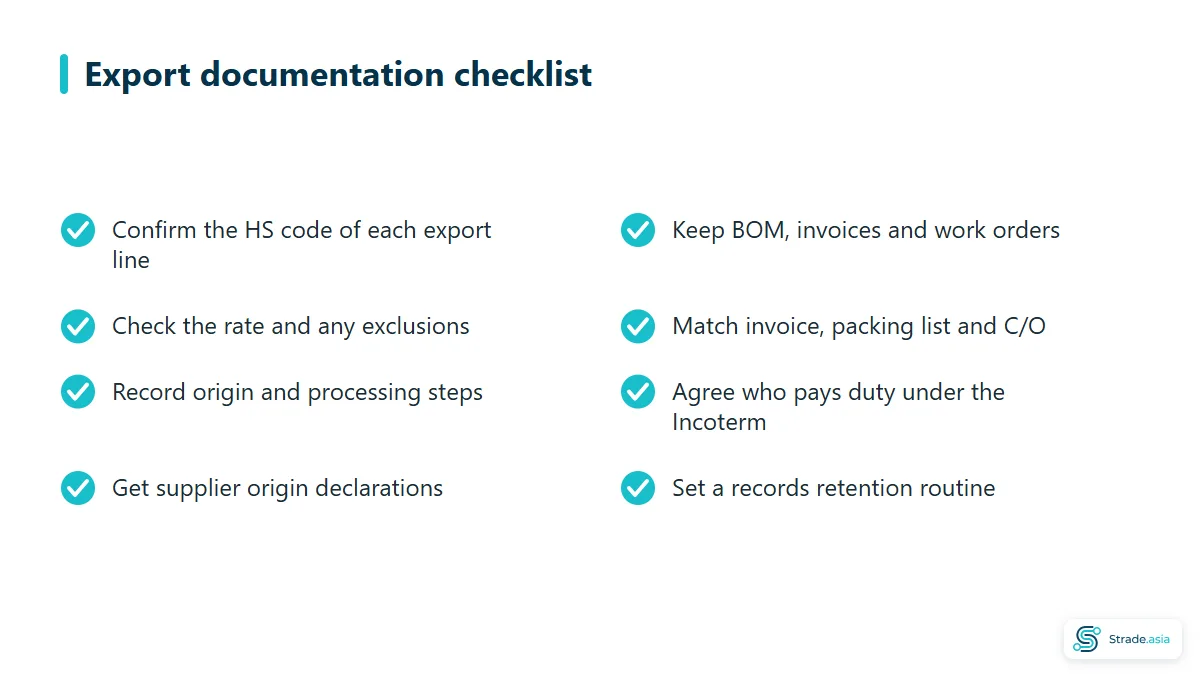
- Review the classification of every product line you ship to the US, at the full level the US importer declares, not only the six-digit international HS code.
- Some electronics headings have been excluded from the reciprocal duties since April, and separate measures, such as investigations under Section 232, may apply to particular products. An exclusion that depends on the code is only as reliable as the code.
- Where classification is unclear, for example a module that could be treated as a part or as a finished apparatus, get a documented opinion and keep it on file.
2. Origin: be able to explain it
The rate depends on origin, and the transshipment provision makes origin evidence more important than before. As covered in our July note on the US-Vietnam framework, US Customs generally applies a substantial transformation test for non-preferential origin. For each product, prepare:
- A process description: what is made, assembled, programmed and tested in Vietnam.
- A BOM showing the origin and cost of each material input.
- Evidence that the operations are real: work orders, routing sheets and labour records.
3. Supplier declarations
An origin claim is only as strong as the information behind it.
- Ask suppliers to state the country of origin of each part on invoices or in a signed declaration.
- For electronic components, the country of origin on a label usually reflects the assembly or test site. Keep the supplier’s statement too.
- Refresh declarations when a supplier changes factory, source or part revision.
4. Records that hold up
US Customs can ask for supporting records after goods have cleared, and importers must keep entry records for several years. Your US customer will look to you for the underlying data. Keep:
- Commercial invoices, packing lists and certificates of origin that agree on description, quantity, value and origin.
- Purchase invoices and supplier declarations for the inputs.
- Production records that link each shipment to the materials used.
- A short file per product with the classification and origin reasoning.
5. Commercial terms
Tariffs change who carries the cost. Check the Incoterm in each contract: under DDP the seller pays import duty; under FOB or FCA the buyer does. If older contracts no longer reflect what both sides expect, raise it with the customer now rather than at invoice time. Our note on Incoterms 2020 sets out where costs and risks change hands.
6. Make it a routine
Documentation fails when it depends on one person remembering. Assign an owner for the origin file of each product line, set a review whenever a BOM, supplier or process changes, and run a short internal check before each new product’s first US shipment. Store documents so that they can be retrieved by shipment, not only by date.
The wider picture
These rates are the latest step in a policy that began with the April announcements, discussed in our analysis of the US reciprocal tariff policy. Further changes, including sector measures and the final terms agreed with individual countries, are still possible. Good documentation is the one preparation that pays off whatever happens next.
For component buyers, the same discipline applies upstream. Ask for origin information when you request quotes, and keep it with each purchase order. It is much easier to collect at the time of purchase than to reconstruct during an audit.
How Strade can help
Strade Asia supplies electronic components to factories in Vietnam and across Asia, with CoC, C/O and CQ supplied with the goods when the source provides them. We deliver DDP or DAP to factories and export processing enterprises and prepare the customs documents, and our services include origin files, HS code reviews and certificates such as Form E, RCEP, CPTPP and EVFTA. Ask through our RFQ page or see our origin compliance services.


