한국어
 Bahasa Indonesia
 ไทย
 中文 (中国)
 Tiếng Việt
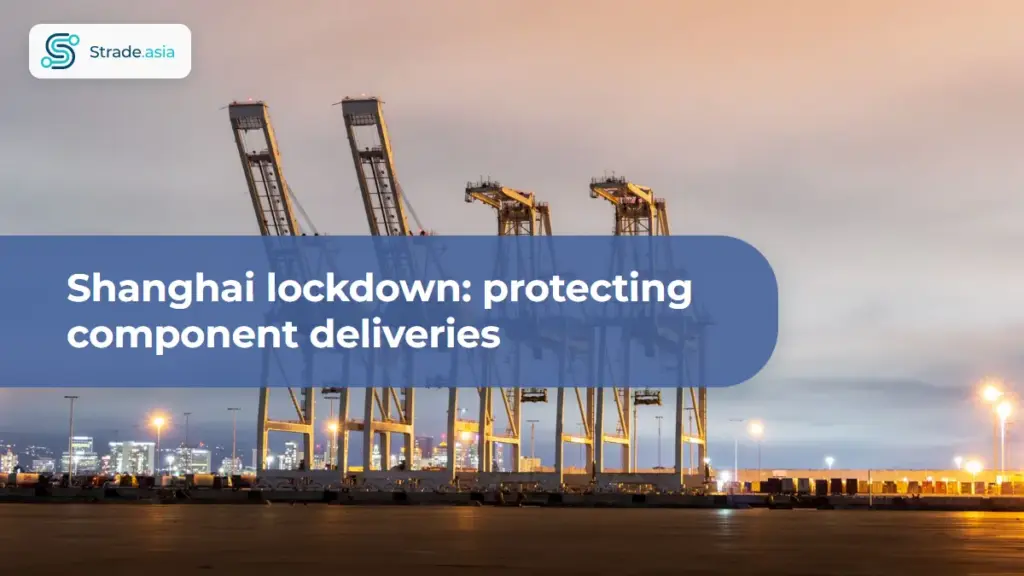
Shanghai has been under lockdown since the end of March. Pudong closed first, on 28 March, and Puxi followed on 1 April. What was announced as a short, two-phase closure has become a citywide lockdown with no clear end date. For electronics buyers in Vietnam, the effects are already visible: delayed shipments, missed sailings, cancelled flights, and factories in the Yangtze River Delta that have stopped or slowed down. This note covers what is happening on the routes, which components are exposed, and what to check now.
What is happening on the ground
- Trucking. Trucks need permits and drivers need recent negative tests to move in and out of the city, and checkpoints across the region slow every journey. Trucking, more than the port itself, is the bottleneck.
- Port. The Port of Shanghai is operating, but containers struggle to reach and leave the terminals. Export cargo misses sailings, imports wait on the quay, and schedules on routes that call at Shanghai are less reliable.
- Air cargo. Many passenger and cargo flights at Pudong airport have been cancelled, and handling is slow for those that still operate. Air freight out of East China is tighter and more expensive.
- Factories. Plants in Shanghai and in surrounding cities of the delta, a major base for semiconductor assembly and test, passive components, PCBs and electronics assembly, have stopped or are running under closed-loop arrangements, with workers living on site. Authorities have started to let selected factories restart under those conditions.
The lockdown follows a week-long shutdown of Shenzhen in March, and other cities have tightened restrictions as cases rose, so the risk is not limited to one city.
Which components are exposed
- Parts made, packaged or tested in Shanghai and nearby cities.
- Parts that ship through logistics hubs in Shanghai’s bonded zones, where many manufacturers and distributors keep regional stock, even when the parts were made elsewhere.
- Bulky items made in the delta, such as cable assemblies, transformers, power supplies and enclosures, which move by sea and road rather than by air.
- Your customers’ other inputs: if their other suppliers are locked down, their build plans and your orders may change too.
Documents can hold up a shipment
A shipment can be ready and still wait for paper. Certificates of origin such as Form E, invoices, packing lists and original documents all need people in offices and couriers on the road. Ask the shipper how the C/O will be issued and how originals will reach you, and agree with your customs broker in advance what to do if the certificate arrives after the goods. Check that HS codes, quantities and values match across all documents, because a correction now takes much longer than usual.
Routes and lead times
Shippers are moving cargo through other ports and airports where they can, or shipping from stock held in South China, Hong Kong or Singapore. Road freight from South China into northern Vietnam suits some goods, but border crossings had long queues this winter and remain sensitive to Covid controls. Every reroute adds cost and uncertainty, and your Incoterms decide who books the freight and who pays, as explained in Incoterms 2020: what changed.
Expect a second wave when Shanghai reopens: a backlog of delayed orders and cargo will meet ships, planes and trucks at the same time. We saw the same pattern after the factory closures in China in early 2020 and during the container shipping disruption of 2021. Lead times quoted today may stretch again in the weeks after restrictions lift.
What buyers should do now
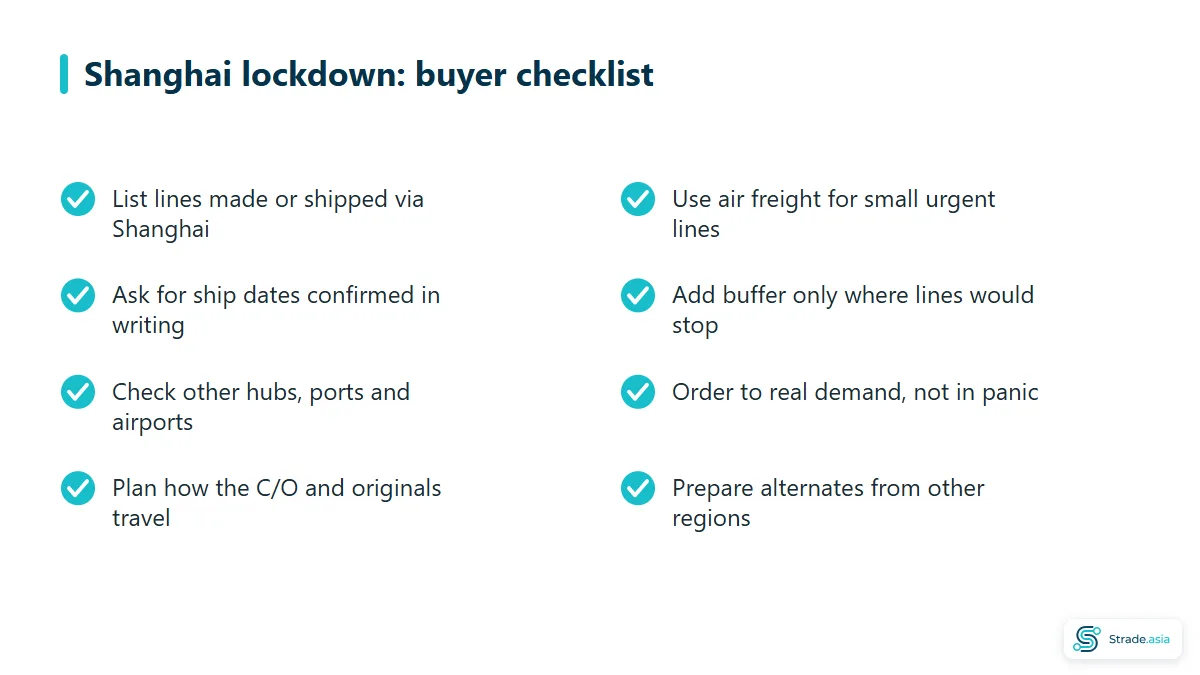
- List exposed lines. Ask suppliers where each critical part is made, tested and shipped from.
- Ask for confirmed dates. Ask for ship dates confirmed in writing, not quoted lead times.
- Check other hubs and routes. Ask whether the same part is held in another warehouse, or can move through another port or airport.
- Plan the documents. Agree how the C/O and originals will travel, and what happens if they are late.
- Use air selectively. For small, high-value parts, air freight from another airport may cost far less than a stopped line.
- Add buffer where it matters. Raise safety stock for the exposed lines that would stop production, not for everything.
- Do not panic-order. Ordering far above real demand creates its own shortage later.
- Prepare alternates. Approve second sources from other regions for single-source lines; our note on dual sourcing across countries covers how.
How Strade can help
Strade is an independent electronic component distributor with its own engineers, supplying factories in Vietnam and Asia. We source from manufacturers, their distributors and vetted open-market suppliers, so when a part is stuck in East China we can check whether the same part is available elsewhere in Asia, and our engineers can propose matching alternates for your team to approve. Deliveries are DDP or DAP to your factory, including export processing enterprises, with customs documents prepared. Read about our electronics supply chain service, or send us the affected lines and our sales team will reply with a quotation.