한국어
 Bahasa Indonesia
 ไทย
 中文 (中国)
 Tiếng Việt
Most component buyers in Vietnam planned for the usual slowdown around the Lunar New Year. This year the holiday did not end on schedule. After the outbreak of a new coronavirus in Wuhan, which was placed under lockdown on 23 January, the Chinese government extended the national holiday, and many provinces, including the main manufacturing centres, told businesses to delay restarting until at least 10 February. The World Health Organization has since named the disease COVID-19.
Factories are now reopening, but slowly. Many workers travelled home for the holiday and face travel restrictions or quarantine before they can return. Some plants have restarted with part of their workforce; others are still waiting for local approval. For factories in Vietnam that depend on Chinese suppliers for components, sub-assemblies and packaging, the effect is starting to show in order confirmations and delivery dates.
Nobody can yet say how the outbreak will develop, so the practical focus is on what buyers can check now.
Where the effect shows up
China makes a large share of the passive components, connectors, magnetics, cables, power supplies, PCBs and plastic parts used in electronics assembly across Asia. Many semiconductor makers also have assembly and test plants there. Even when a part is designed and branded elsewhere, a step in its production may take place in China.
The disruption reaches buyers in three ways:
- Production. Plants running with fewer workers produce less, and a supplier’s own suppliers, of raw materials, lead frames or packaging, may also be short.
- Logistics. Trucking inside China has been slowed by checkpoints and a lack of drivers. Many airlines have suspended passenger flights to mainland China, which removes cargo space in the hold. Vietnam suspended flights to and from mainland China at the start of February, and checks at land border gates have slowed cross-border trucking. Shipments routed through Hong Kong also depend on cross-border trucks from southern China.
- Information. A sales office may be open while the factory is not, so an order acknowledgement does not always mean the goods are being made.
Supplier status: ask specific questions
General reassurance does not help with planning. For each critical part, ask:
- Where is this part made, and where is it assembled and tested?
- Has that site restarted, and with how much of its normal staff?
- Is there finished stock at the factory, in the supplier’s warehouses outside China, or with distributors?
- When will open orders ship, confirmed line by line?
Record each answer with its date, and ask again every week. The situation is changing quickly. If a supplier sends a force majeure notice, ask which site and which orders it covers, and check it against your contract terms.
How the delayed restart affects lead times
Expect quoted lead times to move, and to move unevenly. A part with stock in a regional warehouse may ship normally while the next production lot is late. Watch commodity parts closely: when one supplier slips, buyers turn to others, and their lead times stretch as well. The pattern was similar after the Kumamoto earthquakes, when trouble in one region spread through orders placed elsewhere.
What to do now
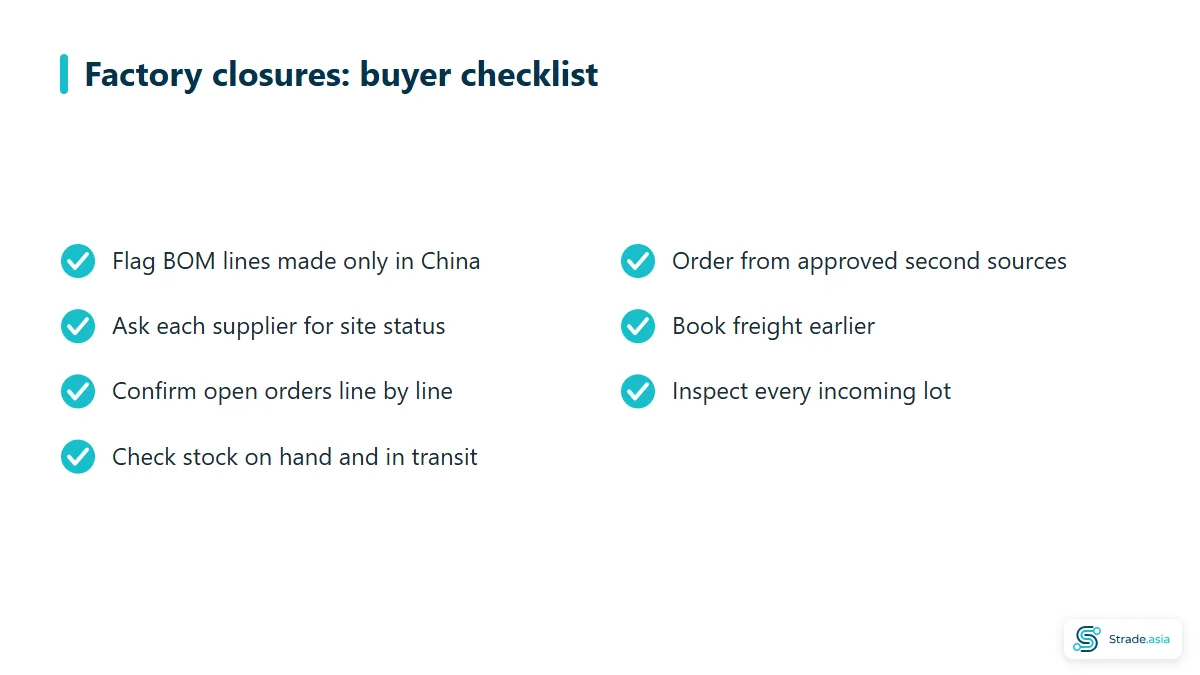
- Map your exposure. Flag BOM lines whose only source, or whose assembly site, is in China.
- Check stock on hand. Compare inventory and parts in transit with production plans for the coming weeks.
- Confirm open orders in writing. Ask for ship dates per line, not general statements.
- Look at second sources. Parts from other makers already on your AML can be ordered now. If there are none, start qualifying; our guide to approved manufacturer lists and second sources explains the steps.
- Consider buffer stock for critical parts. A modest buffer for parts that would stop a line costs less than a stoppage. See buffer stock and consignment.
- Plan freight earlier. Book transport well ahead and allow time for checks at borders and airports.
- Inspect incoming stock carefully. When supply is short, more stock appears from unfamiliar sources. Check labels and barcodes, date codes and packaging on every lot.
Keep internal communication calm and factual. Share what is confirmed with production and sales teams, and avoid acting on rumours about whole regions or industries.
How Strade can help
Strade is an independent electronic component distributor with its own engineers, supplying factories in Vietnam and across Asia. We buy from manufacturers, their distributors and vetted open-market suppliers, and every lot is inspected on receipt for part number, labels, date code, packaging and condition. When a part is short, our engineers can propose an alternate with matching specifications for your team to approve. Our supply chain services cover sourcing and delivery to your plant.
If some of your parts depend on Chinese factories that are not yet back to normal, send us the part numbers or your BOM and we will check other sources and alternates.