한국어
 Bahasa Indonesia
 ไทย
 中文 (中国)
 Tiếng Việt
Since 1 January, the International Chamber of Commerce’s Incoterms 2020 rules have been available for new contracts. They do not replace anything automatically: a purchase order that says “FCA Hong Kong Incoterms 2010” is still governed by the 2010 rules, and many suppliers will keep quoting that way for a while. But as new quotations and frame agreements are drawn up this year, buyers of electronic components will see the 2020 version more often, and a few of the changes matter for how parts reach a factory in Vietnam.
The structure is familiar. There are still eleven rules, split between those for any mode of transport (EXW, FCA, CPT, CIP, DAP, DPU, DDP) and those for sea and inland waterway only (FAS, FOB, CFR, CIF). If you know the 2010 rules, covered in our guide to Incoterms 2010 for component imports, most of what you know still applies.
What changed in Incoterms 2020
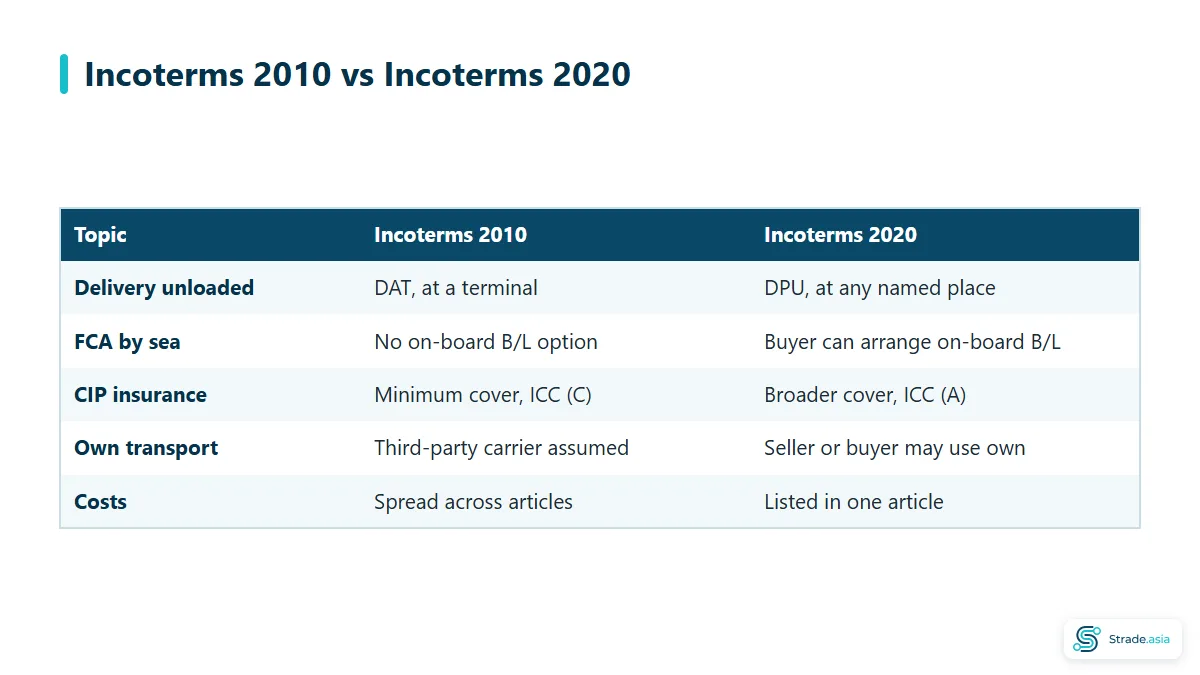
DAT becomes DPU. Delivered at Terminal has been renamed Delivered at Place Unloaded. The seller still delivers the goods unloaded at destination, but the place no longer has to be a terminal: it can be a warehouse or a factory. DPU is the only rule in which the seller unloads at destination. If you want the seller to bring goods to your door and leave the unloading to you, DAP remains the better fit.
FCA and the on-board bill of lading. Under FCA, delivery happens when the goods are handed to the buyer’s carrier, before they are loaded on a vessel, so the seller could not easily obtain an on-board bill of lading. Banks often ask for one under a letter of credit. Incoterms 2020 lets the parties agree that the buyer will instruct its carrier to issue an on-board bill of lading to the seller. This helps with sea shipments of larger component orders paid by L/C.
More insurance under CIP. Under CIP, the seller must now buy cover in line with Institute Cargo Clauses (A), the broad “all risks” level, instead of the minimum Clauses (C). CIF stays at Clauses (C). For high-value semiconductors shipped by air on CIP terms this is a real improvement, but the higher premium may be reflected in the price, and insurance forms part of the customs value on which Vietnam calculates import duty and VAT. The parties can still agree on a different level of cover.
Own means of transport. The 2010 rules assumed that a third-party carrier moves the goods. The 2020 rules allow the seller (under DAP, DPU and DDP) or the buyer (under FCA) to use its own vehicles. This fits local deliveries, such as a supplier’s own truck bringing parts to a factory in an industrial park.
Costs and security in one place. Each rule now lists the costs that each party pays in a single article, and security-related obligations, such as screening and advance data for customs, are allocated more clearly.
What did not change
Incoterms rules still do not deal with transfer of ownership, payment terms or what happens when a contract is breached. They also do not replace customs rules: who acts as importer of record in Vietnam, and who pays import duty and VAT, must still be agreed and checked. A supplier abroad without a Vietnamese entity cannot normally act as importer itself, so ask who will clear the goods under a DDP offer from overseas; DAP is often the simpler term. EXW remains a poor choice for exports from many countries, including mainland China, because the buyer takes on export formalities it may not be able to handle. FOB and CIF are still designed for sea freight, even though they are often used for containers and air shipments where FCA or CIP would fit better.
What buyers should update
- State the version. Write “Incoterms 2020” (or 2010, if you prefer) next to the rule and the named place on every PO and contract.
- Name the place precisely. “FCA Shenzhen” is too vague. Name the warehouse, airport or terminal.
- Review DAT contracts. Replace DAT with DPU, or with DAP if you will unload the goods yourself.
- Check insurance under CIP and CIF. Confirm that the level of cover suits the value of the parts.
- Agree on L/C documents. If you buy FCA by sea under a letter of credit, state in the contract whether an on-board bill of lading is needed.
- Align with your forwarder. Make sure your forwarder and customs broker work from the same terms as your PO, and agree who supplies any certificate of origin needed for preferential duty; our note on CPTPP rules of origin in Vietnam explains why origin records matter.
With the Tet holiday at the end of January, many shipments will be booked over the next two weeks. It is a good moment to check that open orders state their terms clearly, so that cost and risk are not disputed when goods arrive after the holiday. For wider planning when you bring in parts for a new plant, see setting up production in Vietnam.
How Strade can help
Strade is an independent electronic component distributor with its own engineers, supplying factories in Vietnam and across Asia. We deliver on DDP or DAP terms to factories and export processing enterprises and prepare the customs paperwork, so your team can focus on production. Our supply chain services cover sourcing, inspection of every lot on receipt, and documents such as CoC and C/O when the source provides them.
To get prices and terms for your next order, send us your BOM or part list.