한국어
 Bahasa Indonesia
 ไทย
 中文 (中国)
 Tiếng Việt
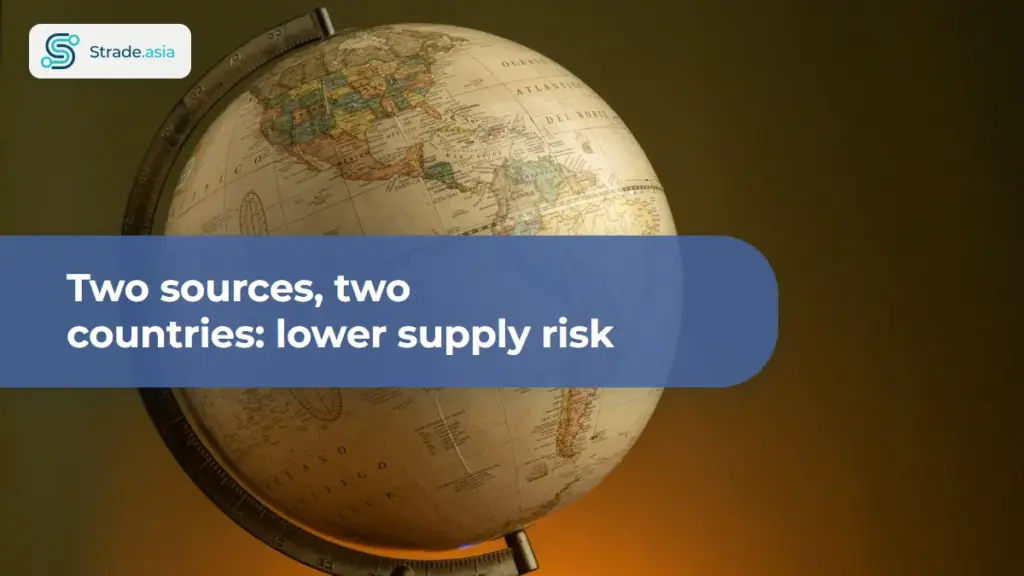
Many factories already have a second source for their most important components. This spring has shown that a second source is not always enough. In February, the delayed restart of factories in China affected many suppliers at once, as we described in extended factory closures in China. Since mid-March, movement restrictions in Malaysia and the Philippines, where many semiconductor assembly and test plants and several passive component factories operate, have reduced output at some sites while plants waited for approval to run or worked with fewer staff. Lockdowns elsewhere have added further gaps.
When two approved suppliers rely on the same region, the same fab or the same assembly plant, they can stop at the same time. Real resilience comes from sources that do not share the same risks.
Where your parts are really made
A part’s brand says little about where it is produced. A typical semiconductor has its wafers processed in one country, its assembly and test done in another, and passes through distribution warehouses in a third. Passive components and connectors may come from plants in China, Japan, Taiwan, Korea or Southeast Asia, sometimes for the same part number from the same brand. A second plant of the same maker is quicker to qualify than a new brand, but it protects you only if you can specify the plant or country of origin, and it does not help if the maker puts the whole part family on allocation.
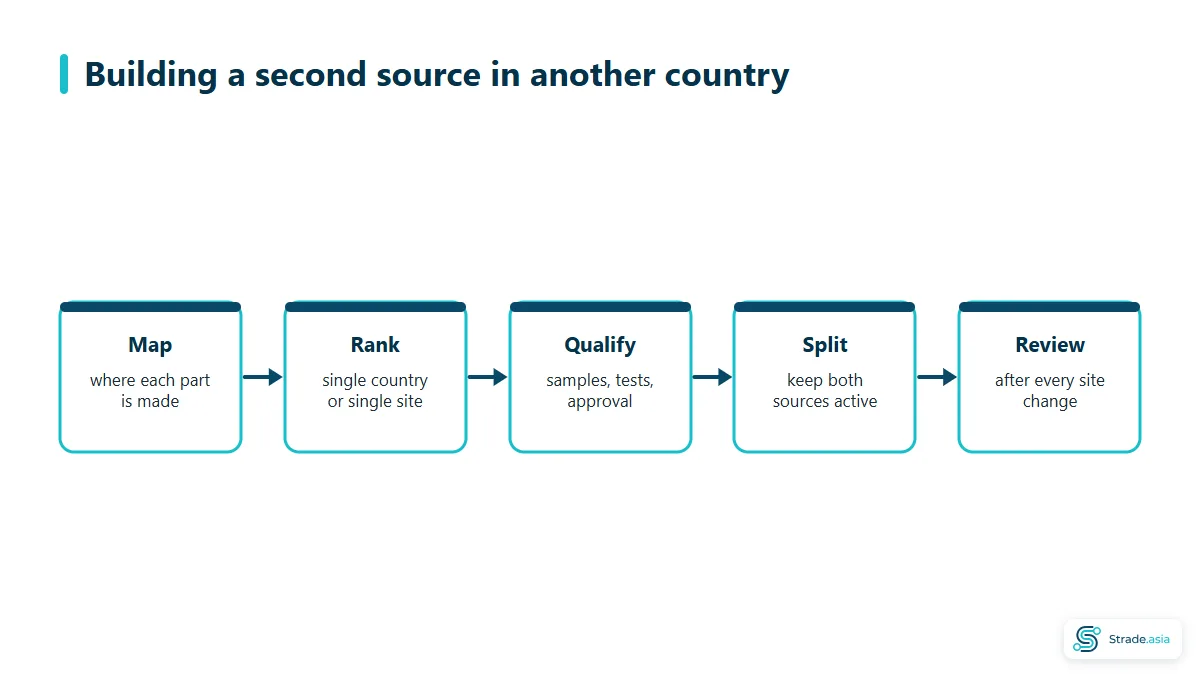
Start by mapping your critical BOM lines:
- Wafer fab or main production site. Which country, and is it a single site?
- Assembly and test site. For ICs this is often in Southeast Asia or China.
- Shipping point. Where does the stock you buy actually leave from?
- Second source. Does it differ in each of the above, or only in the logo?
Ask suppliers for this information directly; many will share it on request, and some show it in change notices and quality documents. Two brands that use the same foundry or the same assembly subcontractor do not give the protection they appear to give. The Kumamoto earthquakes showed how one region can carry parts for many brands.
Qualifying a source in another country
A second source is only useful once it is approved. The usual steps, covered in our guide to approved manufacturer lists and second sources, apply here too:
- Engineering review. Compare datasheets: electrical ratings, package, footprint, pinout, temperature range and reliability data.
- Samples and testing. Build and test units with the new part under your real operating conditions.
- Customer approval. Some customers, especially in automotive, medical and industrial equipment, must approve any change of source.
- Documentation. Update the AML, the BOM and the inspection plan, and record the country of origin, which may affect duty and rules of origin for your exports.
Country of origin also matters for trade policy. Tariff changes over the past two years, discussed in tariff list 3 and supply chain moves, have already pushed many companies to spread production. A source in a different country can lower exposure to such measures as well as to local disruptions. The origin of a part also decides which preferential certificate can apply when it is imported into Vietnam, such as Form E for parts from China or Form D for parts from ASEAN.
The cost of a second source
Dual sourcing is not free, and it pays to be honest about the costs:
- Engineering time for review, testing and approval.
- Lower volume per supplier, which can mean weaker price breaks and less attention.
- More part numbers to manage, with separate stock, MOQs and inspection.
- Small differences in behaviour that production and test teams need to understand.
These costs are usually worth paying for parts that would stop a line and have no ready alternative. For low-cost, widely available parts, a second source may already exist without formal work. The goal is to focus effort where a gap would hurt most.
Keep both sources active
A second source that never receives orders is hard to rely on. Its qualification may lapse, and its supplier will not give you priority in a shortage. Many buyers split volume, even unequally, so that both sources stay active and stock from each is used regularly. Review the split at least twice a year, and again whenever a supplier sends a change notice about wafer, assembly or test sites: a site transfer by one maker can put both sources back in the same country.
How Strade can help
Strade is an independent electronic component distributor with its own engineers, supplying factories in Vietnam and across Asia. We buy from manufacturers, their distributors and vetted open-market suppliers. When a part is short or a source is at risk, our engineers can propose alternates with matching specifications from other makers, and your team decides. Read more about how we support manufacturers.
To check alternates and second sources for your critical parts, send us your BOM.