
 한국어
 Bahasa Indonesia
 ไทย
 中文 (中国)
 Tiếng Việt
Russia’s invasion of Ukraine on 24 February is first of all a human tragedy. For the electronics industry it also raises a supply question that purchasing teams are already asking: what happens to chip supply when two countries that provide key materials are at war? Nobody can say yet how long the disruption will last. What buyers can do is understand where these materials enter the supply chain, ask suppliers the right questions, and avoid the panic buying that made the last shortage worse.
Neon: a small input with no substitute in the fab
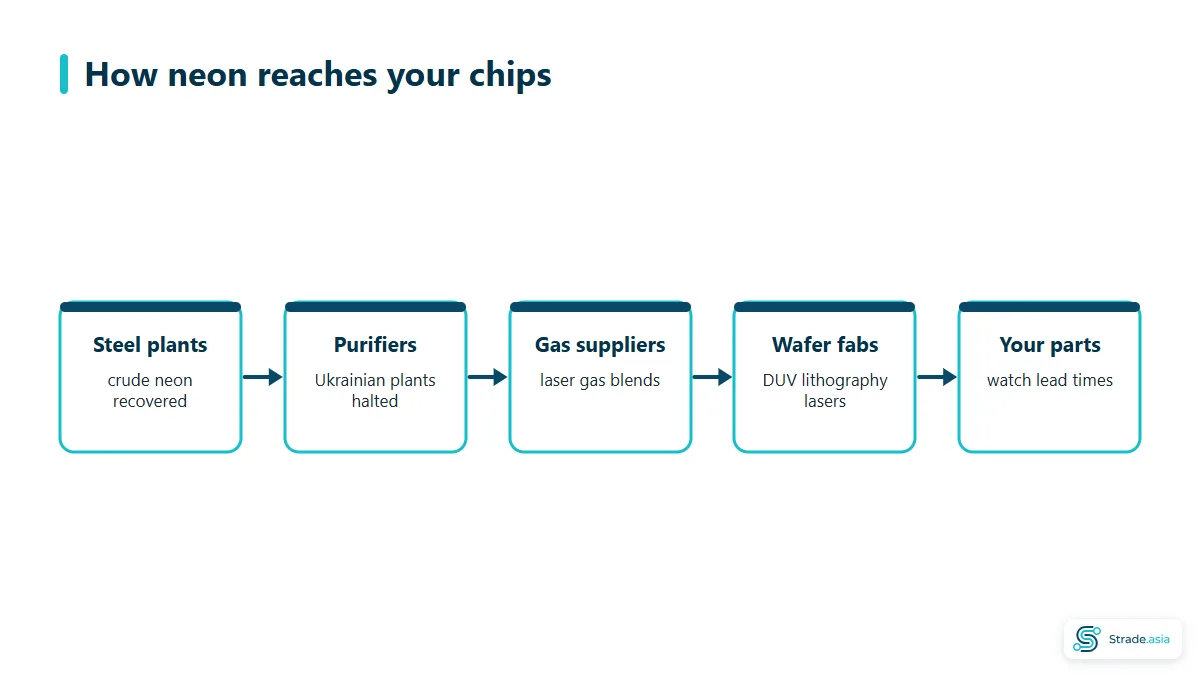
Chipmakers use neon as the main buffer gas in the excimer lasers that power deep ultraviolet (DUV) lithography, the step that prints circuit patterns on wafers. Most chips, from microcontrollers to power management ICs, pass through DUV tools many times.
A large part of the world’s semiconductor-grade neon is purified in Ukraine from crude gas recovered at steel plants in Ukraine and Russia. The two best-known Ukrainian purifiers, Ingas in Mariupol and Cryoin in Odesa, have stopped production, and the fighting around Mariupol makes a quick restart unlikely. The same plants also purify krypton and xenon, which fabs use in other process steps.
The picture is less alarming than it sounds. After the 2014 annexation of Crimea sent neon prices soaring, chipmakers and gas suppliers built up stocks and added sources in other countries, and industry groups and several large chipmakers have said they do not expect a short-term effect on output. The risk grows the longer the war lasts: stocks run down, other purifiers need time to expand, and the price of neon and of the laser gas made from it will rise. Smaller fabs with less buying power are the most exposed.
Palladium and other metals
Russia is one of the world’s largest producers of palladium. Most palladium goes into catalytic converters, but electronics uses it too: in plating for lead frames and connector contacts, in silver-palladium electrodes for some capacitors, and in thick-film conductor and resistor pastes. Palladium prices have jumped to record levels since the invasion. Nickel, used in the electrodes of multilayer ceramic capacitors and in battery materials, rose so sharply that the London Metal Exchange suspended nickel trading on 8 March.
Metal prices reach component prices slowly and unevenly. Expect price increase notices on parts with a high precious-metal content, and read them against the validity of your quotations.
Logistics and trade controls
- Air freight. Many airlines are avoiding Russian and Ukrainian airspace, and Russian carriers can no longer fly into the EU, so Asia–Europe air cargo capacity is tighter and some flights take longer routes.
- Rail. Freight trains between China and Europe cross Russia, and shippers face sanctions and insurance questions on that route.
- Export controls. The US, the EU and other partners have restricted exports of semiconductors and many other electronic items to Russia, and the US rules now extend to Belarus. If you sell to customers in or near those markets, screen orders now; we covered the basics of export controls and the Entity List in 2019.
- Energy. Higher gas and power prices add to the costs of fabs and component plants in Europe.
What buyers should do now
- Ask, don’t assume. Ask your main semiconductor suppliers whether they expect any effect from neon supply on the parts you buy, and ask makers of passive components and connectors about palladium and nickel.
- Map single-site parts. Parts made in a single fab are the most exposed to any materials problem; our note on single-source risk after a fab fire explains how to find them.
- Keep orders steady. Over-ordering to build a hoard lengthens the queue for everyone and inflates the backlog that manufacturers plan against. Order to real demand plus an agreed buffer.
- Watch prices and validity. Expect surcharges and shorter validity periods on metal-heavy parts and on freight.
- Prepare alternates. Approve second sources for lines that already have long lead times, before any new shortage reaches them.
- Check customers and destinations. Make sure no shipment, direct or indirect, conflicts with the new export controls.
Lessons from earlier shocks
This is not the first time a materials problem has threatened chip supply. When Japan tightened exports of three chemicals to South Korea in 2019, chip output held up, partly because buyers and suppliers moved quickly on stocks and alternative sources; see Japan–Korea export controls on materials. The difference now is timing. Lead times are still long after two years of shortage, as we described in our outlook for 2022, so the market has little slack to absorb a new shock.
How Strade can help
Strade is an independent electronic component distributor with its own engineers, supplying factories in Vietnam and Asia. We buy from manufacturers, their distributors and vetted open-market sources, and when a part becomes short our engineers propose alternates that match the specification, for the customer to approve. Every lot is inspected on receipt, which matters more when a tight market attracts doubtful stock. Read about our electronics supply chain service, or send us the lines you are worried about and our sales team will reply with a quotation.


