한국어
 Bahasa Indonesia
 ไทย
 中文 (中国)
 Tiếng Việt
The MLCC shortage has sent many designers back to an older technology: the solid tantalum capacitor. Where a high-value ceramic capacitor is unavailable, or loses too much capacitance under DC bias, a tantalum part can offer stable capacitance in a compact package. But tantalum capacitors have their own rules. Used carelessly, they fail, and an MnO2 tantalum that fails short can burn. Before a swap is approved, engineering and purchasing should agree on what to check.
Two kinds of solid tantalum
Both types use a sintered tantalum anode with a tantalum pentoxide dielectric. They differ in the cathode material.
- MnO2 tantalum. The traditional type, with manganese dioxide as the cathode. It is mature, widely made and stable, with moderate ESR. Its weakness is the failure mode: a breakdown can become a low-resistance short, and the oxygen-rich MnO2 can support ignition when high current flows through the fault.
- Polymer tantalum. Uses a conductive polymer cathode, giving much lower ESR and better high-frequency performance. Failures are generally more benign, without ignition. Polymer parts typically have higher leakage current and are more sensitive to moisture, so they carry a moisture sensitivity level and need dry handling before reflow.
Voltage derating
Voltage derating is the most important rule for tantalum capacitors. For MnO2 types in low-impedance circuits, such as power rails fed directly from a supply, makers commonly recommend operating at no more than about half of rated voltage. A 5 V rail, for example, calls for a part rated 10 V or more. Polymer types usually need less derating, often around 10 to 20% depending on the maker and rated voltage. Always follow the specific maker’s guidance, and allow for further derating above 85 °C. MnO2 parts are typically rated to 125 °C, where the permitted voltage falls to a lower category voltage, while many polymer series are rated only to 105 °C.
Surge current
MnO2 tantalum capacitors are most at risk at power-on, when a low-impedance source charges them with high inrush current. Weak points in the dielectric can fail under that stress. Ways to reduce the risk:
- Use more voltage derating in low-impedance positions.
- Add series resistance or soft-start where the circuit allows.
- Choose surge-tested series, which makers screen for this condition.
- Take special care at hot-plugged inputs and battery connections, where inrush is highest.
Tantalum capacitors are polarised and tolerate only a small reverse voltage. Check polarity marking at receiving and on the line: on a tantalum chip the band usually marks the positive terminal, the opposite of most aluminium electrolytics.
Where tantalum can replace MLCC
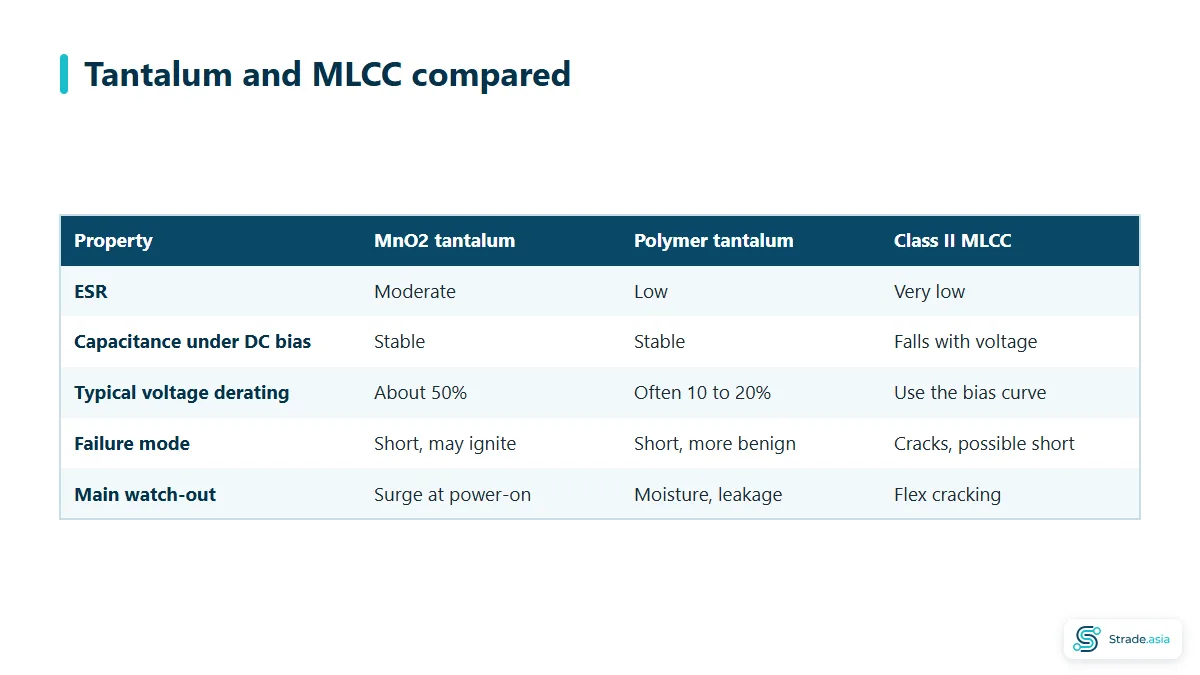
Tantalum capacitors keep their capacitance under DC bias and over temperature far better than class II ceramics. They are not piezoelectric, so they do not produce audible noise, and they do not suffer the flex cracking that affects large ceramic chips. They suit bulk decoupling and hold-up positions on power rails, and input and output filtering where a large, stable value matters more than the lowest ESR.
They are a poorer fit for high-frequency decoupling next to fast ICs, where an MLCC’s very low ESR and inductance matter, and for circuits with high ripple current unless the part is rated for it.
ESR also affects stability. Some older linear regulators were designed around tantalum ESR and may need it, while many modern regulators and DC-DC converters are compensated for ceramic outputs and can behave differently with higher ESR. A swap in either direction needs the regulator datasheet and a test on real boards. Our guide to MLCC alternates and DC bias covers the ceramic side of this comparison, and polymer or aluminium electrolytic capacitors covers larger bulk values.
Checklist before approving a tantalum alternate
- Working voltage, with derating for type, circuit impedance and temperature.
- Surge conditions at power-on and hot-plug.
- ESR, and its effect on regulator stability and output ripple.
- Ripple current rating at the operating frequency and temperature.
- Case size, height and land pattern; tantalum case codes do not map directly to MLCC sizes.
- Moisture sensitivity level and dry storage for polymer types; see our guide to MSL.
- Conflict minerals declarations, since tantalum is one of the metals customers ask about.
- Cost and availability: compare unit price and minimum order quantity, and note that as designers move to tantalum, some popular values have become harder to buy too, so check supply from more than one maker before redesigning.
How Strade can help
Strade’s engineers can propose tantalum, polymer or ceramic alternates with matching specifications for your team to approve, and we source from manufacturers, their distributors and vetted open-market suppliers. Every lot is inspected on receipt, and moisture-sensitive parts are packed and handled according to their MSL.
Send us the capacitor lines you need to cover, with operating voltage and position if you have them, or browse our passive components.