한국어
 Bahasa Indonesia
 ไทย
 中文 (中国)
 Tiếng Việt

On 8 March 2018, ministers from eleven countries signed the Comprehensive and Progressive Agreement for Trans-Pacific Partnership (CPTPP) in Santiago, Chile. The members are Australia, Brunei, Canada, Chile, Japan, Malaysia, Mexico, New Zealand, Peru, Singapore and Vietnam. The agreement is not in force yet: each country must first complete its own ratification. Still, for factories in Vietnam that make or buy electronic products, now is a good time to understand what the agreement covers and what it will ask of exporters.
How we got here
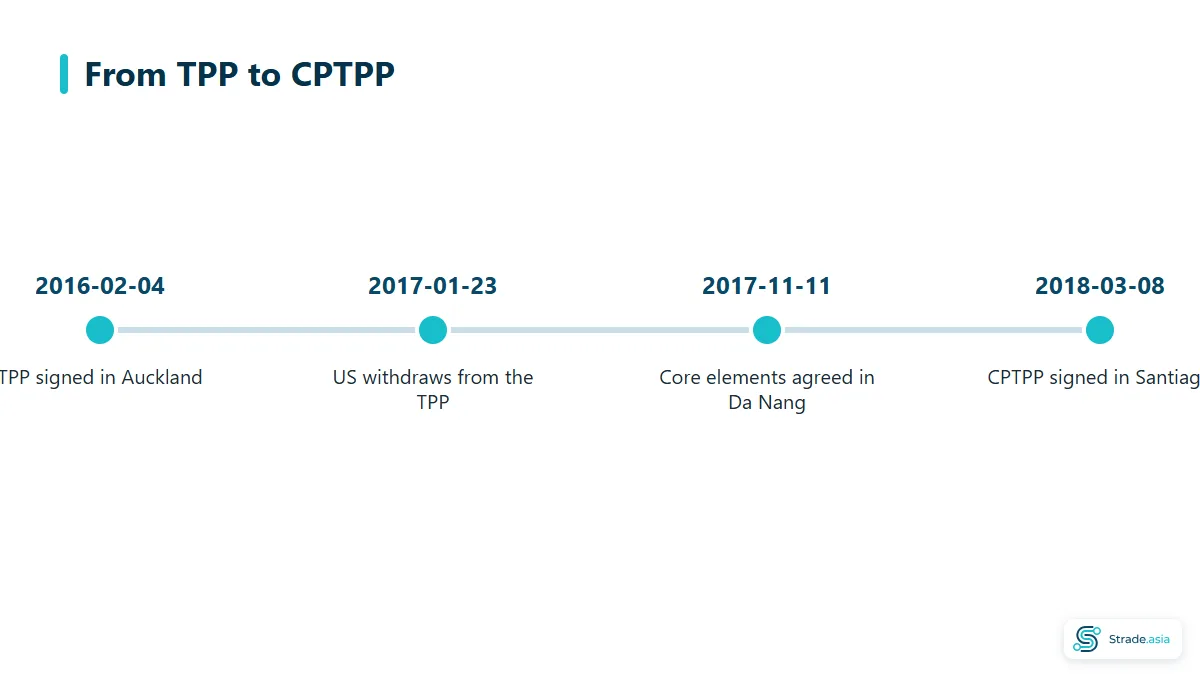
The CPTPP grew out of the Trans-Pacific Partnership, which twelve countries signed in February 2016. In January 2017 the United States withdrew. The remaining eleven decided to go ahead, agreed on core elements at the APEC meetings in Da Nang in November 2017, and signed in March. The CPTPP keeps most of the TPP text but suspends 22 provisions, half of them on intellectual property, that had been included largely at US request.
The agreement enters into force 60 days after at least six signatories have completed ratification. No one can say yet exactly when that will be, and in Vietnam the National Assembly must first approve it.
Why the CPTPP matters for electronics
Many electronic components already cross borders at zero or low duty under the WTO Information Technology Agreement, so for a large share of ICs and passive parts the CPTPP will change little in duty terms, at least in members that take part in the ITA. The gains are more likely for goods that still face duties in some member markets, which is more often true of finished electrical equipment than of individual components. Check the tariff schedules for your own HS codes rather than assuming.
Two other features matter for Vietnam. First, the agreement gives Vietnamese goods preferential access to the three members with which Vietnam has no free trade agreement today: Canada, Mexico and Peru. With the other members, exporters will be able to choose between the CPTPP and existing agreements, product by product. Second, the CPTPP brings eleven economies under one set of rules of origin, so materials from any member can count toward a product’s origin.
Rules of origin: the part that needs work
A preference applies only if your product qualifies as originating under the agreement’s rules. Like other trade agreements, the CPTPP sets product-specific rules by HS code. For electrical and electronic goods these are typically a change in tariff classification, a regional value content threshold, or a choice between the two.
Inputs from any CPTPP member count as originating materials. A capacitor made in Japan or a connector made in Malaysia can therefore help a Vietnamese product qualify. Parts from non-members such as China, Korea or Taiwan are non-originating: they can still be used, but the product must meet its rule in spite of them.
The text lets importers, exporters or producers certify origin, with transition periods for some members. Either way, the burden of proof sits with the company. You will need records that show how each product meets its rule, and suppliers who can back up the origin of what they sell you.
What to do now
- List products and HS codes that you export, or may export, to CPTPP markets, especially Canada, Mexico, Japan and Australia.
- Map the origin of inputs. For each product, record the country of origin and HS code of the main components and materials. Origin is where a part was made, not where it was shipped from: a part made in China and bought through a distributor in Singapore or Japan is still non-originating. Component labels usually show country of origin; see reading component labels and barcodes.
- Ask suppliers for origin data. Request country of origin on quotes and invoices, and supplier declarations where they will be needed.
- Test your key products against the product-specific rules in the published text, so you know which ones are likely to qualify and which inputs make the difference.
- Review trade terms. Who claims the preference and who pays duty depends on your contracts and Incoterms.
Origin data, like the material declarations that customers already ask for under RoHS, is far easier to collect as part of normal purchasing than in a rush when a customer asks for it.
Looking ahead
The CPTPP will not change your costs tomorrow, and its timetable depends on ratification in each country. But origin rules reward companies that know their supply chains in detail. Factories that start mapping inputs now will be ready to claim preferences when the agreement takes effect, and will be better placed to answer customers’ questions about origin under any agreement.
How Strade can help
Strade supplies electronic components to factories in Vietnam and across Asia and provides origin and export documentation services, including certificates of origin such as Form E and HS code review. CoC and C/O documents travel with the goods when the source provides them, and we deliver DDP or DAP with customs documents prepared.
Send us your BOM to check sources and origin information for your parts, or read more about our origin and compliance services.