한국어
 Bahasa Indonesia
 ไทย
 中文 (中国)
 Tiếng Việt
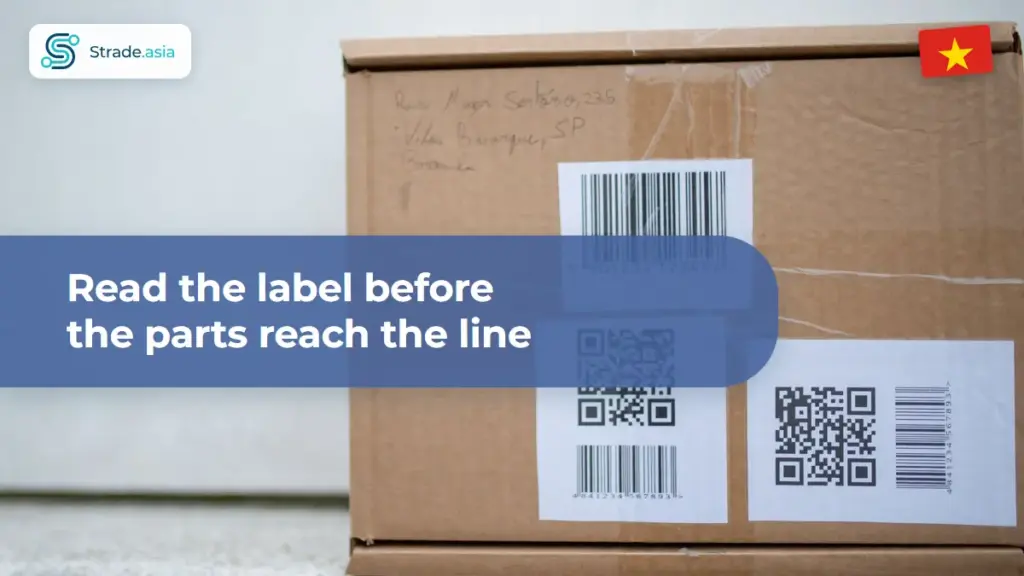
Every reel, tray, tube or bag of components carries a manufacturer label, and every carton usually carries a few more from distributors and forwarders. At goods receipt, that label is the first and cheapest piece of evidence about what you have received. A receiving clerk who reads it properly catches wrong parts, mixed lots and suspect stock before they reach the line.
What a manufacturer label shows
Layouts differ between manufacturers, but most labels carry the same core fields:
- Manufacturer part number (MPN). The full ordering code, often with suffixes for packaging, temperature grade or RoHS status. The marking printed on the part itself is usually shorter and may not match the MPN character for character.
- Quantity. The number of pieces in that reel, tray or bag.
- Lot or batch number. Links the parts to a production lot, which you need for any complaint or traceability query.
- Date code. Usually the year and week of manufacture or assembly, in the manufacturer’s own format; see our guide to date codes.
- Moisture sensitivity level. Often on a separate caution label on the moisture barrier bag, with floor life and bake conditions, as explained in our article on MSL.
- Country of origin. Where the part was produced, as the manufacturer declares it. This matters for customs and certificates of origin.
- Compliance marks. RoHS or lead-free symbols, the ESD symbol and sometimes a halogen-free mark.
Many labels also show a reel or box ID, the seal date of the dry pack and the supplier’s internal codes.
1D and 2D barcodes
Labels usually encode the key fields in barcodes. Linear (1D) barcodes, often Code 128 or Code 39, typically carry one field each: one for the part number, one for quantity, one for the lot. Two-dimensional codes, such as Data Matrix, PDF417 or QR codes, can carry all fields in one symbol.
Many labels put a short prefix, called a data identifier, in front of each value so that the scanner knows which field it is reading: for example Q for quantity, or 1P for the supplier’s part number. Receiving software can use these to fill in the goods receipt record directly, which removes typing errors. Before you rely on it, test that your scanners and software read each supplier’s format correctly.
Matching the label to the order
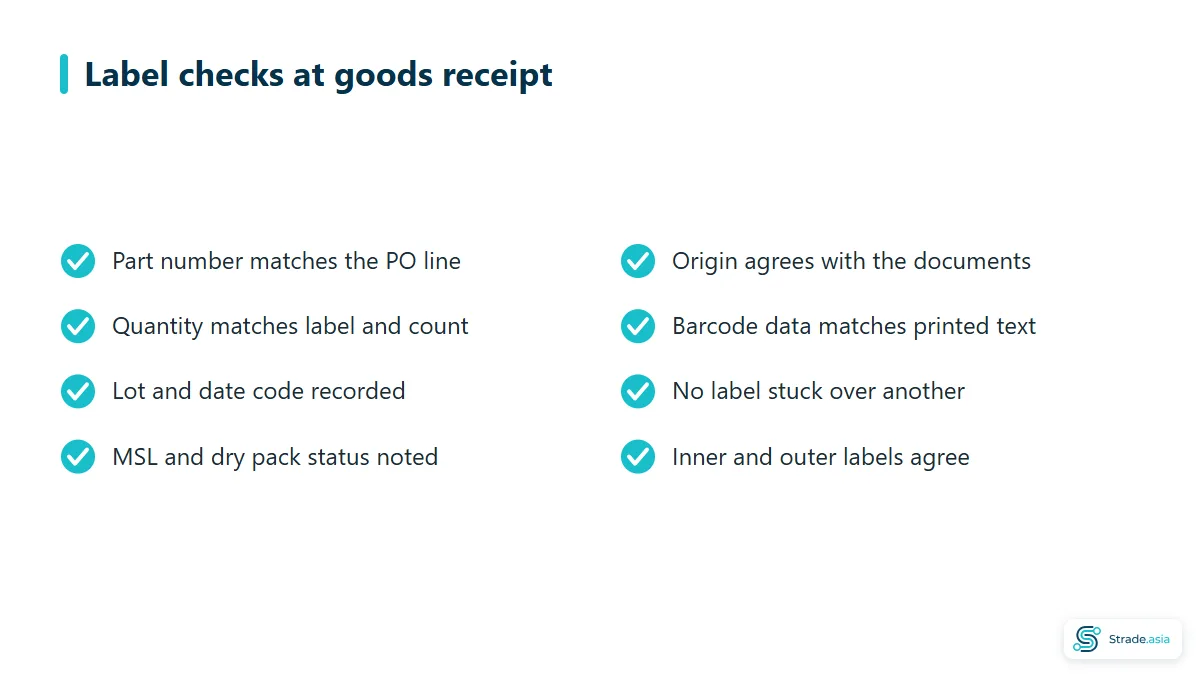
- Part number. Compare the full MPN, suffixes included, with the PO line. A different packaging suffix may be acceptable; a different temperature grade or tolerance is not.
- Quantity. Compare the label quantity with the packing list and, for high-value parts, with a count or weight check.
- Lot and date code. Record them for every reel, since one outer carton can hold several lots, check them against any date code limits agreed with the supplier or your customer, and keep photos of the original labels in case you need to raise a quality claim.
- Origin. Check that the country of origin on the label agrees with the invoice, the customs declaration and any certificate of origin. Goods shipped from a regional hub such as Hong Kong or Singapore still carry their country of manufacture, and a mismatch can hold a shipment at customs even when no preferential duty is claimed.
- Inner and outer labels. The label on the reel should agree with the labels on the bag and the box.
Do not open an intact moisture barrier bag at goods receipt unless an inspection issue requires it, because opening it starts the floor-life clock. When you must open a package, do it at an ESD-safe bench, as described in ESD control in the receiving area, check the humidity indicator card, and reseal or dry-store moisture-sensitive parts promptly.
Relabelling: when to look closer
Distributors legitimately add their own labels for their stock systems, and re-reeled or repacked parts need new labels, as noted in our packaging guide. But a label is also the easiest thing to fake, especially on open-market buys when parts are short. Look closer when:
- a label has been stuck over another label;
- the printing, fonts or layout differ from other lots from the same manufacturer;
- the barcode data does not match the printed text;
- the date code on the label does not match the marking on the parts;
- the manufacturer label is missing and only a reseller label remains.
None of these proves a problem, but each is a reason to check the parts themselves: marking, appearance and, if needed, X-ray or electrical tests.
How Strade can help
Strade is an independent electronic component distributor with its own engineers, supplying factories in Vietnam and across Asia. Every lot we receive is inspected for part number, labels, date code, packaging and appearance, with X-ray or sample testing for sensitive parts or on request. Send us your BOM for a quote, together with any labelling requirements your receiving team has.