한국어
 Bahasa Indonesia
 ไทย
 中文 (中国)
 Tiếng Việt
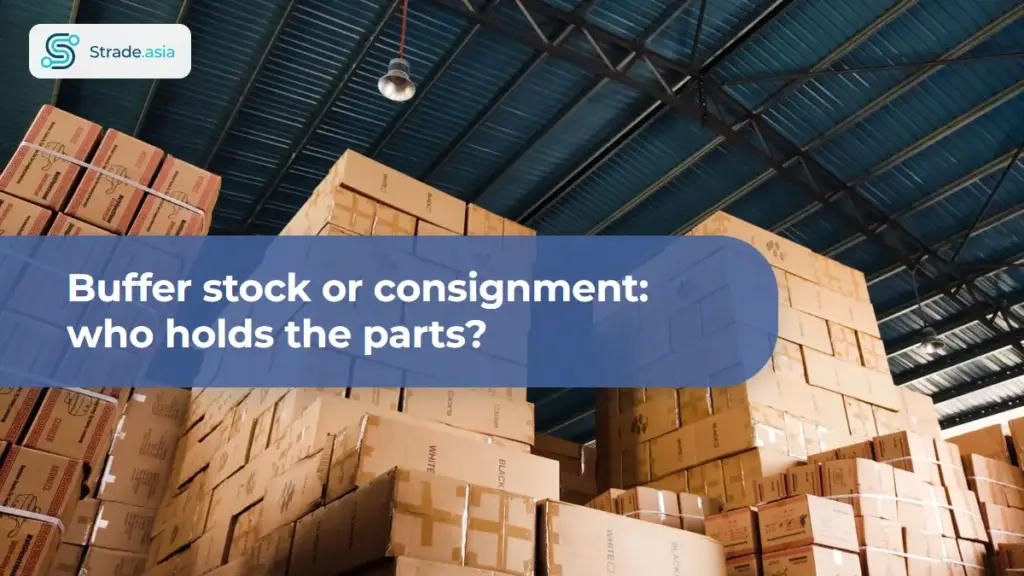
Since memory prices turned up in 2016, and MLCCs and chip resistors followed in 2017, many factories have learned that lean inventory can stop a line. The natural reaction is to build buffer stock. But stock costs money: cash tied up, warehouse space, handling, insurance, and the risk that parts become obsolete or unusable before they are needed. The question is not only how much to hold, but who holds it and on what terms.
Five ways to hold stock
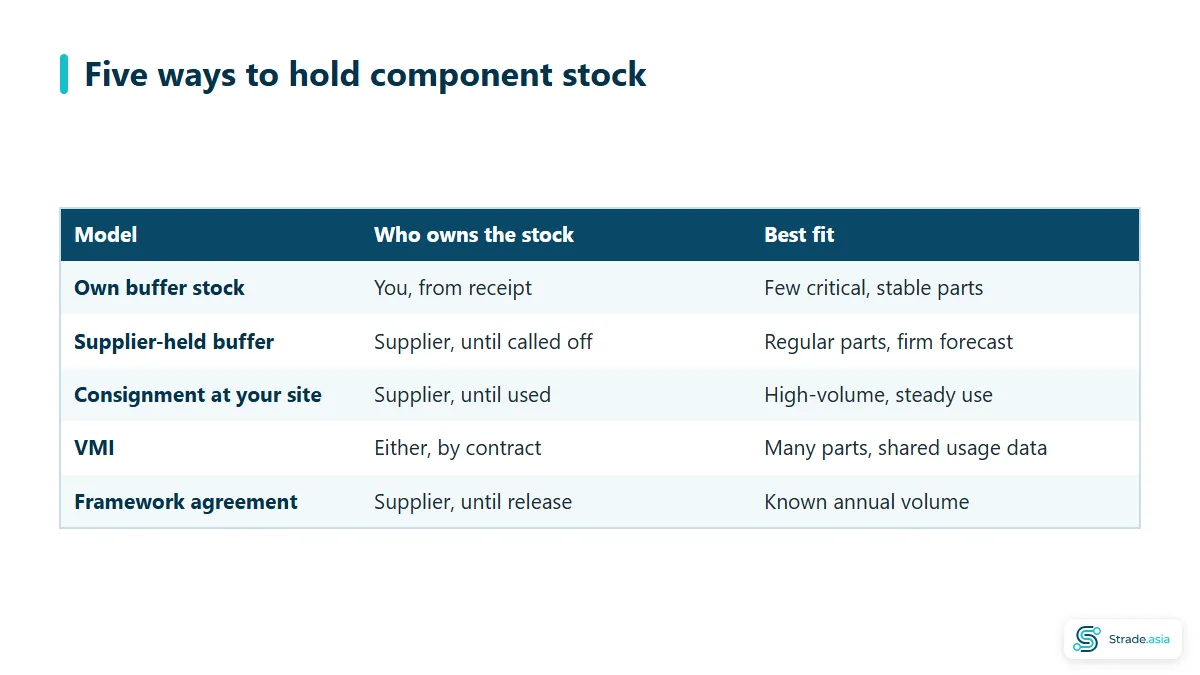
1. Your own buffer stock
You buy extra quantity and keep it in your own warehouse. It is simple and gives you full control, but you carry all the cost and risk from the day of receipt. It fits a small number of critical parts with stable designs and steady usage. Moisture-sensitive parts need dry storage and floor-life tracking, as described in our guide to MSL, and every part needs a date code policy and first-in, first-out rotation, so that buffer stock is used before it ages.
2. Supplier-held buffer stock
The supplier buys and holds an agreed quantity for you and ships against your orders. You usually commit to take the stock within a set period, so the cost is shared rather than removed. It works for regular parts where you can give a reliable forecast. Check where the stock is held: parts kept in a regional hub such as Singapore or Hong Kong still need transport and import clearance, so they reach your line more slowly than stock held in Vietnam.
3. Consignment
The supplier places stock in your warehouse or next to your line, but keeps ownership until you use it. You pay for what you withdraw, usually against regular usage reports and physical counts. Consignment protects you from stock-outs without tying up your cash, but it needs clear rules: who insures the stock, how counts are done, what happens to damaged parts, and how unused stock is returned or bought when the agreement ends. For export processing enterprises and bonded warehouses, check with your customs and tax advisers how consigned goods must be declared and taxed, especially when an overseas supplier keeps ownership of stock in Vietnam.
4. Vendor-managed inventory (VMI)
The supplier monitors your stock and usage and replenishes within agreed minimum and maximum levels. Ownership can sit with either party, depending on the contract. VMI reduces purchasing work across many parts, but it only works if you share accurate usage and production plans.
5. Framework agreements
A framework or blanket agreement sets price, total quantity and terms for a period, and you release deliveries as you need them. The supplier can plan purchasing against the total, and you avoid committing cash until each release. Read the terms on unused quantity: in a shortage, many agreements become non-cancellable.
Costs and risks to weigh
- Holding cost. Finance, space, handling and insurance add up. Count them before deciding how many weeks of cover to hold.
- Obsolescence. Designs change and parts reach end of life. Stock bought for a product that changes becomes excess inventory.
- Shelf life and storage. Date codes, solderability and moisture sensitivity all limit how long parts can wait.
- Commitment. Supplier-held stock and framework agreements usually include liability for the quantity bought on your behalf, and in a shortage suppliers are often reluctant to hold allocated parts without firm orders.
- Data discipline. Consignment and VMI depend on accurate counts and usage figures. Weak data turns them into disputes.
Choosing the right mix
Most factories need a combination rather than a single model. A practical approach:
- Rank parts by their impact on the line and by supply risk.
- Hold your own buffer only for the few parts that are both critical and hard to replace.
- Put high-volume, steady-use parts under consignment or supplier-held buffer.
- Cover the rest with framework agreements and good forecasts.
- Review every quarter: what moved, what did not, and what has changed in the market.
As we noted in allocation explained, the same forecast that supports these arrangements also improves your share when parts are rationed. And during the current MLCC shortage, many buyers have found that a few weeks of extra cover on the right capacitors was worth far more than its holding cost.
A note on agreements
Whatever model you choose, put it in writing. The agreement should name the parts and approved makers, the minimum and maximum levels, how usage is reported, the price basis, who pays for storage and insurance, and what happens to remaining stock at the end. Changes in design or demand are the usual source of disputes, so agree in advance how they will be handled.
How Strade can help
Strade provides component supply chain services to factories in Vietnam and across Asia, alongside parts sourcing, OEM and ODM work. Most orders are bought to the customer’s request, packed in anti-static packaging with moisture control by MSL, and delivered DDP or DAP to factories and export processing enterprises with customs documents prepared.
Tell us which parts you want to secure, together with your forecast, and read more about our supply chain services.