
 한국어
 Bahasa Indonesia
 ไทย
 中文 (中国)
 Tiếng Việt
Electronic components are small, valuable and often urgent, so most of them travel by air freight or express courier. Yet many quotes still name a term written for sea freight, or simply say “EXW”. The Incoterms rule on a purchase order decides who pays for each leg of the journey, who handles customs and at what point the risk of loss passes from seller to buyer. A poor choice rarely shows until something goes wrong: a shipment held at the airport, a damaged carton, a bill for duties nobody expected.
The current version is Incoterms 2010, published by the International Chamber of Commerce and in use since 1 January 2011. It has eleven rules. Seven can be used for any mode of transport (EXW, FCA, CPT, CIP, DAT, DAP and DDP); four are meant for sea and inland waterway only (FAS, FOB, CFR and CIF). For air and courier shipments, use the first group.
EXW: simplest for the seller, hardest for you
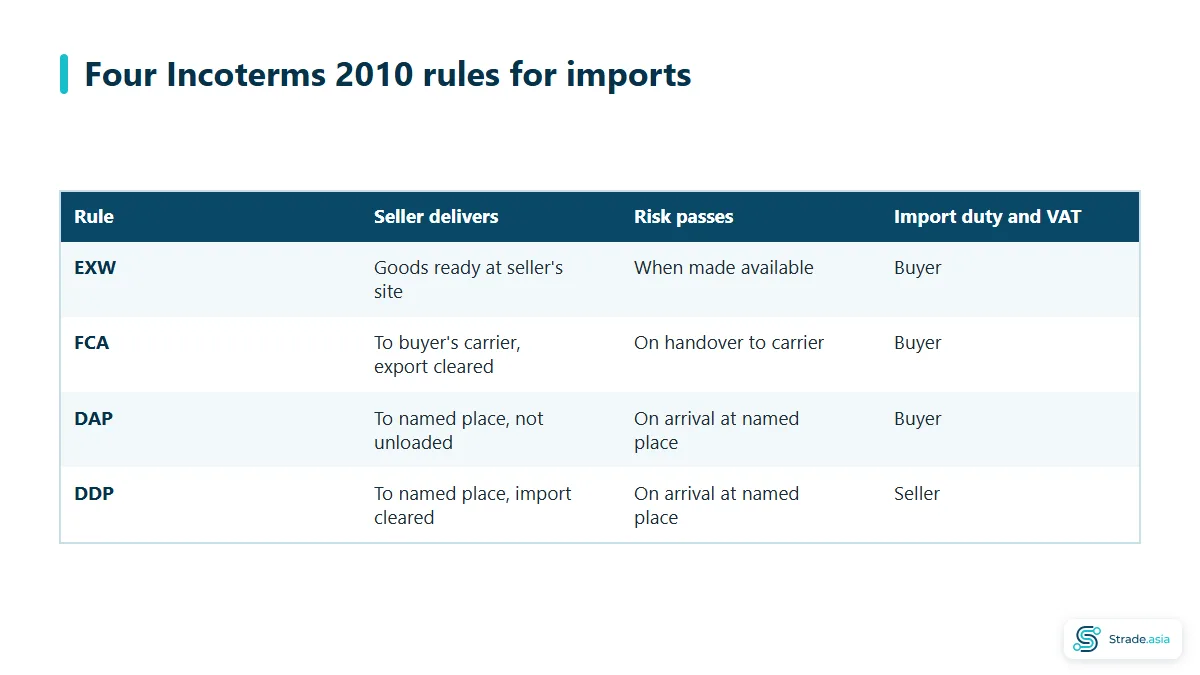
Under Ex Works, the seller makes the goods available at its own premises, not loaded on any vehicle. Everything else falls to the buyer: collection, loading, export clearance in the seller’s country, transport, import clearance, duties and taxes. Risk passes as soon as the goods are made available.
The trap is export clearance. A buyer in Vietnam usually cannot clear goods for export from Singapore, Hong Kong or the US, and the rule does not oblige the seller to help. In practice your forwarder arranges it with the seller’s cooperation, which you cannot count on. Unless the forwarder knows the seller well, FCA is cleaner.
FCA: the better factory-gate term
Under Free Carrier, the seller clears the goods for export and hands them to the carrier you have nominated, at a named place. If that place is the seller’s premises, the seller also loads them; if it is another named place, such as your forwarder’s warehouse, the seller delivers them there on its own transport, ready for unloading. Risk passes on handover. FCA is what many buyers mean when they write FOB on an air shipment; FOB covers goods loaded on board a vessel and does not fit air freight.
DAP and DDP: delivered to your factory
Under Delivered at Place, the seller arranges and pays for transport to a named destination, such as your factory, and bears the risk until the goods arrive there, ready for unloading. You handle import clearance, pay import duty and VAT, and unload.
Under Delivered Duty Paid, the seller also clears the goods for import and pays duties and taxes. This is the most convenient rule for the buyer, but a seller without a company in Vietnam usually needs a local agent to act as importer and declare the goods. Agree who appears as importer, and how import VAT will be recovered, before you accept DDP. For export processing enterprises and imports for export production, duty treatment differs from ordinary imports, so whoever clears the goods must know the enterprise’s status and the right type of declaration.
Courier waybills sometimes still show “DDU”, a rule that was dropped from Incoterms 2010 and in practice replaced by DAP. If you see it, confirm in writing who pays duties and taxes.
What Incoterms do not cover
- Ownership. When title passes is set by the sales contract, not by the Incoterms rule.
- Payment. Payment terms are agreed separately.
- Most insurance. Only CIF and CIP oblige the seller to insure, and then only to a minimum level. Under other rules, agree who insures valuable shipments.
- Protection inside the carton. ESD packing, dry packing for moisture-sensitive parts, labels and documents must be stated on the order.
Documents to ask for
Whatever the rule, a component import needs a commercial invoice, a packing list and an air waybill or bill of lading. Where a part carries import duty, claiming a preferential rate under a free trade agreement needs a valid certificate of origin, such as Form E for goods from China, Form D for goods from ASEAN countries or the forms used under the agreements with Korea and Japan. Check the HS code first, and ask for the certificate when you order, not after arrival. Shipments containing lithium batteries need dangerous goods documents for the carrier, as noted in our article on lithium-ion battery safety. When the goods arrive, unpack and check them as described in ESD control in the receiving area.
Write the term in full
Name the rule, the place and the version, for example “DAP [factory address], Incoterms 2010”. A rule without a precise place leaves room for argument about where the seller’s obligations end: naming only a city or an airport can leave you paying terminal handling, storage and local trucking you expected the seller to cover.
How Strade can help
Strade is an independent electronic component distributor with its own engineers, supplying factories in Vietnam and across Asia. We deliver DDP or DAP to factories and export processing enterprises and prepare the customs documents, and CoC, C/O and CQ travel with the goods when the source provides them. Ask for a delivered quote, or read about our supply chain services.


