한국어
 Bahasa Indonesia
 ไทย
 中文 (中国)
 Tiếng Việt
Since 4 July, Japanese companies exporting three materials to South Korea have needed individual licences, instead of the simpler arrangements used before. The materials are fluorinated polyimide, used in flexible displays; photoresists, used to pattern circuits on wafers; and high-purity hydrogen fluoride, used to etch and clean them. On 2 August, Japan’s Cabinet went further and decided to remove South Korea from its “white list” of preferred trading partners for export controls. The change was published on 7 August and takes effect later this month; it brings stricter licensing and catch-all checks for a wider range of goods, not only the three materials.
South Korea is home to some of the world’s largest memory and display makers, and Japanese suppliers are major producers of these materials. Buyers everywhere have been watching for any effect on memory chips and display panels. So far, the effect for component buyers has been uncertainty rather than visible shortage. Japan approved the first individual licence, for a photoresist shipment, on 8 August, so shipments are not banned, but each review takes time, and few people outside the companies involved know how much material is in the pipeline.
For factory buyers in Vietnam, where many assembly lines use Korean memory, display panels and other parts, the episode is a reminder that supply risk does not start at your supplier, or even at the chip maker. It starts with materials most buyers never see.
Why upstream materials matter
A memory chip passes through many hands before it reaches your line: chemical and gas suppliers, wafer makers, the fab, assembly and test, the module maker and the distributor. Several upstream inputs come from very few suppliers, sometimes concentrated in one country or one site. A disruption there, whether from an earthquake, a fire, contamination or a policy decision, can reach finished parts weeks or months later.
We discussed the physical version of this risk after the Kumamoto earthquakes. The current dispute shows that the same concentration can be exposed by trade policy, as the US Entity List decision did in May from a different direction.
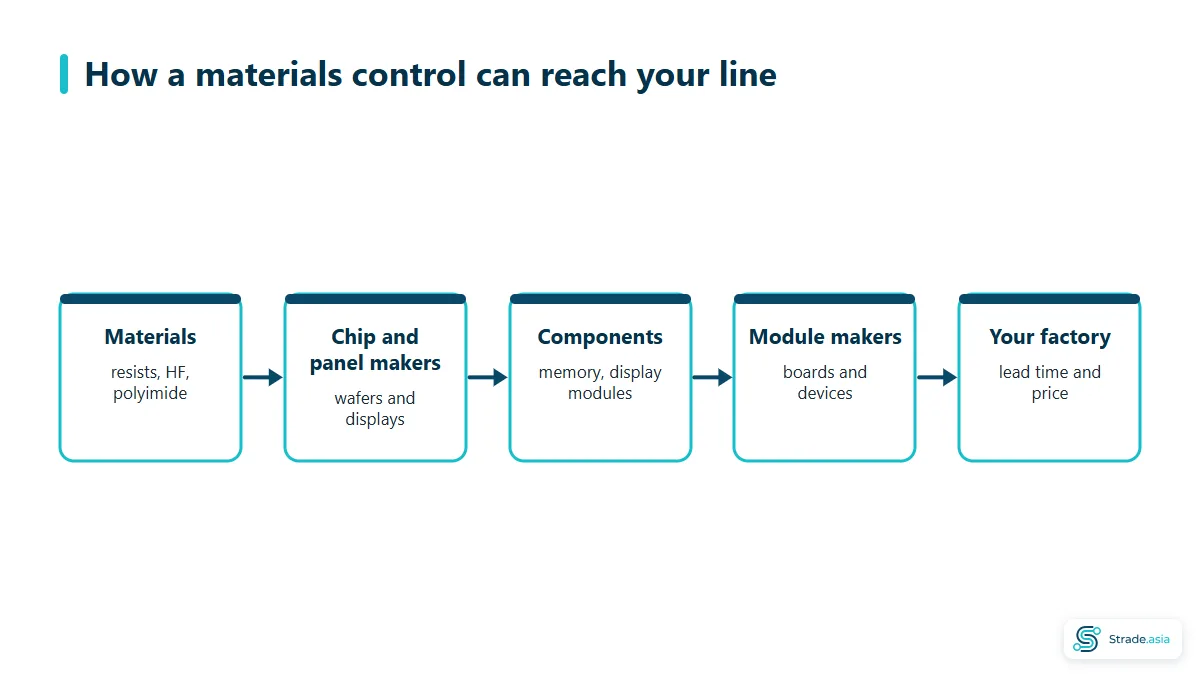
What it could mean for memory and displays
Memory prices have been falling since late last year, as covered in buying memory in a downturn, and inventories at memory makers give some cushion. A prolonged disruption in materials could still tighten supply, and spot prices tend to jump on headlines even while contract prices stay soft. Buyers should avoid two opposite mistakes: buying in a panic on headlines, and assuming nothing can change.
Display panels and touch modules are another area to watch, especially for products that use small OLED panels.
How to review your upstream exposure
You cannot map the chemicals behind every part. You can map where your critical parts are made and how many sources you have:
- List critical parts. Memory, display panels and any single-source semiconductors on your main BOMs.
- Ask where they are made. Fab and assembly locations, and whether the manufacturer has more than one qualified site.
- Ask about materials. Manufacturers will not share details, but many will say whether they have alternative material sources or safety stock.
- Review buffer stock. For parts that would stop a line, extra stock costs less than a stoppage. Our article on buffer stock and consignment compares the options.
- Prepare alternates. Memory from another maker, even in a compatible package, needs qualification time. Start before you need it.
- Watch notices. Product change notices about materials or sites should reach the right engineer quickly.
Keep perspective
Trade disputes can ease as quickly as they arise, or they can drag on. The point of this review is not to predict the outcome but to know where you are exposed, so that you can act early if the situation changes. The same review also prepares you for the next disruption, whatever its cause.
It also helps to keep communication open with suppliers. A supplier who knows your forecast and your critical parts is better placed to warn you early and to reserve stock if supply tightens.
How Strade can help
Strade is an independent electronic component distributor with its own engineers, supplying factories in Vietnam and across Asia. Most of our orders are bought to the customer’s request, and many are urgent. We source from manufacturers, their distributors and vetted open-market suppliers, and inspect every lot on receipt, with X-ray or sample testing for sensitive parts or on request. When a part is at risk, our engineers can propose alternates with matching specifications for your team to decide on. Read more about our supply chain services.
To check sources and alternates for the memory and other critical parts on your BOM, send us your part list.