한국어
 Bahasa Indonesia
 ไทย
 中文 (中国)
 Tiếng Việt

On 14 April, and again in the early hours of 16 April, strong earthquakes struck Kumamoto prefecture on the island of Kyushu in southern Japan. Lives were lost, many people had to leave their homes, and roads, water and power were cut across the area.
Kyushu is also home to many semiconductor plants. Renesas Electronics stopped production at its Kawashiri plant in Kumamoto, which makes microcontrollers and other chips, while it inspected the damage. Sony stopped its image sensor plant in Kumamoto for the same reason. Other factories in the region paused for checks, and the effect reached beyond electronics: Toyota halted assembly at many of its plants in Japan because a supplier in Kumamoto could not deliver parts.
The companies are restoring production in stages, and how long full recovery takes will depend on what their inspections find. The more useful question for a factory buyer is a broader one: which of your parts depend on a single site?
Why single-site parts matter
Most buyers know which manufacturer makes each part. Far fewer know where it is made. A semiconductor passes through a wafer fab (the front end) and then an assembly and test plant (the back end), often in different countries. Many parts are made in only one fab, because qualifying a second fab costs the maker time and money, and some are assembled at only one site.
When that site stops, there is no quick fix. A wafer fab does not simply restart after an earthquake: equipment must be inspected and recalibrated, cleanrooms cleaned, and wafers that were in process when the shaking began may have to be scrapped. Moving a part to another fab requires qualification by the maker and often by its customers.
This has happened before. The 2011 earthquake in eastern Japan damaged Renesas’ Naka plant and left carmakers short of microcontrollers. The same year, floods in Thailand stopped hard disk drive and component factories. Each time, the buyers who coped best already knew where their critical parts came from.
Map your single-site exposure
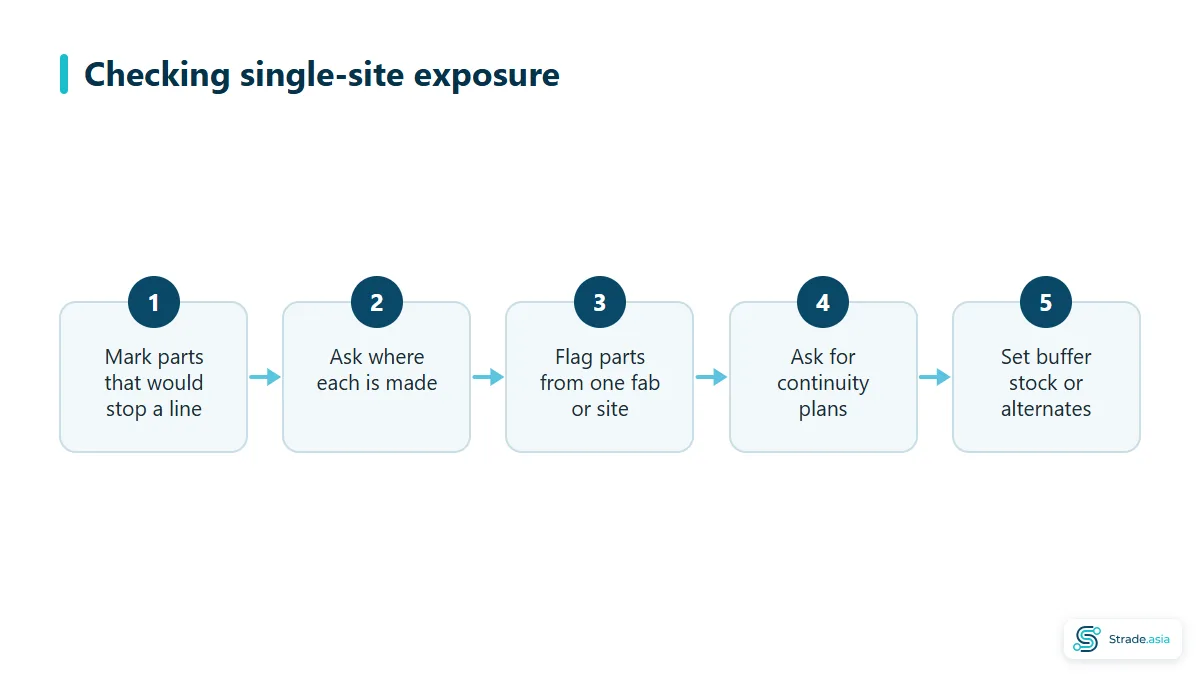
- Mark the parts that would stop a line. Start with parts that have no approved alternate, long lead times or custom features, and include bought-in modules and sub-assemblies whose chips may come from a single fab. For most factories this is a short list.
- Ask where each is made. Ask your suppliers, or the maker directly, for the fab and assembly sites of each critical part. Many makers will share this when a customer asks about business continuity.
- Flag single-site parts. Note which parts come from one fab or one assembly site, and which makers have a qualified second site.
- Ask for continuity plans. Ask how the maker would supply customers if the site stopped: finished goods held elsewhere, die stored for later assembly, or a second fab already qualified. Ask how customers would be told.
- Decide on buffer stock or alternates. For each single-site part, choose whether to hold extra stock, qualify an alternate, or both.
Buffer stock without waste
Extra stock costs money, so hold it only where it counts: single-site parts that would stop a line. Agree the quantity with production planning, based on how long it would take to qualify an alternate. Store it properly. Moisture-sensitive parts belong in sealed dry packs or dry cabinets, as described in our guide to moisture sensitivity levels, and buffer stock should be rotated first-in, first-out so it does not age on the shelf.
Alternates
An alternate approved in advance is the best protection against a site outage. Pin-compatible parts from another maker are the easiest; microcontrollers, with their firmware, take the longest. Consolidation among suppliers narrows the field, which is another reason to watch the effects of recent semiconductor mergers on your BOM.
Watch the open market
After a disruption, large buyers move quickly to secure stock, and lead times can stretch for the affected parts and for their closest substitutes. Open-market prices tend to rise, and so does the risk of poor or counterfeit stock. If you need to buy outside normal channels, inspect labels, date codes, marking and packaging, and test samples of critical parts before they go into production.
How Strade can help
Strade is an independent electronic component distributor with its own engineers, supplying factories in Vietnam and across Asia. We source from manufacturers, their distributors and vetted open-market suppliers, and every lot is inspected on receipt, with X-ray or sample testing for sensitive parts or on request. When a part is at risk, our engineers propose alternates with matching specifications for your team to approve. Learn more about our supply chain services.
Send us your list of critical parts and we will help you check availability and alternates.