한국어
 Bahasa Indonesia
 ไทย
 中文 (中国)
 Tiếng Việt
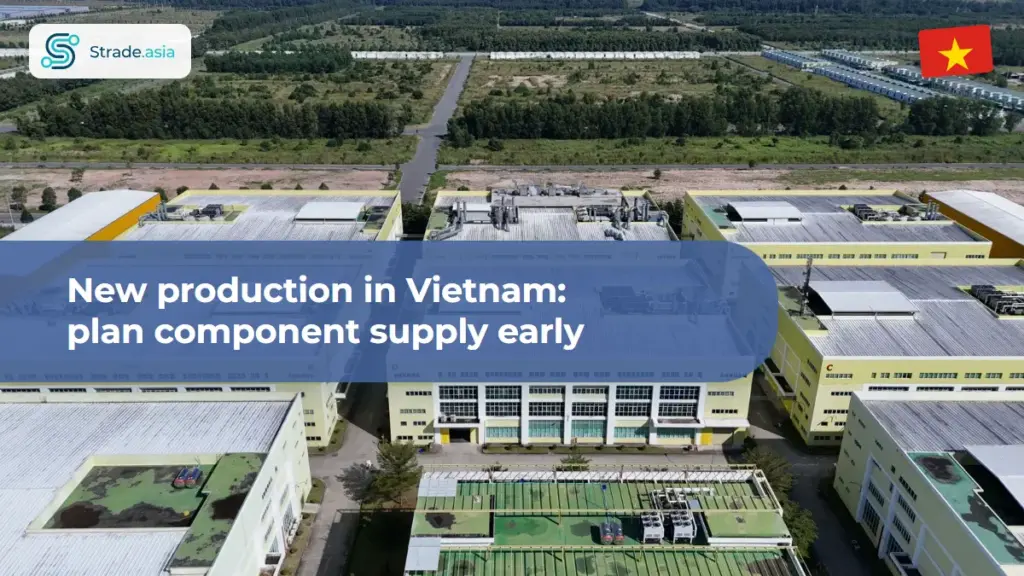
Over the past year, a growing number of manufacturers have moved production to Vietnam or added a line here alongside existing plants in China and elsewhere. The reasons vary: US tariffs on Chinese goods, rising costs, customers asking for a second manufacturing base, and trade agreements such as CPTPP. As we noted in tariff list 3 and supply chain moves, the trend was already visible last year. Whatever the reason, the same question soon comes up: how will components reach the new line, on time and with the right documents?
Most components for electronics assembly are not made in Vietnam. They come from manufacturers and distribution hubs in China, Hong Kong, Taiwan, Singapore, Japan, Korea and further afield. Planning that flow early saves weeks of delay later.
Decide the customs set-up first
How components are imported depends on the company’s status and on what happens to the goods.
- Export processing enterprises (EPEs) operate under a separate customs regime. Goods imported for export production are generally not subject to import duty or import VAT, and purchases of materials from the domestic market are treated as imports, usually declared as on-the-spot exports and imports. EPE status suits factories that export almost everything they make.
- Production for export and processing under contract for a foreign party allow duty exemption on materials used in exported goods, subject to declaring the production facility to customs, which may inspect it, and to reporting how those materials were used.
- Ordinary imports for goods sold in Vietnam pay duty and VAT at the normal rates, reduced where a valid certificate of origin under a trade agreement applies.
Each route has reporting obligations, including periodic reports that reconcile imported materials with production and exports. Set up material codes and consumption norms in your ERP from the start; reconciling them later is painful.
Classify components early
Every imported part needs an HS code on the customs declaration. Components that look alike can classify differently: a module may not share the heading of the chip inside it, and a power supply may not share the heading of a DC-DC converter board. Agree a classification for each part number with your customs broker before the first shipment, and keep it consistent. Some products, such as radio equipment, including some Wi-Fi, Bluetooth or cellular modules, may also need specialised checks or certification before import.
Plan lead times from the hubs
Lead time to a factory in Vietnam has three parts: the supplier’s lead time, transport and customs clearance.
- Supplier lead time depends on stock. Parts held by distributors in Hong Kong, Singapore or Shenzhen may ship within days; factory orders can take weeks or months.
- Transport by air from regional hubs is quick. Sea freight is cheaper for bulky items but slower. Road transport from southern China is widely used for factories in northern Vietnam, while plants in the south rely more on air and sea.
- Clearance depends on complete documents and correct HS codes. Missing or inconsistent paperwork is a frequent cause of avoidable delay.
Delivery terms decide who handles each step. Our guide to Incoterms 2010 for component imports compares EXW, FCA, DAP and DDP.
Get the documents right
For each shipment, expect:
- a commercial invoice and packing list with manufacturer part numbers;
- an air waybill or bill of lading;
- a certificate of origin where a preferential rate is claimed, such as Form E for goods from China, Form D from other ASEAN countries, Form AK or KV from Korea, and Form AJ or JV from Japan;
- a CoC and, where required, other quality documents from the source.
A certificate of origin must match the invoice exactly. Small differences in names, HS codes or quantities can cost the preferential rate. Even where your factory imports duty-free, keep supplier origin documents, because they help prove the origin of your own exports. For your own exports, our article on CPTPP rules of origin explains how origin is built up from the BOM.
Set up receiving properly
A new factory’s receiving area needs the same controls as an established one: ESD protection, moisture control for sensitive parts, and checks of labels and date codes against the order. See ESD control in the receiving area for the basics.
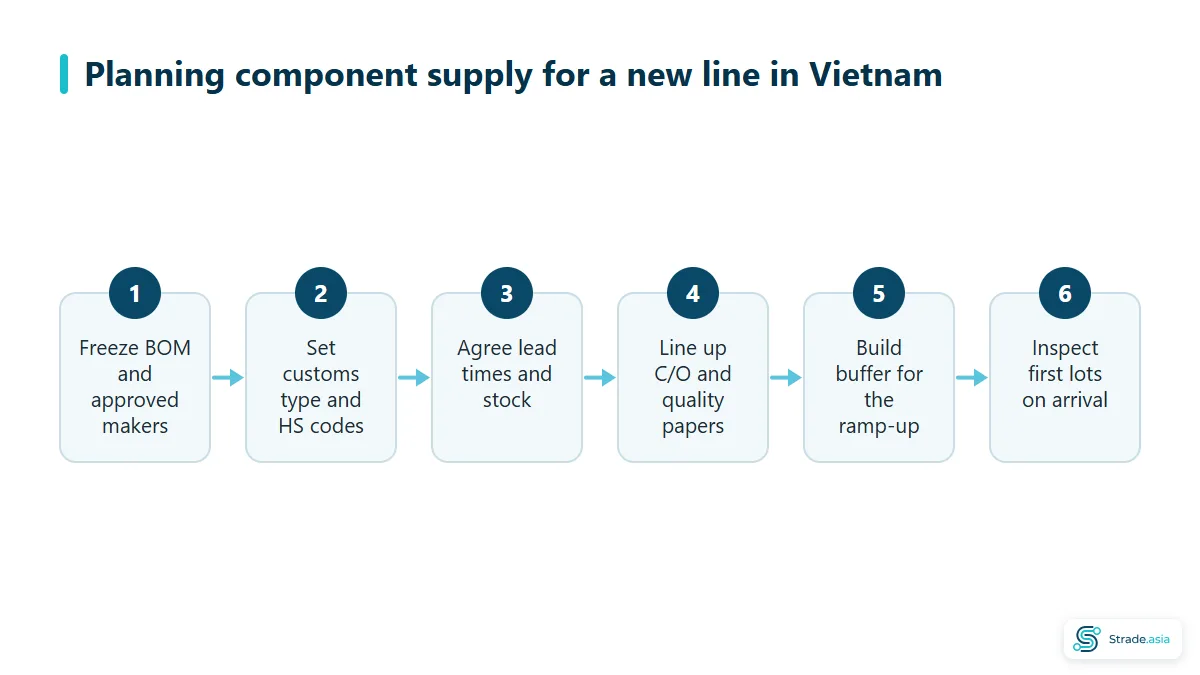
A checklist for the first months
- Freeze the BOM and approved manufacturer list for the products moving.
- Classify every part and agree the customs type for each flow.
- Agree lead times with suppliers, including stock held in the region.
- Build buffer stock for long-lead and single-source parts during the ramp-up.
- Check that certificates of origin and quality documents arrive with each shipment.
- Inspect the first lots of every part carefully.
How Strade can help
Strade is an independent electronic component distributor with its own engineers, supplying factories in Vietnam and across Asia. Most orders are bought to the customer’s request, from manufacturers, their distributors and vetted open-market suppliers. Every lot is inspected on receipt, packed against static and handled to its moisture sensitivity level. We deliver DDP or DAP to factories and export processing enterprises and prepare the customs documents. See how we work for manufacturers.
If you are planning a new line in Vietnam, send us your BOM in Excel, CSV or PDF.