한국어
 Bahasa Indonesia
 ไทย
 中文 (中国)
 Tiếng Việt

After two years of shortage, the memory market has turned. NAND flash prices softened first, and DRAM contract prices followed from the fourth quarter of last year. Recent results and comments from memory makers point to weaker demand from smartphones and data centres, and to inventory building up across the supply chain.
For factory buyers who spent 2017 and much of 2018 chasing allocation, falling prices are welcome. They also bring their own risks: buying too much too early, holding stock that loses value every month, and missing the quieter signal that some older memory parts are being phased out.
Why DRAM and NAND prices are falling
Memory is a cyclical market. During the shortage, which we described in memory supply in 2017, makers raised output and added capacity, while customers built safety stock to protect their lines. As demand growth slowed, that stock started to be used up rather than replenished, and new orders fell. NAND output also grew as makers moved to denser 3D processes.
None of this tells you when the bottom will come. Nobody can call the end of a downturn reliably, and buyers who try usually end up either holding expensive stock or paying more when the market turns.
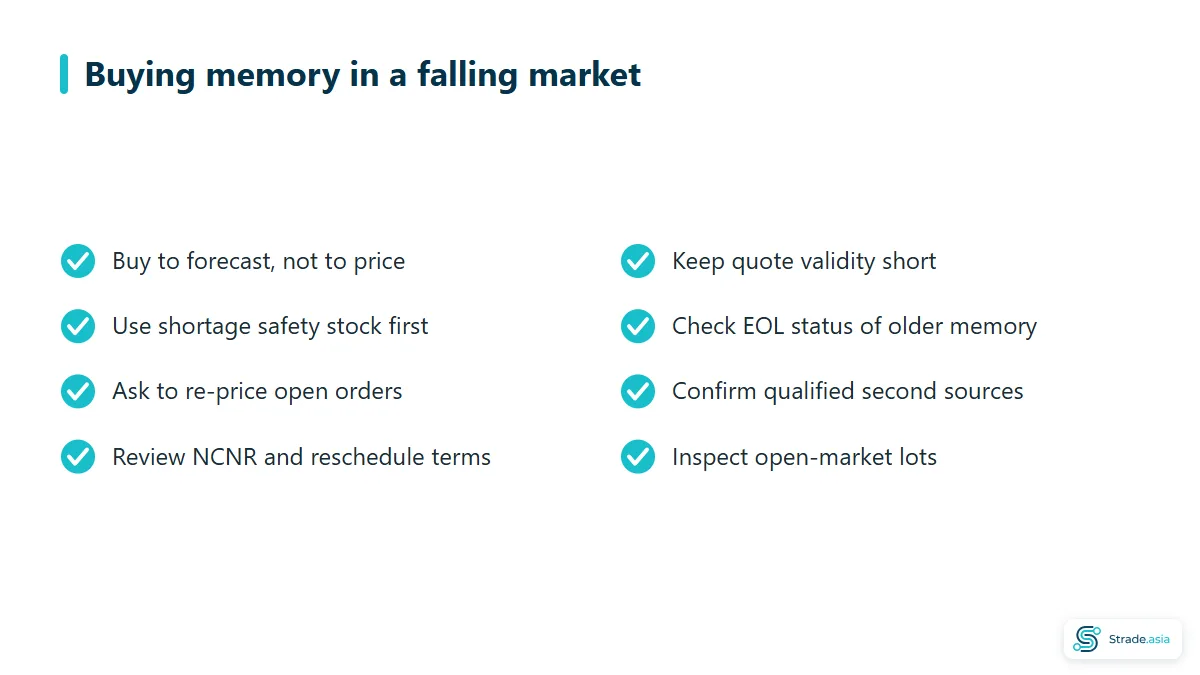
Do not over-buy
The most common mistake in a falling market is to buy a large quantity because the price looks good compared with last year, or because spot quotes have dropped below contract prices. Memory bought at today’s price can still be worth less next quarter, shorter lead times reduce the need to order far ahead, and holding stock costs money: cash, storage space, and the handling of moisture-sensitive packages.
- Buy against your forecast, not against the price chart.
- Keep order quantities and delivery dates close to actual production needs.
- If you still hold safety stock from the shortage, use it before buying more.
- Check whether existing stock is approaching the age limits your customers or your own quality rules allow.
If you already hold more than you need, our article on excess component inventory lists the options before a write-off.
Renegotiate what you can
Prices agreed during the shortage may now be well above the market.
- Open orders. Ask suppliers to re-price lines that have not shipped. Many would rather adjust a price than see orders cancelled or pushed out.
- Price agreements. If you agreed fixed prices for a period, check the review clauses and ask for a review where the contract allows.
- NCNR orders. Non-cancellable, non-returnable orders placed during allocation are binding, but a supplier may agree to reschedule them. Ask early.
- Quote validity. In a falling market, short validity periods work in your favour. Ask for quotes to be refreshed regularly rather than locking prices for long periods, and for recurring parts, ask about scheduled releases instead of one large delivery.
Be fair in negotiation. The market will turn again, and suppliers remember which customers cancelled everything at the first sign of oversupply. Our guide to allocation explains why order history matters when supply tightens.
Watch for EOL on older memory
Lower prices for mainstream DRAM and NAND do not apply equally to all memory. Price falls are usually sharpest on high-volume parts, while industrial-temperature grades and older memory tend to follow more slowly. When makers adjust output in a downturn, they tend to concentrate on high-volume products and newer generations. Older densities and interfaces, such as legacy SDRAM, DDR2 and low-density SLC NAND used in industrial controllers, meters and networking equipment, may be moved to fewer fabs, offered by fewer suppliers or discontinued.
For industrial products with long lives, this matters more than the price. Check:
- the lifecycle status of every memory part on your BOMs;
- whether each part has a second source that is qualified, not just listed;
- any product change or discontinuation notices received in the past year;
- how much demand remains for products that use older memory.
If a part is near end of life, plan a last-time buy or a redesign while there is still time. Our guide to approved manufacturer lists and second sources covers how to qualify an alternate.
Keep an eye on quality
When prices fall, more stock moves through the open market, including excess from other buyers. Most of it is genuine, but a downturn also brings refurbished, remarked and poorly stored parts into circulation. Check date codes, labels and packaging on every lot, and test samples for critical applications.
How Strade can help
Strade is an independent electronic component distributor with its own engineers, supplying semiconductors, passive components, connectors and power products to factories in Vietnam and across Asia. Most orders are bought to the customer’s request. We source from manufacturers, their distributors and vetted open-market suppliers, and inspect every lot on receipt: part number, labels, date code, packaging and appearance, with X-ray or sample testing for sensitive parts or on request. When a memory part is heading for end of life, our engineers can propose alternates with matching specifications for your team to decide on.
To check current prices and alternates for the memory on your BOM, send us your part numbers.