한국어
 Bahasa Indonesia
 ไทย
 中文 (中国)
 Tiếng Việt
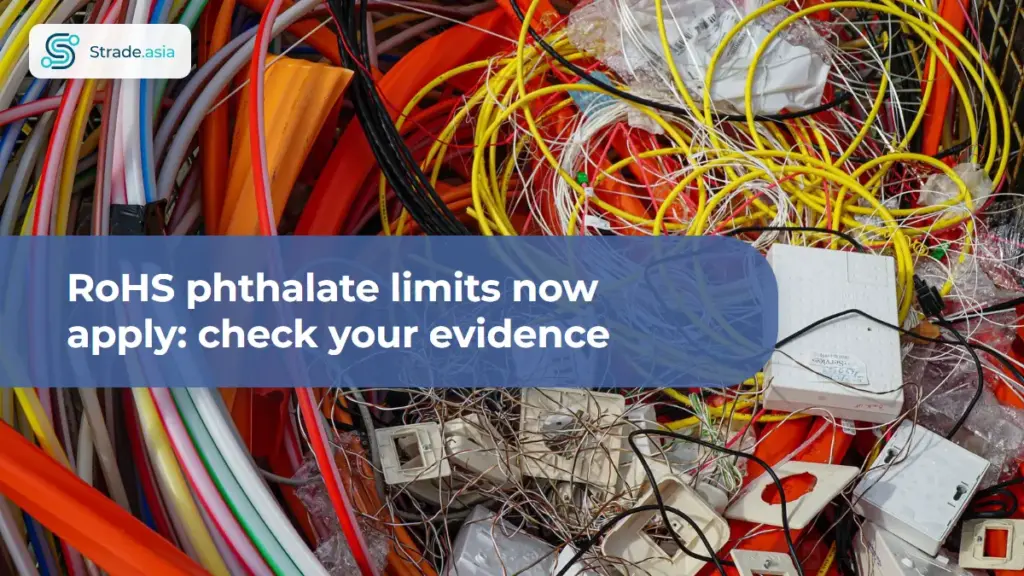
Since 22 July, four phthalates have been restricted substances under the EU RoHS Directive. Directive (EU) 2015/863 added DEHP, BBP, DBP and DIBP to Annex II of Directive 2011/65/EU, bringing the list of restricted substances to ten. The restriction now applies to most electrical and electronic equipment placed on the EU market; medical devices and monitoring and control instruments, including industrial ones, follow at a later date.
We described the change in 2017 in RoHS and four phthalates: what to prepare. Now that the date has passed, the question for factories in Vietnam that export to Europe, or that supply customers who do, is whether the evidence is in place.
Where phthalates are found
Phthalates are plasticisers, used mainly to make PVC and some other polymers flexible. Semiconductors, ceramic capacitors and resistors are rarely a concern. The higher-risk parts in electronic equipment are:
- PVC-insulated cables, power cords and wire harnesses;
- flexible sleeving, tubing and grommets;
- lead wires on fans, transformers, motors and sensors;
- overmoulded connectors and strain reliefs;
- some adhesives, tapes, inks, coatings and rubber seals;
- plastic accessories shipped inside the product.
The limit, 0.1% by weight for each of the four phthalates, applies to each homogeneous material, as with the other RoHS substances. A cable assembly can pass for its copper and fail for its jacket.
What RoHS declarations should state
Many supplier RoHS declarations in circulation still refer only to the original six substances, or cite Directive 2011/65/EU without mentioning the amendment. Others use informal labels such as “RoHS 3” or “10-substance RoHS”, which still need the formal citation behind them. These are not enough. Ask for a declaration that:
- names the manufacturer part number or a clearly defined product range;
- refers to Directive 2011/65/EU as amended by Directive (EU) 2015/863, or lists all ten substances;
- is issued by the manufacturer, signed and dated, not only by a reseller;
- states any exemption relied on.
Where a part is an assembly, such as a fan or a cable harness, the declaration should cover the whole part, including bought-in wires and sleeving.
Test reports
For high-risk materials, supporting test reports are worth having. IEC 62321-8 describes methods for determining phthalates in polymers: pyrolysis or thermal desorption gas chromatography-mass spectrometry (Py/TD-GC-MS) for screening, and solvent extraction followed by GC-MS for confirmation. A useful report identifies the material and sample tested and the laboratory, and is recent enough to reflect the current material. A report on a different colour or compound grade proves little.
Cables and PVC deserve the closest look
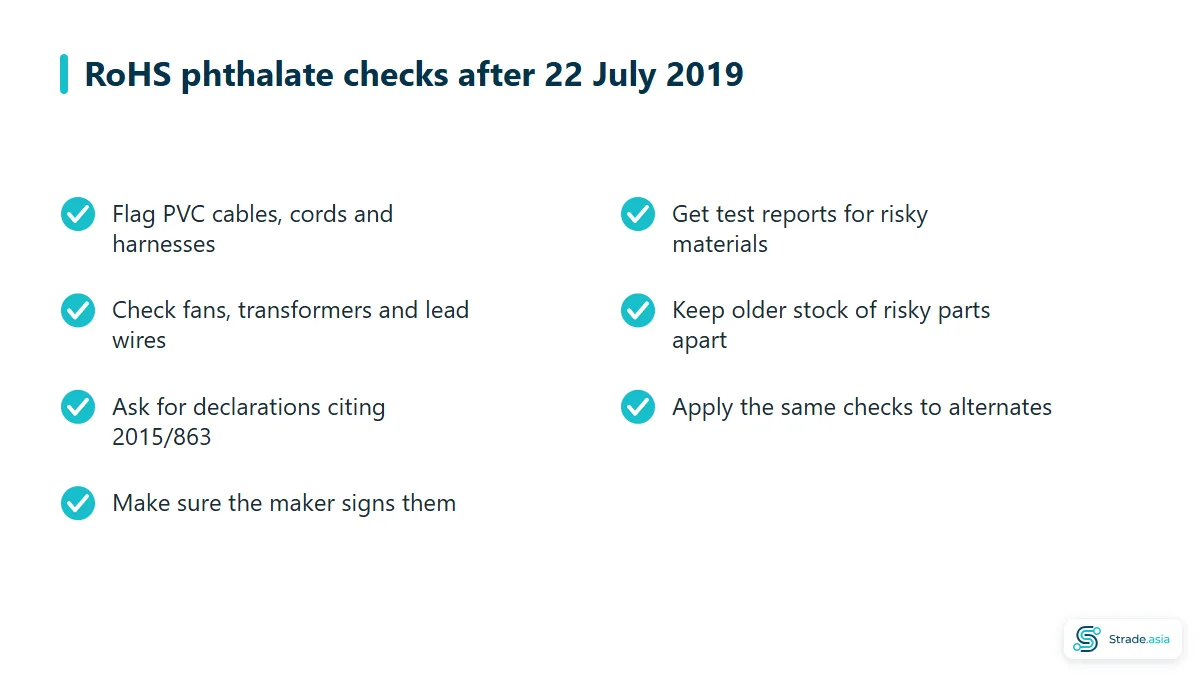
Flexible PVC has traditionally relied on phthalate plasticisers, which is why cables, cords and harnesses carry the most risk. Phthalate-free PVC compounds are widely available, but a change of plasticiser can affect flexibility in the cold, flame performance and long-term ageing. If a cable supplier changed its compound to comply, ask whether safety approvals were updated for the new material and whether the change was formally notified to you.
Old stock and spare parts
Parts made before 22 July are not automatically exempt: what counts is when the finished equipment is placed on the EU market. There is a carve-out for cables and spare parts used to repair, reuse or upgrade equipment placed on the market before that date; check the exact wording before relying on it. Review stock of cables, harnesses and wired parts. Where a supplier changed the material without changing the part number, ask from which lot or date code the change applies, and keep compliant and unconfirmed stock clearly separated. Our article on excess component inventory covers options for stock that can no longer go into EU-bound products.
Update supplier files
Treat this as a change to your approval records:
- flag each high-risk part on your BOMs;
- request updated declarations and, where needed, test reports;
- record the date and version of each document;
- check every new alternate against the same requirement, as described in qualifying second sources.
Customers in Europe will increasingly ask for this evidence with each new product approval, so a complete file now saves time later.
How Strade can help
Strade is an independent electronic component distributor with its own engineers, supplying factories in Vietnam and across Asia. We source from manufacturers, their distributors and vetted open-market suppliers, and inspect every lot on receipt: part number, labels, date code, packaging and appearance. CoC, C/O and CQ documents travel with the goods when the source issues them. When a part cannot meet the requirement, our engineers can propose an alternate with matching specifications for your team to decide on.
When you send an RFQ for EU-bound products, tell us so that compliance documents can be requested from the source. Send us your BOM.