한국어
 Bahasa Indonesia
 ไทย
 中文 (中国)
 Tiếng Việt
A reel of ICs can pass incoming inspection, sit on a shelf for a few weeks, go through reflow and still fail, sometimes months later in the field. One common cause is moisture. Plastic packages absorb water vapour from the air. During reflow the trapped moisture turns to steam within seconds, and the pressure can separate the mould compound from the die or lead frame, or crack the package. In severe cases the package bulges or cracks with an audible pop, which is why the effect is called “popcorning”. In milder cases the damage is invisible, and the part passes functional test only to fail later. That is why moisture-sensitive components carry a moisture sensitivity level (MSL), which sets how they are stored, how long they may stay out of the bag and when they must be baked.
Lead-free soldering made the problem more important, because it needs higher reflow temperatures. In a humid climate like Vietnam’s, with many production floors that are not fully air-conditioned, it deserves daily attention.
Two standards
Moisture sensitivity is handled by two joint IPC/JEDEC standards:
- J-STD-020 sets how a maker classifies a part: samples are soaked in controlled humidity, run through reflow and checked for damage, and the part is given a moisture sensitivity level (MSL).
- J-STD-033 sets how classified parts are packed, shipped, stored, used and, when needed, baked.
The levels
The MSL tells you how long a part can stay out of its dry pack, on the factory floor, before it must be soldered. This is its floor life.
| Level | Floor life out of the bag | Floor conditions |
|---|---|---|
| 1 | Unlimited | ≤30 °C / 85% RH |
| 2 | 1 year | ≤30 °C / 60% RH |
| 2a | 4 weeks | ≤30 °C / 60% RH |
| 3 | 168 hours | ≤30 °C / 60% RH |
| 4 | 72 hours | ≤30 °C / 60% RH |
| 5 | 48 hours | ≤30 °C / 60% RH |
| 5a | 24 hours | ≤30 °C / 60% RH |
| 6 | Bake before use, then the time on the label | ≤30 °C / 60% RH |
Two details are often missed. First, the level is tied to the peak reflow temperature at which the part was classified, and that temperature is printed on the moisture label. A part classified for a lower peak may need different handling in a lead-free process. Second, the floor lives assume the conditions shown. A warmer or more humid floor shortens them, and J-STD-033 gives tables for other conditions.
The dry pack
Parts rated MSL 2 to 5a must ship in a dry pack: a heat-sealed moisture barrier bag containing desiccant and a humidity indicator card (HIC). For MSL 6, dry packing is optional because the parts must be baked before use in any case, but the caution label is still required. A caution label on the bag shows the level, the floor life, the peak reflow temperature and the bag seal date, and states how long the sealed bag can be stored.
Handling, step by step
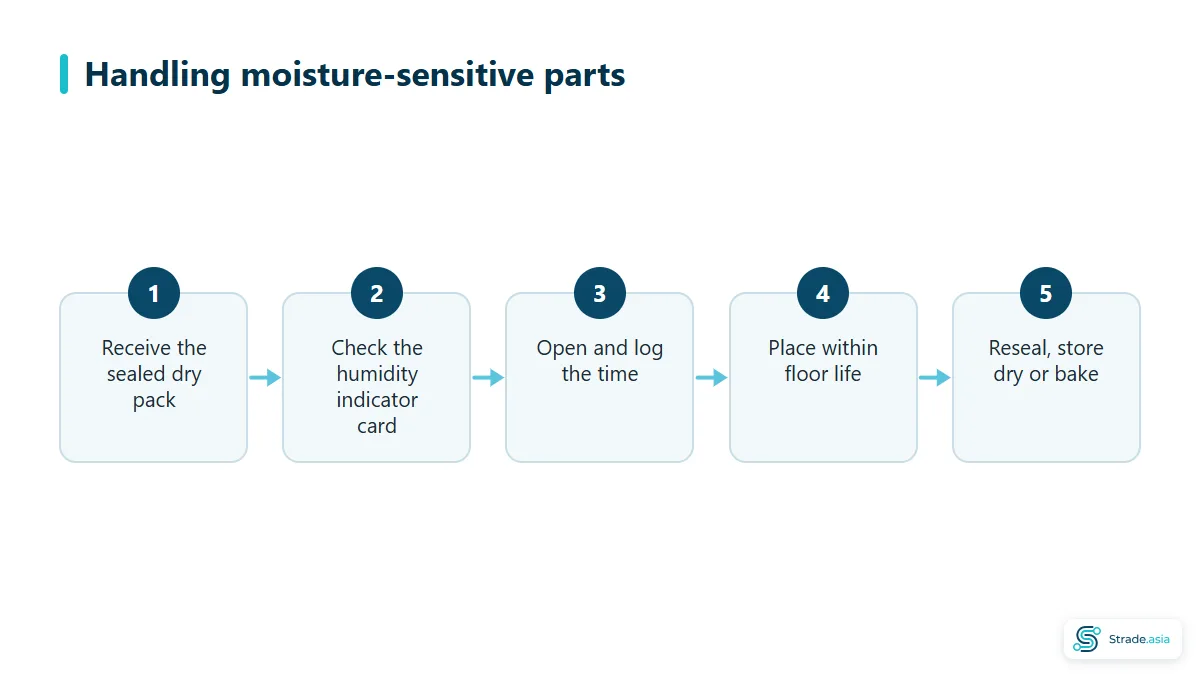
- Receive the sealed dry pack. Check that the bag is intact, with no punctures or open seals, and check the seal date against the shelf life on the caution label. Cut tape or split reels that arrive outside the original dry pack need extra care, and may need baking before assembly. Inspect labels and quantities without opening the bag where you can.
- Check the humidity indicator card. Read the card as soon as the bag is opened. Read the spot named for that level on the card or on the bag’s moisture caution label; if that spot has changed colour, the parts must be baked before use.
- Open and log the time. Record the date and time of opening on the reel or tray label, with the MSL. Each reel needs its own record, especially when reels are split for kits.
- Place within floor life. Plan kitting so that moisture-sensitive reels reach the line close to when they are needed.
- Reseal, store dry or bake. Parts not used in time can be resealed in a barrier bag with fresh desiccant and a new HIC, or kept in a dry cabinet. J-STD-033 sets when dry storage pauses or resets the floor-life clock; follow its rules rather than guessing. Parts past their floor life must be baked.
Baking
Baking drives the moisture out, but it has costs:
- Packaging limits. Only trays rated for high temperature can go into a hot oven. Tape and reel and most tubes cannot, so those parts need a low-temperature bake, which takes far longer.
- Solderability. Baking oxidises leads and grows intermetallic layers, which can reduce solderability. Repeated bakes add up, so baking should not become the routine fix for poor handling.
Common mistakes
- Opening every dry pack at receiving to count parts, then storing the reels open.
- Treating all parts as level 1. Most passives are, but many ICs, LEDs and modules are not; check every new part number.
- Losing track of time when reels move between stores, kitting and the line.
- Ignoring change notices. When a part moves to a new assembly site, its MSL can change, one of the quieter effects of the semiconductor mergers we wrote about in January.
- Checking labels on some goods but not others. The desk that checks the efficiency mark on Level VI external power supplies should check the moisture label on every dry pack too.
How Strade can help
Strade is an independent electronic component distributor with its own engineers, supplying factories in Vietnam and across Asia. Every lot is inspected on receipt, and moisture-sensitive parts are kept and shipped in dry packs according to their MSL, in antistatic packaging. Read more about why factories work with Strade.
To source moisture-sensitive ICs, LEDs or modules for your next build, send us your BOM.