한국어
 Bahasa Indonesia
 ไทย
 中文 (中国)
 Tiếng Việt
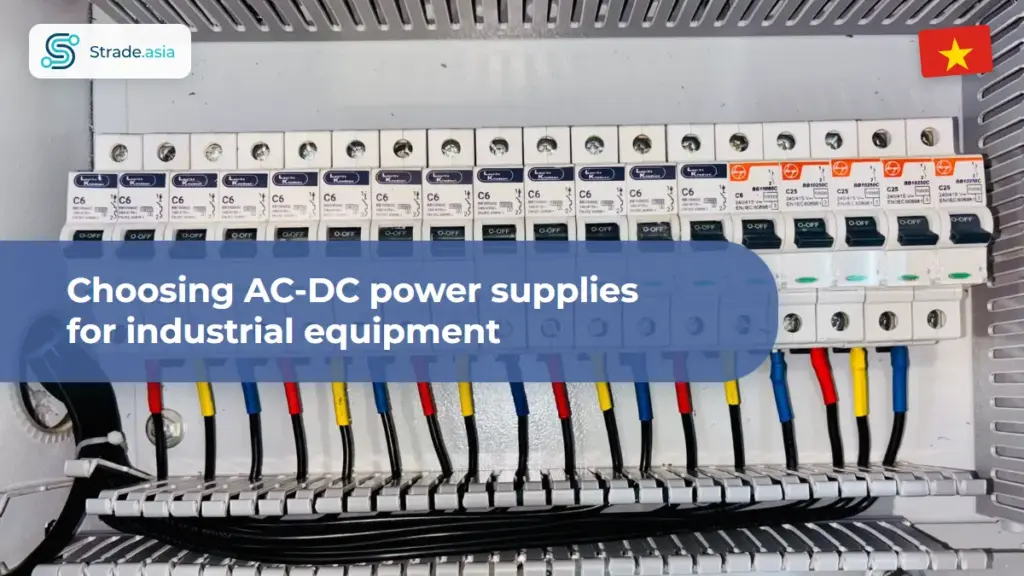
An AC-DC power supply is the part nobody thinks about until it fails: the whole control panel goes dark, the machine stops, and the fault is often hard to find. Two units labelled “24 V, 240 W” can behave very differently in a hot sealed cabinet, on a motor load, or running three shifts a day. This article lists the questions buyers and engineers should ask a supplier before choosing a part number.
1. Mounting
- DIN rail: the usual choice in control panels; quick to fit and tidy to wire.
- Enclosed or open frame: used inside machines, instruments and packaging equipment; open-frame units need airflow and proper guarding.
- Board-mounted modules: for small, low-power devices.
Ask for dimensions, the fixing method, the terminal type (screw or spring) and the clearance needed around the unit for cooling.
2. Input voltage
Check that the input range covers the factory supply, including sags and surges. A single-phase universal-input unit works in many countries; higher power may call for a three-phase model. Ask about surge immunity, ride-through during short dips, and whether the unit has power factor correction (PFC), since harmonic current limits apply to equipment above a certain power.
3. Output voltage, power and peak load
- Output voltage and adjustment range: 24 V is the common level for industrial control; ask whether it can be trimmed to compensate for voltage drop on long cables.
- Continuous power against the real load: leave headroom instead of running the unit at its rating all day.
- Peak power: motors, solenoid valves, large capacitors and lamps draw high current for a short time at start-up. Some supplies allow short overloads; others do not.
- Ripple and noise: if the supply feeds sensors, analog inputs or measurement circuits, ask for the output ripple and noise figures and the conditions they were measured under.
4. Derating for temperature and altitude
This is the most often missed point. The power on the label usually applies only up to a certain ambient temperature; above it, the supply must be derated according to the curve in the datasheet. A sealed cabinet next to an oven, a compressor or in direct sun can run far hotter than the room. Ask for the derating curve against temperature, mounting orientation and, for factories at altitude, height above sea level.
5. Inrush current and protection coordination
When power is applied, the input capacitors charge and draw a large inrush current. If several supplies switch on together, the upstream circuit breaker may trip. Ask for the inrush value and the recommended breaker or fuse.
6. Protection features
- Overcurrent and short circuit: does the unit go into hiccup mode or hold a constant current? Heavy start-up loads usually need constant current.
- Output overvoltage and overtemperature protection.
- A DC OK relay contact or signal so the PLC can monitor the supply.
- Parallel or redundant operation, if the system must not stop.
7. Safety and EMC approvals
Depending on the market and the type of equipment, a machine builder may need supplies approved to standards such as IEC/UL 62368-1, IEC 61010-1 for measurement and control equipment, or UL 508 for industrial control equipment, plus emission standards such as EN 55032 and harmonic limits such as IEC 61000-3-2. Ask for exactly the approvals your market requires, and for current certificates that cover the exact part number.
8. Environment and lifetime
Ask for the operating temperature range, humidity rating, vibration resistance, whether a conformal coating is available for dusty or humid sites, the lifetime of the electrolytic capacitors at your real operating temperature, and the manufacturer’s warranty period.
9. Documents
Ask for the current datasheet revision, the installation manual, the safety certificates and, for exported equipment, a certificate of origin for the actual shipment.
How Strade helps
Power products are Strade’s lead product group, covering AC-DC power supplies, DC-DC converters, batteries and chargers, and power management parts. For projects and contractors building panels, when the specified brand is hard to buy, our engineers propose equivalents for you to submit for approval. For machine builders and other manufacturers, send the BOM for production quantities and get a quotation for each line. Every lot is inspected before it ships, as described on why Strade.
Need power supplies for a panel or a machine about to ship? Send a request for quotation with the voltage, power and approvals you need.