한국어
 Bahasa Indonesia
 ไทย
 中文 (中国)
 Tiếng Việt
A year ago, multilayer ceramic capacitors (MLCCs) were the easiest parts on most BOMs to buy. They cost very little, every distributor held stock, and few buyers planned for them. That has changed. Since the second half of 2017, a widening MLCC shortage has stretched lead times for many parts from weeks to months, some makers have put parts on allocation, and open-market prices for common values have risen sharply. For factories in Vietnam that build power supplies, controllers and consumer products, a missing capacitor can stop a line as surely as a missing processor.
Why the MLCC shortage is happening
Several forces are at work at the same time:
- More capacitors per product. Each new generation of smartphones uses more MLCCs than the last, and cars use more as their electronic content grows, from engine control and safety systems to infotainment and electric drives.
- Makers favour small, high-value parts. The leading makers in Japan, Korea and Taiwan have been moving capacity toward very small case sizes and automotive grades, where demand and margins are strongest. General-purpose parts and larger case sizes have lost capacity, and some series have been discontinued.
- Capacity is slow to add. New powder, stacking and firing lines take time to build and qualify, and makers were cautious about expanding after years of low prices.
- Double ordering. As lead times grow, buyers order further ahead and from several sources at once. That makes demand look larger than it is, and lead times stretch further.
We first noted the change in MLCC lead times start to stretch. Since then the shortage has spread from a few series to a wide range of values, voltages and case sizes.
What buyers can do now
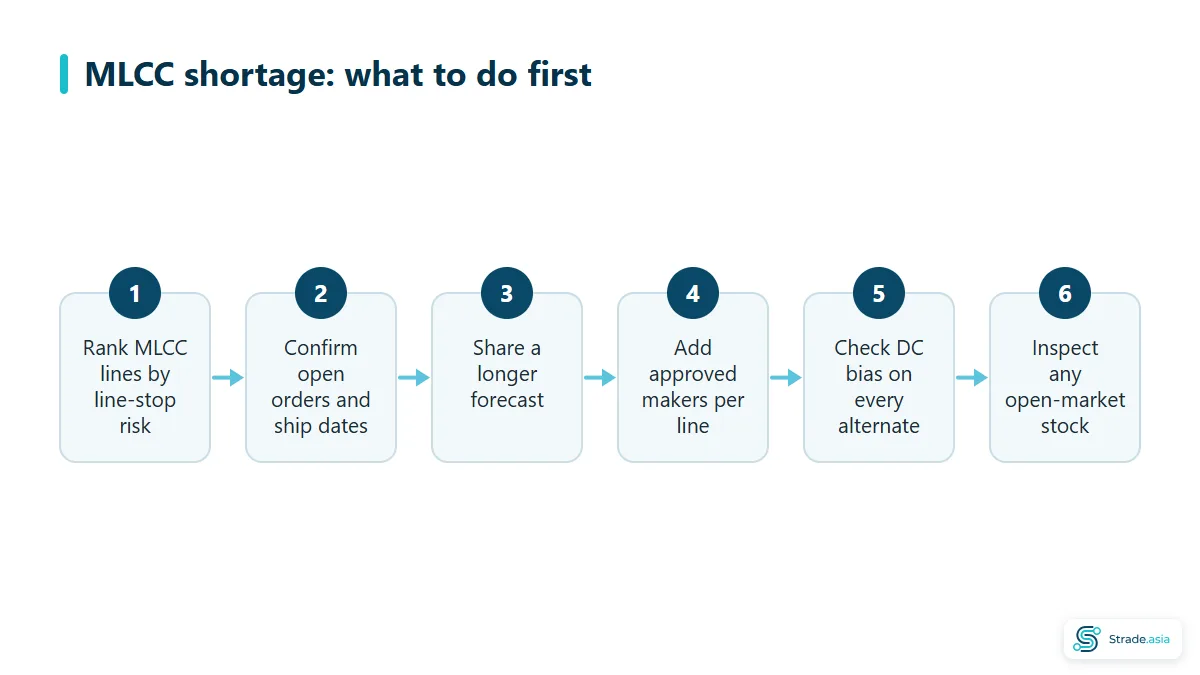
- Rank your MLCC lines by risk. Go through each BOM and mark the capacitors that would stop a line. High-capacitance values, high-voltage parts, larger case sizes such as 0805, 1206 and 1210, and automotive grades are among the most exposed.
- Confirm every open order. Ask each supplier for a confirmed ship date and price on every line, in writing, and check what will ship before the Lunar New Year holiday. An order acknowledged months ago is not a promise of delivery or price today.
- Give a longer forecast. Share your expected usage for the next two quarters or more. Makers and distributors on allocation serve first the customers whose demand they can see.
- Widen the approved list. Many MLCCs are industry standard: the same capacitance, voltage, dielectric and case size are made by several manufacturers. Adding a second or third approved maker per line is often the fastest route to more supply. Our guide to approved manufacturer lists explains how to qualify one.
- Check DC bias on every alternate. Class II ceramics such as X7R and X5R lose capacitance as DC voltage is applied, and the loss differs between makers, case sizes and voltage ratings. An alternate with the same nominal value can deliver much less capacitance in your circuit. Ask engineering to compare the makers’ DC bias curves at the real operating voltage before approving.
- Be careful with unknown sources. When franchised stock runs out, offers arrive from brokers. Some are genuine; some are old, poorly stored or relabelled. Buy only from sources you have vetted, and inspect every lot: labels, date codes, reel packaging and, for critical parts, capacitance measured on samples.
Engineering can help too
Designers can reduce exposure, both now and in new products. Use common values and case sizes where possible, and avoid specifying the smallest case or the highest capacitance unless the design needs it. Where a capacitor sits on a regulator output, a higher voltage rating, or one case size up where the pads allow, may give more effective capacitance and open up more sources, as long as the larger size is not itself one of the scarce ones. In some positions a tantalum or polymer capacitor may be an option, but that needs a full review of ESR, voltage derating and regulator stability, not just a matching value.
Plan for a long squeeze
No one can say yet when supply will catch up with demand. New capacity takes time to come on line, and demand from phones and cars is still growing. As we suggested in planning 2018 component purchases, passives deserve the same planning this year as memory and semiconductors: forecasts, framework orders where possible, and buffer stock for the few parts that would stop a line.
How Strade can help
Strade is an independent electronic component distributor with its own engineers, supplying passive components, semiconductors, connectors and power products to factories in Vietnam and across Asia. We source from manufacturers, their distributors and vetted open-market suppliers, and we inspect every lot on receipt, checking part number, labels, date code, packaging and appearance. When an MLCC is short, our engineers can propose alternates with matching specifications for your team to approve.
Send us your BOM or a list of the MLCCs you are struggling to buy, and we will check availability and alternates.