
 한국어
 Bahasa Indonesia
 ไทย
 中文 (中国)
 Tiếng Việt
Open almost any switch-mode power supply and you will find aluminium electrolytic capacitors at the input and output. Over the past decade, conductive polymer capacitors have taken over many output positions, especially on low-voltage rails next to processors and in point-of-load converters. Buyers now often see both offered in the same case size and ask whether one can replace the other. Sometimes it can; sometimes the swap creates new problems.
How polymer and liquid electrolytics differ
Both are aluminium electrolytic capacitors, with an etched aluminium anode and a thin oxide dielectric. The difference is the cathode. A conventional capacitor uses a liquid electrolyte soaked into a paper separator; a polymer capacitor uses a solid conductive polymer instead. That one change drives most of the differences:
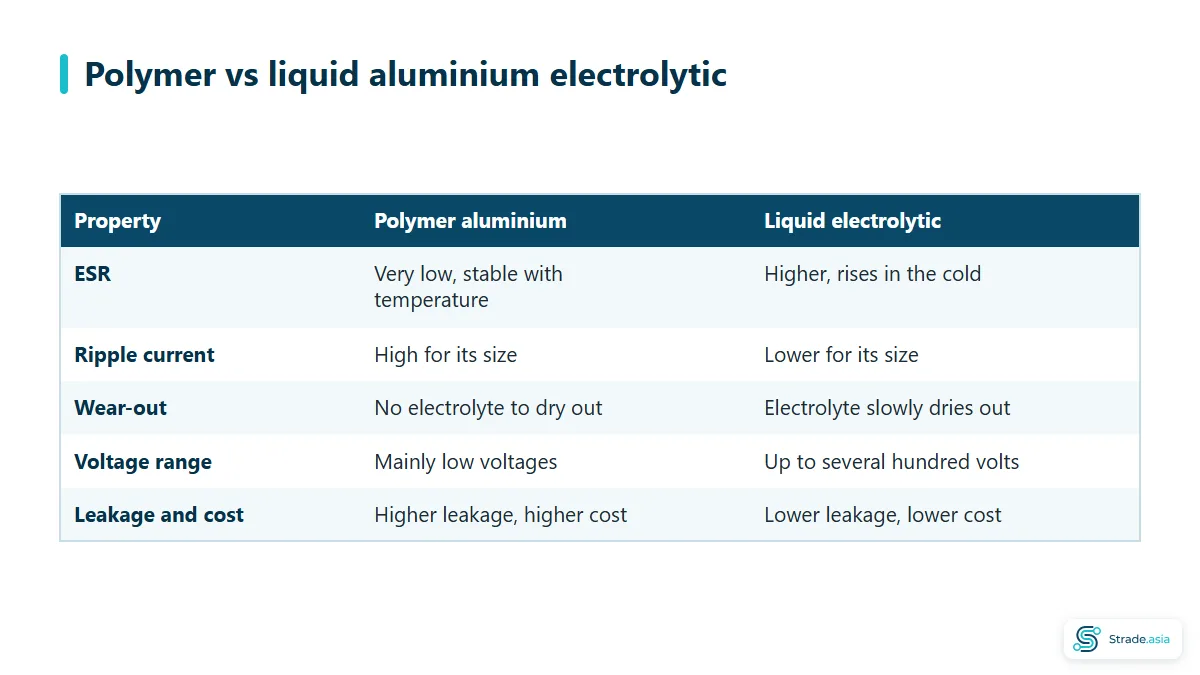
- ESR. The conductive polymer has far lower resistance than a liquid electrolyte, so ESR is much lower. It also stays nearly constant across temperature, while the ESR of a liquid type rises sharply in the cold.
- Ripple current. Lower ESR means less heating for the same ripple current, so a polymer part can carry more ripple for its size.
- Lifetime. A liquid capacitor slowly loses electrolyte through its seal, faster when hot, and its ESR rises as it dries. Manufacturers commonly estimate that its life roughly doubles for every 10 °C drop in temperature, as discussed in our article on capacitor lifetime and temperature. Polymer capacitors have no liquid to lose, and many makers state a stronger gain from cooler operation, often tenfold for every 20 °C. Use the formula each manufacturer publishes rather than one general rule.
- Voltage. Liquid electrolytics cover a wide voltage range, up to the several hundred volts needed for bulk capacitors after a mains rectifier. Polymer types are made mainly for lower voltages.
- Leakage current. Polymer types generally leak more than comparable liquid parts, which matters in battery-powered and standby circuits.
- Cost and availability. For the same capacitance and voltage, polymer parts cost more and often have fewer drop-in second sources than liquid types, so lead times can tighten faster when demand rises.
Where each fits
Polymer capacitors suit low-voltage, high-current outputs: point-of-load converters, processor and FPGA rails, and DC-DC modules where ripple current is high and space is tight. Their low ESR also improves transient response, often allowing fewer capacitors. They are a strong choice in equipment that runs hot, or must start in the cold, where liquid types change most.
Liquid electrolytics remain the normal choice for high-voltage bulk storage after rectification, for hold-up capacitors, and for cost-sensitive positions where ripple is modest. With good thermal design and a long-life, high-temperature series, they give reliable service.
Hybrid capacitors combine a conductive polymer with a small amount of liquid electrolyte. They keep much of the low ESR of polymer types, while the liquid helps repair the oxide layer, giving lower leakage and better tolerance of voltage stress. They are offered at higher voltages than most pure polymer types and are used in automotive and industrial designs.
Before you swap one for the other
A polymer capacitor in a position designed for a liquid type is not always an upgrade:
- Check loop stability. Some regulators, including certain linear regulators and older switching controllers, rely on the output capacitor’s ESR for stability. A much lower ESR can make them oscillate, so check the regulator datasheet for a required ESR range.
- Check inrush current. Lower ESR allows higher inrush at power-on, which can stress switches, fuses and connectors.
- Respect voltage limits. Polymer types tolerate voltage spikes above their rating poorly, and when overstressed they are more likely than liquid types to fail short, which can load a high-current rail. Follow the manufacturer’s derating advice and the absolute maximum ratings.
- Compare leakage. In low-power or battery circuits, the higher leakage may matter.
- Check moisture sensitivity. Many SMD polymer capacitors carry an MSL rating and need dry storage before reflow.
- Test in the circuit. Measure ripple, temperature and transient response on the real board, especially in DC-DC converter designs.
Going the other way, replacing a polymer part with a liquid one to save cost or during a shortage, means more ripple heating, higher ESR in the cold and often a larger or taller case for the same ripple rating. Check the space on the board, the ripple rating and lifetime at the real operating temperature.
How Strade can help
Passive components and power products are both part of the Strade range. As an independent distributor with its own engineers, we compare capacitor series against your operating conditions and propose alternates with matching specifications when a part is short; your team decides. Browse our passive components or send us your BOM for a quote.


