한국어
 Bahasa Indonesia
 ไทย
 中文 (中国)
 Tiếng Việt
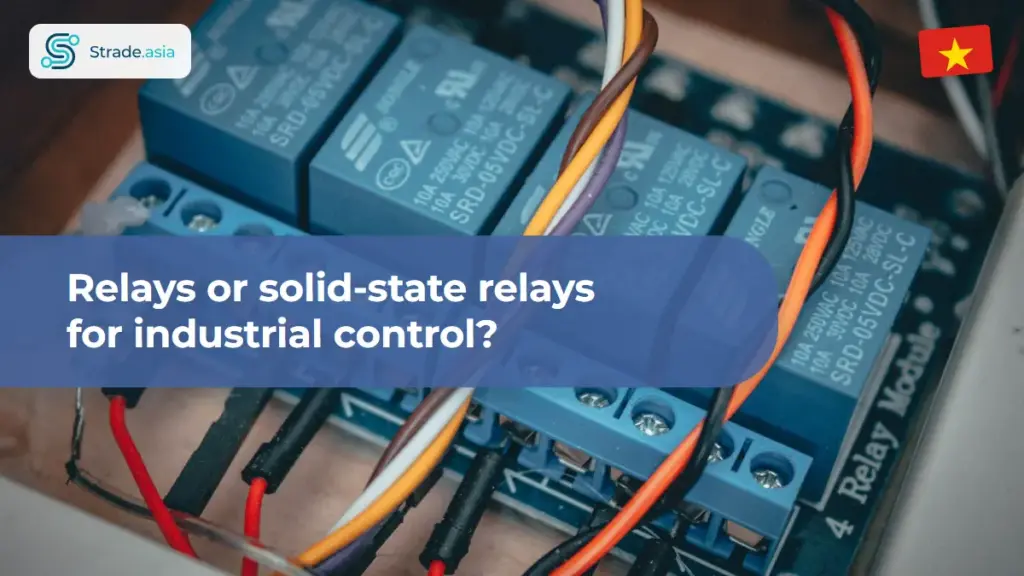
A control panel can switch the same heater, valve or contactor coil with an electromechanical relay or with a solid-state relay (SSR). Both are common and often chosen by habit. But they wear out differently, fail differently and need different protection around them. A wrong choice shows up months later: burnt contacts on a heater relay that cycles every few seconds, or an SSR that leaks enough current to keep a small load half on.
How they differ
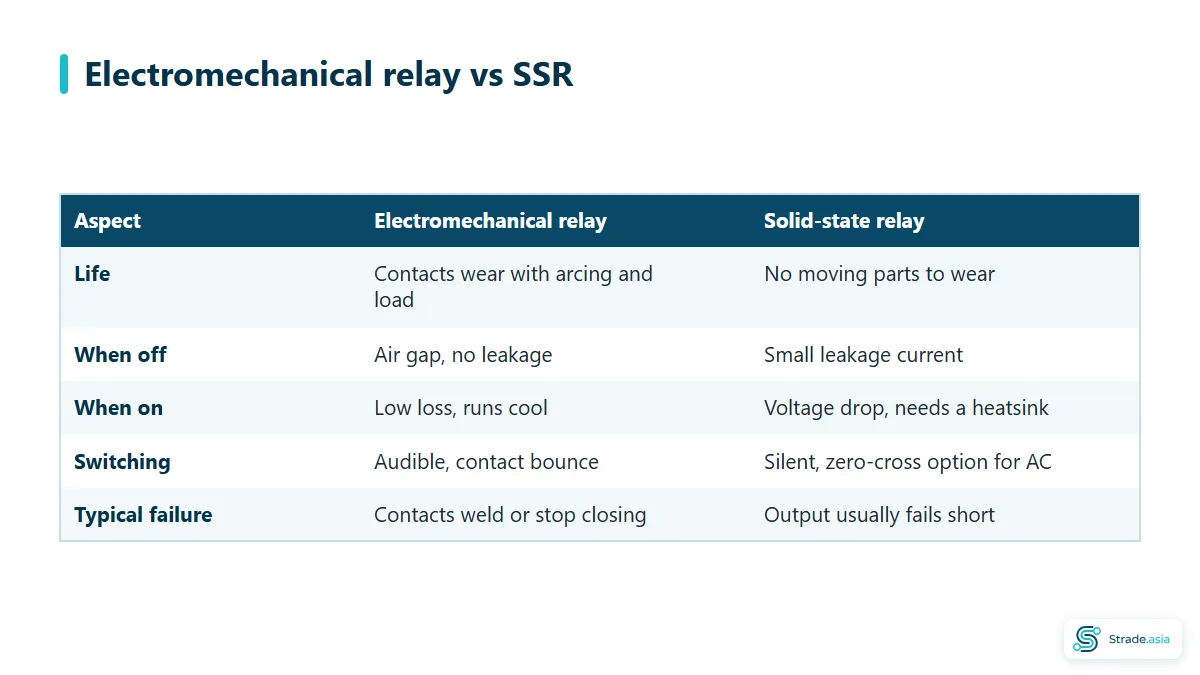
An electromechanical relay moves physical contacts with a coil. When open, there is an air gap and no current flows; when closed, contact resistance is low and the relay runs cool. An SSR switches with semiconductors, usually thyristors or a triac for AC loads and MOSFETs for DC loads, driven through an optocoupler. It has no moving parts, switches silently and can switch very often, but it always drops some voltage when on and leaks a little current when off.
Contact life and switching rate
A relay’s mechanical life without load is far higher than its electrical life at rated load, often by two orders of magnitude. Electrical life falls further with inductive loads, lamps and high inrush, because each opening draws an arc that erodes the contacts. A relay switching a heater every few seconds can use up its electrical life quickly, which is why temperature controllers usually drive heaters through SSRs. For a load switched a few times a day, a relay lasts for years.
Leakage and minimum load
An SSR in its off state passes a small leakage current, mostly through its internal snubber. That is harmless for a heater, but it can keep a small relay coil, an indicator lamp or a PLC input from turning fully off. A bleeder resistor across the load, or a relay, solves it. Relays have the opposite problem: contacts made for power loads may not switch very small signal currents reliably, so low-level signals need relays with gold-plated or twin contacts.
Heat
An AC SSR typically drops around one to one and a half volts when on, so it dissipates roughly a watt or more for every amp of load current. That heat needs a heatsink sized from the datasheet’s derating curve, and space in the panel. In a hot, sealed cabinet, derating often decides the design.
Zero-cross or random turn-on
Most AC SSRs for resistive loads switch on near the zero crossing of the voltage, which limits inrush and electrical noise. Random turn-on types switch immediately and suit phase-angle control and some inductive loads. Transformers are a special case: switching on at voltage zero can drive the core into saturation and cause a large inrush, so check the SSR maker’s application notes. AC-output SSRs only turn off at a current zero, so they cannot switch DC; DC loads need a DC-output SSR or a relay rated for DC breaking.
Inductive loads and coil suppression
Contactor coils, solenoids and motors store energy that must go somewhere when the current stops:
- DC relay and contactor coils: a diode across the coil absorbs the spike that would otherwise damage the transistor or PLC output driving it. A plain diode slows the release, which shortens the life of that relay’s own contacts; a diode with a Zener or a TVS diode releases faster. See our article on TVS diodes and surge protection.
- AC coils: an RC snubber or a varistor across the coil.
- Contacts switching inductive loads: an RC snubber or varistor across the contacts reduces arcing.
- SSRs on inductive loads: check the surge current and dv/dt ratings, and fit a varistor where the datasheet recommends one.
A DC SSR is a MOSFET switch in a package, so the same rules on voltage margin and on-resistance apply as in MOSFET selection basics.
Failure modes and safety
Relays usually fail with contacts that weld after heavy inrush, or wear until they no longer close reliably. SSRs most often fail short, leaving the load on. Neither should be the only means of switching off a load for safety; use contactors and safety relays designed for that function. Protect SSRs with fuses fast enough for their semiconductors, which a short circuit can destroy before a standard fuse opens. Our article on choosing a fuse for power circuits explains the ratings.
A quick guide
- Frequent switching of resistive heaters: zero-cross SSR on a heatsink.
- Occasional switching, mixed loads, or a need for a true air gap when off: relay.
- Very small signal loads: relay with gold contacts, or a signal-level solid-state switch.
What to put on the order
- The full part number, including coil voltage, contact form and material, or SSR input and output ranges.
- Load type and current, including inrush.
- The approvals your market needs, for example IEC 61810-1 for relays, IEC 62314 for SSRs, or UL recognition.
How Strade helps
Strade is an independent component distributor with its own engineers, supplying relays, SSRs and the parts around them to factories and machine builders in Vietnam and across Asia. When a specified relay is hard to buy, our engineers compare coil, contact and load ratings and propose alternates for the customer to approve. See how we work with factories and manufacturers.
Building panels or machines? Send a request for quotation with the part numbers and quantities you need.