한국어
 Bahasa Indonesia
 ไทย
 中文 (中国)
 Tiếng Việt
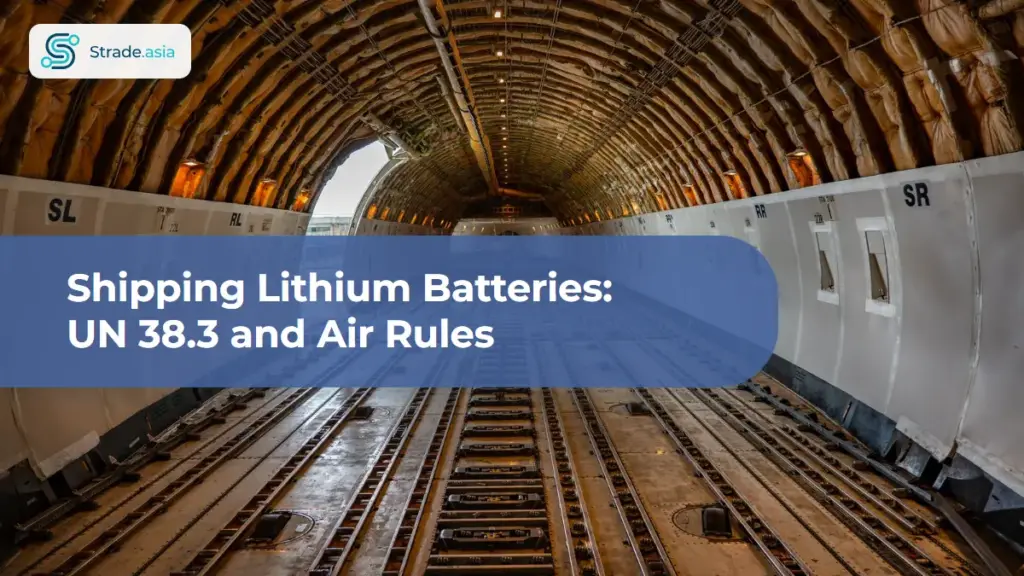
Air shipments of lithium cells and batteries face strict checks at Asian cargo hubs. Under the UN Manual of Tests and Criteria and the IATA Dangerous Goods Regulations (DGR), missing UN 38.3 paperwork, the wrong packing instruction, excessive charge, or outdated labels can hold cargo at origin airports, add repacking fees, and delay factory lines. Buyers in Vietnam and across Asia also face two firm dates: the transition period for the old lithium battery labels ends on 31 December 2018, and the UN 38.3 test summary requirement applies from 1 January 2020.
UN 38.3 testing and the upcoming test summary
Every lithium metal or lithium-ion cell and battery type must pass the applicable transport tests under Part III, sub-section 38.3 of the UN Manual of Tests and Criteria. There are eight: altitude simulation (T.1), thermal test (T.2), vibration (T.3), shock (T.4), external short circuit (T.5), impact or crush (T.6), overcharge for rechargeable batteries (T.7), and forced discharge for cells (T.8). Design changes beyond the limits set in the Manual require retesting, making UN 38.3 essential alongside lithium-ion battery safety checks for buyers.
Under the 20th revised edition of the UN Model Regulations and the IATA DGR 60th Edition (effective 1 January 2019), manufacturers and subsequent distributors of cells and batteries made after 30 June 2003 must make available the test summary defined in paragraph 38.3.5 of the Manual from 1 January 2020. The summary records the maker, test lab, report ID, ratings, and passed tests. Many airlines and forwarders already ask for UN 38.3 proof before confirming cargo space.
IATA DGR packing instructions 965-970
IATA DGR assigns six packing instructions by chemistry and how the batteries are packed:
| PI | UN Number | Chemistry and Packing | Aircraft |
|---|---|---|---|
| — | — | — | — |
| PI 965 | UN 3480 | Lithium-ion, standalone | Cargo Aircraft Only |
| PI 966 | UN 3481 | Lithium-ion, packed with equipment | Passenger and Cargo |
| PI 967 | UN 3481 | Lithium-ion, contained in equipment | Passenger and Cargo |
| PI 968 | UN 3090 | Lithium metal, standalone | Cargo Aircraft Only |
| PI 969 | UN 3091 | Lithium metal, packed with equipment | Passenger and Cargo |
| PI 970 | UN 3091 | Lithium metal, contained in equipment | Passenger and Cargo |
Each instruction splits into sections by energy or lithium content: PI 965 and PI 968 use Sections IA, IB and II, while PI 966, 967, 969 and 970 use Sections I and II. Small lithium-ion cells (up to 20 Wh) and batteries (up to 100 Wh), or lithium metal cells (up to 1 g) and batteries (up to 2 g), can qualify for Section II with simpler paperwork. Standalone Section II shipments under PI 965 and PI 968 are limited to one package per consignment, so factory production lots typically move under Section IB or IA as Class 9 dangerous goods on freighters, tightening capacity and raising landed cost.
State of charge, labels and shipping documents
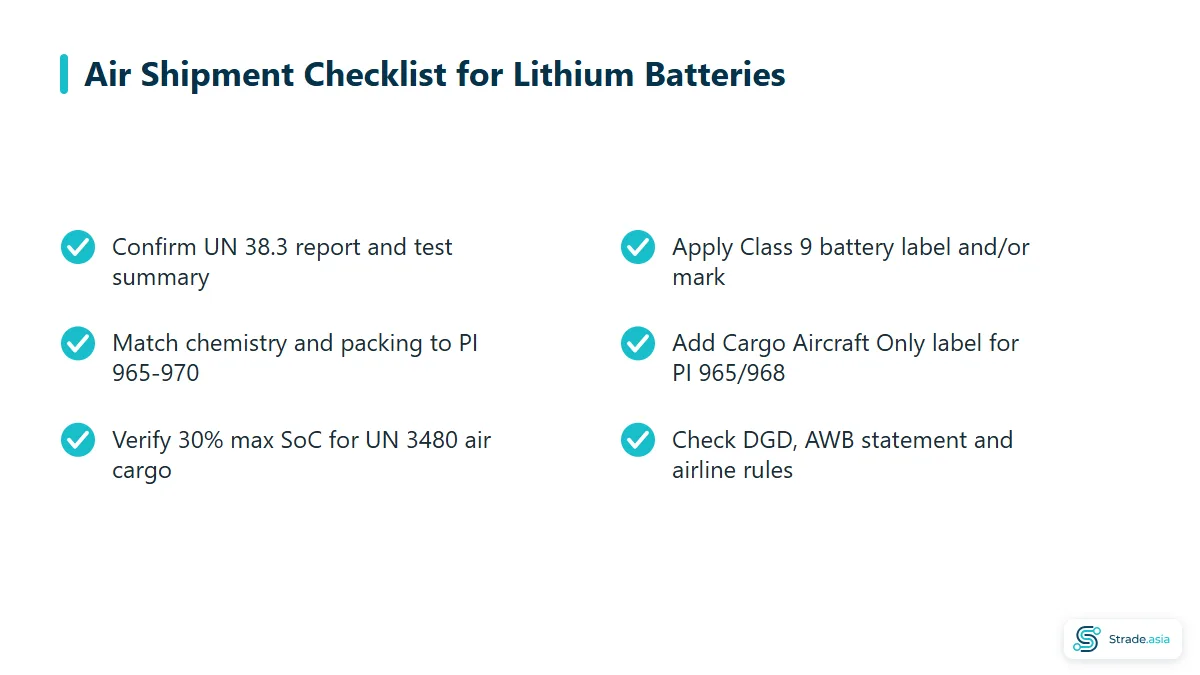
Since April 2016, standalone lithium-ion cells and batteries shipped under PI 965 (Sections IA, IB, and II) must travel at a 30% maximum state of charge (SoC) of rated capacity unless origin and operator states approve otherwise. Confirming this limit before dispatch prevents terminal holds on urgent orders. On receipt, check the date codes on cells and packs too, since lithium cells slowly lose charge and capacity in storage.
Label rules tighten on 1 January 2019: the two-year transition that began when the new label and mark were introduced on 1 January 2017 ends on 31 December 2018. Fully regulated packages (Sections I, IA and IB) must then display the Class 9 Lithium Battery hazard label with the battery graphic instead of the generic Class 9 label, and Section IB packages carry the Lithium Battery Mark as well. Packages needing a battery mark must use the standardized Lithium Battery Mark showing the UN number and a phone number, which replaces the old lithium battery handling label, and standalone PI 965 and PI 968 cartons also require the Cargo Aircraft Only label.
Shipping documents must match the cartons. Fully regulated lots (Sections I, IA and IB) require a Shipper’s Declaration for Dangerous Goods (DGD) signed by trained staff, while Section II shipments generally need a compliance statement on the Air Waybill (AWB). Asian forwarders also commonly require a Safety Data Sheet (SDS) and UN 38.3 proof. Agreeing on export clearance duties under Incoterms 2010 for component imports avoids repacking disputes, and warehouse teams should verify markings when reading component labels at goods receipt.
Buyer checklist before booking air freight
- Request UN 38.3 reports now and confirm when suppliers will provide test summaries ahead of January 2020.
- Confirm UN number, watt-hour rating or lithium content, packing instruction (PI 965-970) and the outer packaging the section requires, such as UN specification packaging for Section IA, before quoting air freight.
- Write the 30% maximum SoC rule for UN 3480 air shipments into purchase order packing instructions.
- Verify that suppliers switch to the Class 9 Lithium Battery label and Lithium Battery Mark by 1 January 2019.
- Check airline operator variations with your forwarder early, and route bulk standalone stock by sea when lead times allow.
Sourcing with receiving checks and customs support
Strade Asia is an independent distributor of electronic components with its own engineers, supplying factories in Vietnam and across Asia with power products, semiconductors, passive components, connectors, and other categories. Every lot is checked on receipt for part number, label, date code, packaging, and visual condition, with CoC, C/O, and CQ accompanying goods when provided by the source, and DDP or DAP delivery arranged with customs documents prepared through our component supply chain services. Send your BOM or line items via our request for quotation page to check sourcing options.