한국어
 Bahasa Indonesia
 ไทย
 中文 (中国)
 Tiếng Việt
Every switching power supply is a noise source. Its transistors switch high voltages at high frequency with fast edges, and without a filter part of that energy flows back into the mains wiring. There it can disturb other equipment, and a product that fails conducted emission limits cannot be placed on the market. For buyers and engineers, the input filter is where several small but critical parts meet: common-mode chokes, X and Y capacitors and, in many products, a complete filter module.
Two kinds of noise
Conducted noise on the mains takes two forms.
- Differential-mode noise flows out on one conductor and back on the other, like the supply current itself. It comes mainly from the pulsed input current of the converter.
- Common-mode noise flows in the same direction on both line and neutral and returns through earth. It is driven by fast voltage changes at the switching node, coupling through stray capacitance to the chassis and earth, for example between a transistor and its heatsink or across the transformer.
A filter must deal with both, and the parts for each are different.
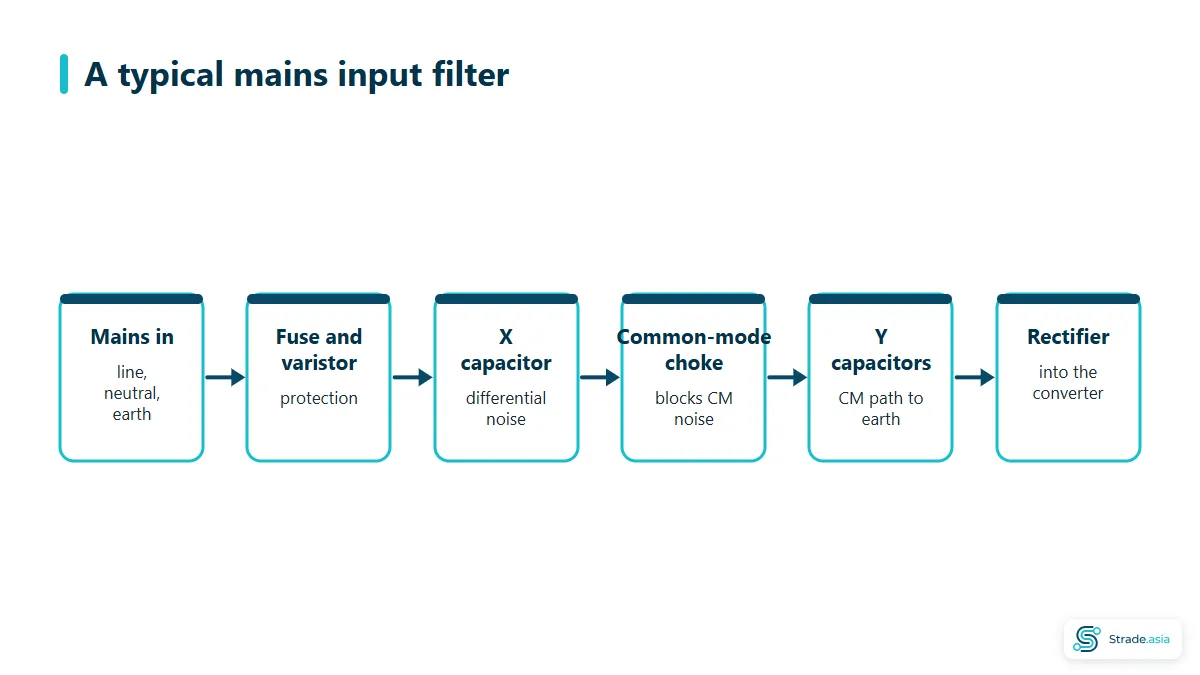
The parts of an input filter
Common-mode chokes
A common-mode choke has two windings on one core, arranged so that the supply current in line and neutral produces opposing flux that cancels. The choke therefore presents little impedance to the supply current and does not saturate, while common-mode noise, flowing the same way in both windings, sees a high impedance. When choosing one, check:
- Rated current and temperature rise at the highest input current, which occurs at the lowest mains voltage and full load.
- Impedance across frequency. Nominal inductance does not tell the whole story; winding capacitance limits performance at higher frequencies.
- DC resistance, which sets losses and heating.
- Core material. High-permeability ferrites give high inductance at lower frequencies, while nanocrystalline cores perform over a wider range.
- Leakage inductance, which also helps to filter differential noise.
- Insulation and safety approvals, since the choke sits on the mains side.
X capacitors
X capacitors connect between line and neutral and short differential noise. They must be safety-rated, class X1 or X2, because they are exposed to mains surges. Since an X capacitor can hold a charge after the plug is pulled, a bleeder resistor or discharge circuit is usually needed to bring the voltage at the plug pins down quickly.
Y capacitors
Y capacitors connect from line and neutral to earth and give common-mode noise a short path back to its source. They are safety-critical: a Y capacitor that failed short could make the chassis live, so only certified class Y1 (double or reinforced insulation) or Y2 (basic or supplementary insulation) parts may be used, according to the insulation required. Their value is also limited, because they pass a small leakage current to earth and safety standards cap the touch current. Medical equipment has much lower limits than IT or industrial equipment.
Filter modules
Where space or design time is short, a ready-made module or a filtered IEC inlet combines choke and capacitors in a shielded case. Compare rated current and voltage, leakage current, safety approvals and insertion loss curves. Insertion loss is usually measured in a 50 Ω system, which is not the real impedance of your converter or the mains, so treat the curves as a guide and confirm by measurement. Many DC-DC converter modules also call for an external filter to meet emission limits.
The standards
In Europe, multimedia equipment is tested to EN 55032, which replaced EN 55022 under the EMC Directive in 2017. Conducted emissions are measured through a line impedance stabilisation network from 150 kHz to 30 MHz, with Class B limits for residential environments and less strict Class A limits for others. Other product families and markets use other rules, such as EN 55011 for industrial, scientific and medical equipment and FCC Part 15 in the United States. Confirm which standard applies to the end product in each target market, and which safety approvals the X and Y capacitors need there, before designing or buying a filter.
Buying tips
- Specify chokes by maker part number or full drawing. A “similar” choke with the same nominal inductance can perform differently.
- Treat X and Y capacitors as safety parts: keep the certified series, change only with engineering approval and an update to the product’s safety report, and approve a second certified maker on your approved manufacturer list before you need one.
- Check current derating of chokes at your highest ambient temperature.
- When a power supply is close to the limit, small changes, such as a new choke maker or different heatsink grounding, can push it over. Repeat the EMC check after any change.
- Review filtering and protection together; see TVS diodes and surge protection and choosing a fuse.
How Strade can help
Power products are Strade’s main product group, alongside semiconductors, passive components and connectors. Our engineers can propose alternates with matching specifications for chokes, safety capacitors and filter modules for your team to decide on, and every lot is inspected on receipt.
Send us your power supply BOM or filter part numbers, or browse our power products.