한국어
 Bahasa Indonesia
 ไทย
 中文 (中国)
 Tiếng Việt

A component date code tells you when an electronic part completed manufacturing or packaging, most often written as a two-digit year and two-digit calendar week such as 1642 for week 42 of 2016. For buyers and quality engineers in Vietnam and across Asia, reading date codes accurately helps protect solderability, catch remarked or mixed-lot stock at receiving, and prevent rigid age rules from stretching lead times or raising BOM cost.
How to Read Common Date Code Formats
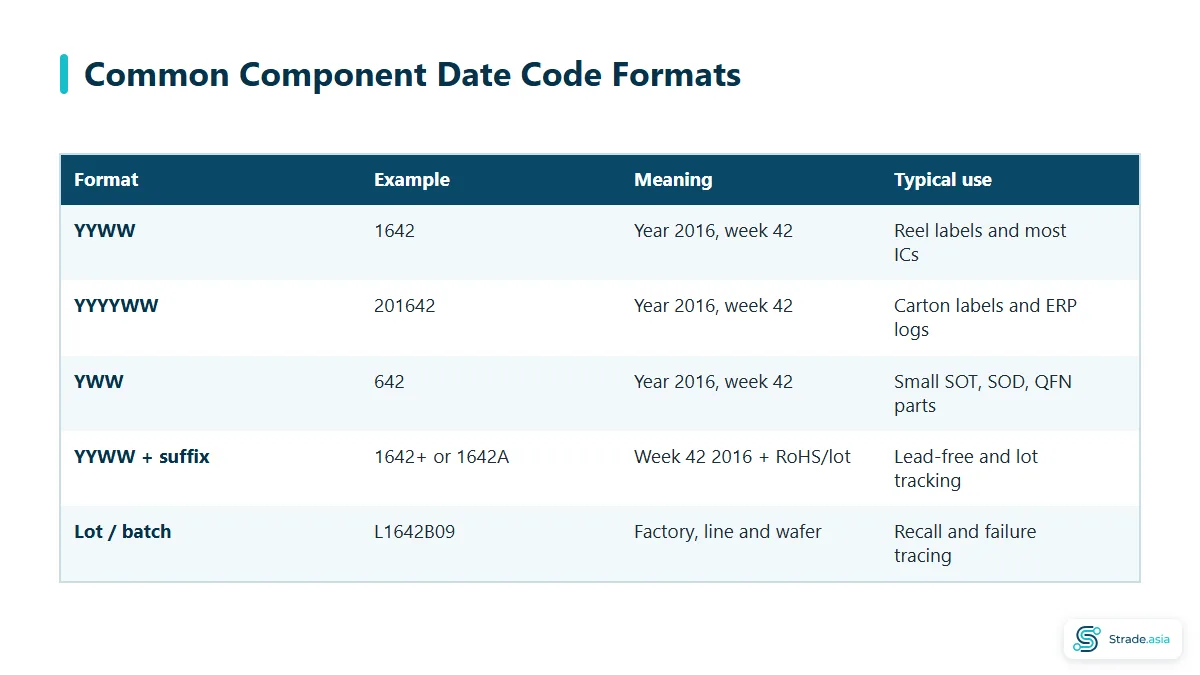
Most manufacturers use a year-and-week scheme, shortening the marking as packages get smaller. Four-digit YYWW codes are the most common on reel labels and IC top markings, while some carton labels and ERP records use six-digit YYYYWW codes to remove decade ambiguity.
On compact packages such as SOT-23, SOD, and small QFN parts, laser-marking space is tight. Manufacturers compress the date into YWW (three digits) or a two-character year-month code. Because a single year digit repeats every decade—642 could mean week 42 of 2016 or 2006—and alphanumeric month letters vary by brand, receiving teams should check small-package markings against the reel label and the manufacturer’s marking guide.
Two related markings also matter at incoming inspection:
- Suffixes and RoHS symbols: Trailing marks such as +, G, or e3 usually indicate lead-free or “green” status, terminal finish, or an assembly site rather than part of the date.
- Lot codes versus date codes: A date code shows when a lot was finished, while the lot code (or batch code) links parts to a specific wafer lot, plant, and line. During a manufacturer quality alert or recall, the lot code—not the date code alone—tells you which reels are affected.
Why Storage Conditions Matter as Much as Age
Old date codes concern production teams mainly because component leads oxidize over time. Oxidized tin or tin-alloy plating wets poorly during reflow or wave soldering, causing open joints, tombstoning, or rework. Some component families are more sensitive than others: aluminum electrolytic capacitors can suffer gradual oxide-layer degradation during long storage, a factor closely tied to electrolytic capacitor lifetime.
Still, the calendar alone is a rough indicator. A component kept in an unopened, factory-sealed moisture barrier bag with intact desiccant and a dry humidity indicator card inside a controlled warehouse often still solders cleanly after long storage. Check the bag’s seal date as well as the component date code, since dry-pack shelf life runs from the seal date. By contrast, a six-month-old reel stored in a hot, humid plant with a punctured bag can absorb moisture and fail reflow. Date code checks therefore belong alongside moisture sensitivity levels (MSL) and packaging controls.
Setting Practical Date Code Limits on Purchase Orders
Many factories put a blanket rule on every purchase order, such as “date code within 12 months only.” Across Asian EMS and OEM supply chains, rigid blanket limits carry real trade-offs.
When allocation tightens or lines require slow-moving, specialized, or end-of-life (EOL) parts, authentic factory-sealed stock held in the channel is often older than a blanket 12-month window allows. Rejecting it automatically pushes buyers back into long factory lead times, forces engineering to qualify alternates mid-build, or drives urgent searches into open-market channels where remarked stock is far more common. Dropping date code limits altogether, however, invites mixed-lot reels, oxidized leads, and remarked parts.
A tiered PO policy works better:
- Set the tightest windows for moisture-sensitive ICs, aluminum electrolytics, and regulated builds such as automotive electronics supply chains where customer audits require strict traceability.
- Allow older factory-sealed lots for passives, connectors, and approved EOL or spot buys when storage seals are intact or sample solderability testing to J-STD-002 confirms lead condition.
What Buyers and Incoming QA Should Do Now
Four straightforward habits strengthen date code control without slowing your receiving dock:
- Replace blanket PO clauses with tiered rules. Agree with quality engineering on separate age windows for active ICs, electrolytics, general passives, and EOL buys so buyers know when to request an exception.
- Check markings at three levels. Inside your ESD-controlled receiving area, compare the outer carton label, the reel or tray label, and the physical top marking on sample parts. Mismatches, inconsistent fonts, or mixed date codes inside one sealed reel that the factory label does not declare are immediate red flags; some manufacturers do combine adjacent date codes on one reel and list them on the label.
- Record lot codes with date codes. Require both on packing lists and Certificates of Conformance (CoCs) so your ERP or MES can isolate affected boards quickly if a field issue arises.
- Set an exception path for older stock. When a tight-supply part falls outside your standard age window, use visual inspection, packaging checks, X-ray, or sample solderability tests instead of rejecting sound stock automatically.
Sourcing With Verified Lot Inspection
As an independent distributor of electronic components serving factories in Vietnam and across Asia, Strade Asia checks every lot on receipt—verifying part numbers, labels, date codes, packaging, and visual condition, with X-ray or sample testing available for sensitive parts or on request. Shipments use anti-static packing and moisture control to the required MSL, with CoC, C/O, and CQ documents when provided by the source, delivered DDP or DAP through our component supply chain service. To check sourcing options or request a quotation, send your BOM or enter line items on our RFQ page.