한국어
 Bahasa Indonesia
 ไทย
 中文 (中国)
 Tiếng Việt
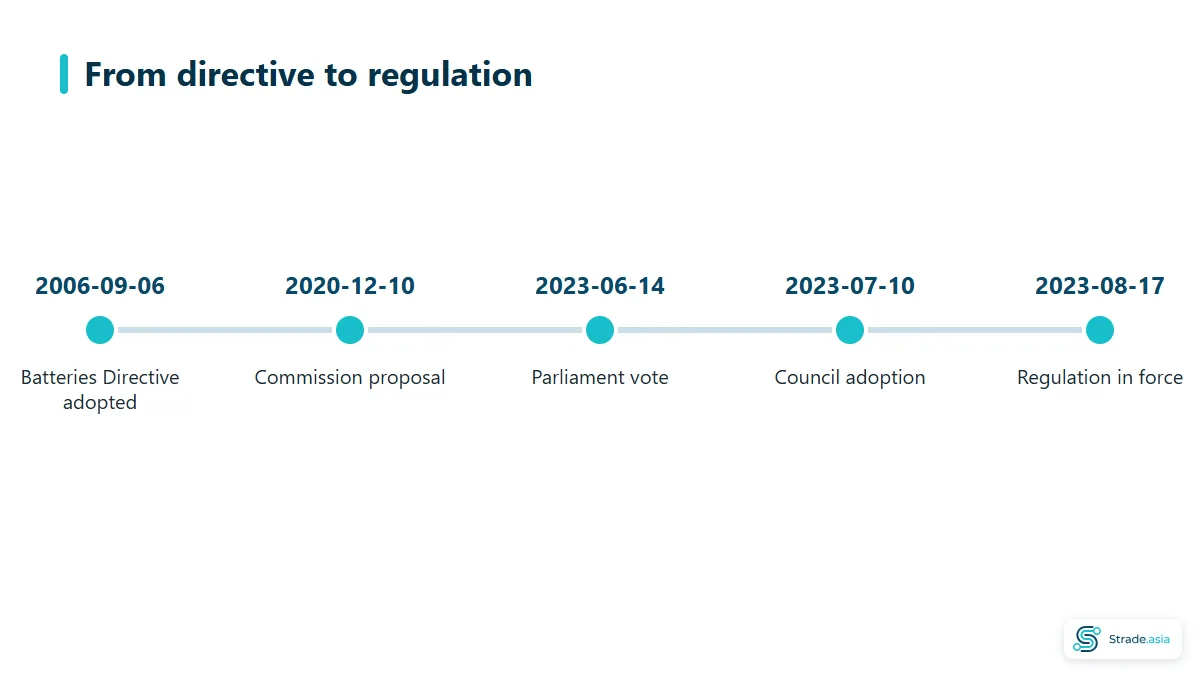
On 17 August, the new EU Battery Regulation, Regulation (EU) 2023/1542 on batteries and waste batteries, entered into force. It replaces the Batteries Directive of 2006 with a single regulation that applies directly in every EU member state, and it covers the whole life of a battery: design, labelling, safety, carbon footprint, supply chain due diligence, collection and recycling. For factories in Vietnam that build products containing batteries for European customers, from power tools and UPS units to IoT devices with a coin cell, the new rules will reach the purchasing desk through customer requests for documents.
What the regulation covers
The regulation sorts batteries into five categories: portable batteries, batteries for light means of transport (such as e-bikes and e-scooters), starting, lighting and ignition (SLI) batteries, industrial batteries, and electric vehicle batteries. Many obligations depend on the category, so the first task is to know which category each battery in your products falls into.
What changes, and when
Most of the regulation applies from 18 February 2024, but many obligations are phased in over the following years, and several depend on detailed rules the European Commission has yet to adopt. As currently set out in the text:
- Hazardous substances. Existing limits on mercury and cadmium continue, and a new limit on lead is added for portable batteries.
- Conformity and CE marking. Batteries themselves will need a conformity assessment, an EU declaration of conformity and CE marking.
- Labels and QR codes. New labelling requirements, including capacity and chemistry information and later a QR code, are scheduled over the coming years.
- Carbon footprint. Declarations start with electric vehicle batteries and extend later to rechargeable industrial and light transport batteries, once the calculation rules are adopted.
- Removability. Portable batteries built into appliances will have to be removable and replaceable by the end user from 2027, with limited exceptions.
- Battery passport. Electric vehicle, light transport and larger industrial batteries will need a digital battery passport from 2027.
- Due diligence. Larger companies placing batteries on the EU market must check the sourcing of cobalt, lithium, nickel and natural graphite.
- Recycled content. Documentation of recycled content, followed by minimum shares, comes later in the decade.
Dates tied to detailed rules, such as the carbon footprint declarations, depend on when the European Commission adopts those rules, so treat the list as a planning guide and check the current status before committing a design or contract.
Who carries the obligations
Most duties fall on the manufacturer, importer or distributor who places the battery, or the product containing it, on the EU market. A factory in Vietnam that ships finished goods to a European brand is usually not that party, but its customer is, and the customer will need conformity files and material data that only the supply chain can provide. Cell and pack suppliers that cannot provide this documentation may have to be replaced, and qualifying a new battery source takes time.
Documents to collect from battery and cell suppliers
Start building the file now, even for obligations that apply later:
- Identity of the battery and cell maker, with model numbers, chemistry, rated capacity and date of manufacture.
- Safety test reports, such as IEC 62133 for portable lithium cells and packs, discussed in lithium-ion battery safety, and the UN 38.3 test summary needed for transport, covered in our note on shipping lithium batteries under UN 38.3.
- Substance declarations for mercury, cadmium and lead, alongside the RoHS and REACH declarations you already collect; the approach is similar to the one in RoHS phthalates now apply.
- Information on raw material sourcing for lithium, cobalt, nickel and graphite, which customers may ask for as due diligence rules approach.
- Carbon footprint data, when cell makers can provide it.
- Change notices. Ask suppliers to tell you before changing cell source, chemistry or production site.
Design questions to raise now
Products launching in 2027 are being designed today. If a product uses a built-in portable battery, including a coin cell soldered to the board for memory backup, the design team should consider now whether the end user can remove and replace it with commonly available tools, or whether one of the limited exceptions applies. Battery packs also contain protection circuits and fuel gauges, described in battery management system basics, and any redesign of the pack is a chance to choose components with long availability and clear documentation.
How Strade can help
Strade is an independent electronic component distributor with its own engineers, supplying factories in Vietnam and across Asia, with power products as our main group. Each lot is checked on receipt, and the CoC, C/O and CQ travel with the goods when the source provides them. Our origin and compliance service helps with certificates of origin and export documents.
If you are reviewing the battery-related parts in a product for Europe, from protection ICs and MOSFETs to connectors and fuses, send us your BOM and we will quote the lines with the documents available from each source.