한국어
 Bahasa Indonesia
 ไทย
 中文 (中国)
 Tiếng Việt

Through 2018, the passive component shortage turned multi-layer ceramic capacitors (MLCCs) and thick-film chip resistors from routine commodity buys into major bottlenecks for electronics factories across Vietnam and Asia. Power-supply makers, EMS providers, and industrial or automotive assembly plants faced stretched lead times, strict allocation, and sharp price rises on parts that normally represent a small fraction of BOM cost. Even as some standard consumer lines show early signs of easing at the close of the year, makers continue to favour automotive grades and small case sizes, so automotive-grade and high-capacitance parts remain tight heading into 2019. For purchasing and engineering teams, four practical lessons stand out: share rolling forecasts, qualify alternates in the BOM early, stop double ordering, and verify every open-market lot.
1. Replace Spot Buying With Rolling Forecasts
Factories that relied on short-horizon spot purchase orders took the heaviest hit once passive makers placed common case sizes on allocation. When manufacturers allocate scarce parts, accounts with steady order history and clear demand visibility receive priority over ad-hoc buyers. Teams that appeared only when reels ran low had little leverage in the queue.
Heading into 2019, buyers should share rolling forecasts with core suppliers and review them monthly with production planning. Separate firm near-term demand from longer-term upside so suppliers can plan raw-material and production capacity without locking your factory into unnecessary stock commitments.
2. Pre-Qualify Alternates in Every BOM
The most costly line stops during the shortage occurred where a single passive part number sat alone on a bill of materials. Qualifying a replacement after reels run dry forces engineers to rush bench testing and wait for customer approval while SMT lines stand idle.
Preventing that bottleneck means building second sources into an approved manufacturer list during design or routine engineering reviews rather than during an allocation crisis. For MLCCs, buyers and engineers must check beyond nominal capacitance and footprint, reviewing dielectric class, voltage rating, temperature behaviour and how DC bias affects MLCC alternates at working voltage. For thick-film chip resistors, compare tolerance, TCR, power rating, working voltage and, where needed, anti-sulfur construction. Where PCB layout allows, approving an adjacent case size or an alternative capacitor type gives buyers much wider sourcing room when one package tightens.
3. Stop Double Ordering Across Channels
Under heavy allocation pressure, many factories placed duplicate orders for the same build across several distributors and brokers, intending to cancel the rest once the first shipment landed. Across Asia’s supply chain, double ordering distorted real demand, kept lead times stretched longer than actual consumption warranted, and pushed suppliers toward stricter non-cancellable, non-returnable (NCNR) terms.
As demand softens in parts of the consumer sector, buyers who double ordered now face unwanted excess stock and higher working-capital cost. Maintain one consolidated view of open purchase orders per part number across all vendors, reconcile coverage before placing urgent buys, and cancel redundant orders promptly where contract terms permit.
4. Vet Brokers and Inspect Open-Market Lots
Extended factory lead times drove many purchasing teams onto the open market for passives for the first time. While vetted open-market channels can bridge genuine shortages, unscreened brokers expose SMT lines to remarked reels, mixed date codes, poor storage, or oxidised terminations that cause soldering defects in reflow.
Before placing an order outside direct channels, verify how the supplier screens its upstream sources, confirm whether documents such as CoC or C/O can travel with the shipment, and agree on inspection and return terms in writing. At goods receipt, treat open-market passives with the same discipline as high-value ICs: apply a clear routine for reading component labels and barcodes, verify date codes and the condition of reels and carrier tape, check packaging and storage, and run sample capacitance or resistance measurements and solderability checks whenever a lot arrives from an unfamiliar source.
What Buyers Should Do Before Q1 Builds
With Q1 schedules and pre-Lunar New Year shipping cutoffs approaching across Asia, purchasing and engineering teams can put these habits in place this month:
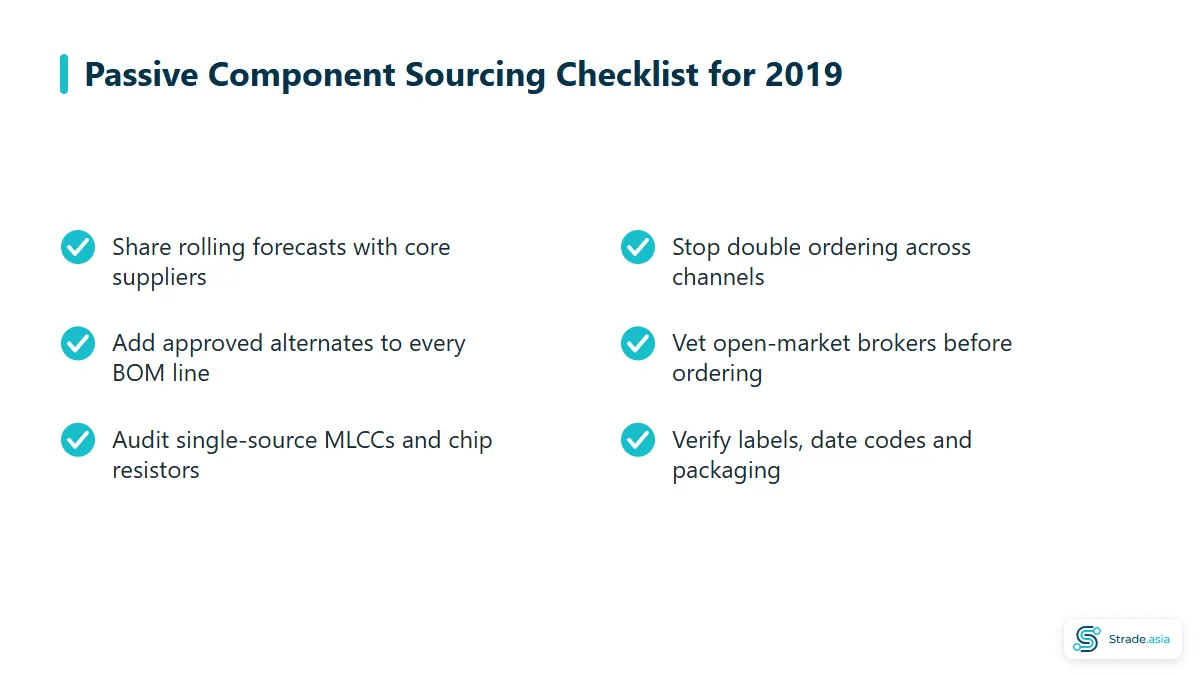
- Audit active BOMs for single-source MLCCs and chip resistors, starting with automotive-grade and high-capacitance parts that remain constrained.
- Share updated rolling forecasts with core suppliers so Q1 and post-holiday builds hold clearer allocation priority.
- Reconcile open purchase orders across all channels to strip out duplicate bookings and review NCNR exposure.
- Approve at least one alternate manufacturer or adjacent case size on high-runner passive lines before supply tightens again.
- Standardise broker vetting criteria and goods-receipt checks ahead of any urgent spot buys.
Sourcing Passive Components With Strade Asia
Strade Asia is an independent distributor of electronic components with its own engineers, supplying factories in Vietnam and across Asia with passive components, power products, semiconductors, connectors, and other component categories. When a part is short or discontinued, our engineers propose alternates matching your specification for your team to decide. We source from manufacturers, manufacturers’ distributors, and vetted open-market suppliers, check every lot on receipt (part number, label, date code, packaging, and visual condition, with sample testing or X-ray on sensitive parts or on request), pack to ESD and MSL requirements, and deliver DDP or DAP with customs documents prepared. Send your BOM (Excel, CSV, or PDF) or enter part lines to request a quotation.