한국어
 Bahasa Indonesia
 ไทย
 中文 (中国)
 Tiếng Việt
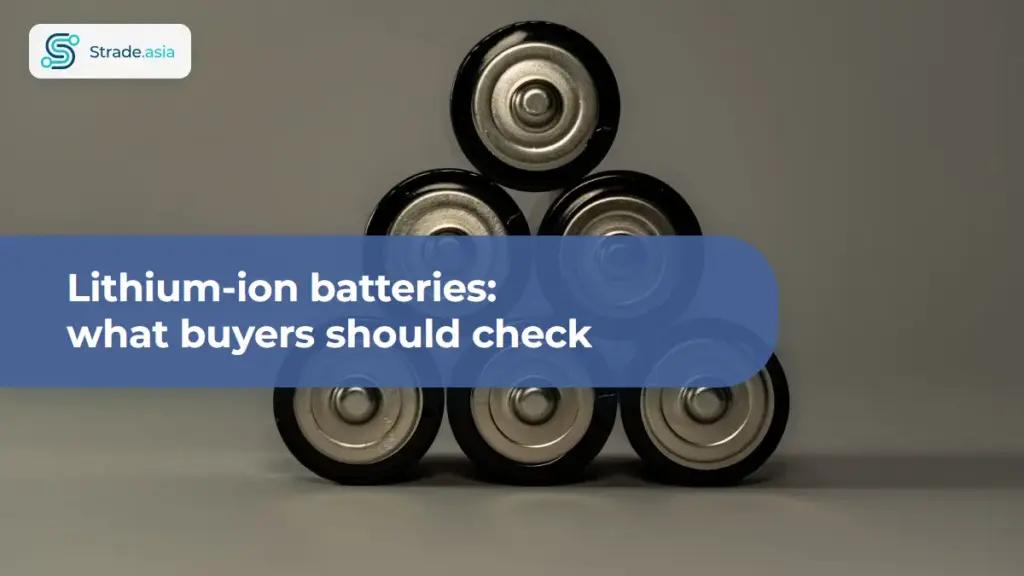
On 2 September, Samsung announced a recall of its Galaxy Note 7 smartphones after reports of battery fires. The cause is a matter for Samsung and its suppliers, and we will not speculate on it. But the recall has led many product companies, including makers of far simpler devices than a flagship phone, to ask how well they understand the lithium-ion batteries in their own products.
For factories in Vietnam that build handheld instruments, power tools, lighting, wearables or backup units, the question is practical: what should a buyer check before a cell or battery pack goes into a product?
Why lithium-ion needs care
Lithium-ion cells pack a lot of energy into a small space, with a flammable electrolyte and a thin separator between the electrodes. If the separator fails and the electrodes touch, the internal short heats the cell, which can drive further reactions and more heat: thermal runaway. Common triggers include manufacturing defects such as contamination or a damaged separator, overcharging, deep discharge followed by recharging, charging when the cell is too cold or too hot, physical damage and external heat.
A safe product therefore depends on two things: a good cell, and protection that keeps the cell inside its limits.
Protection is a chain
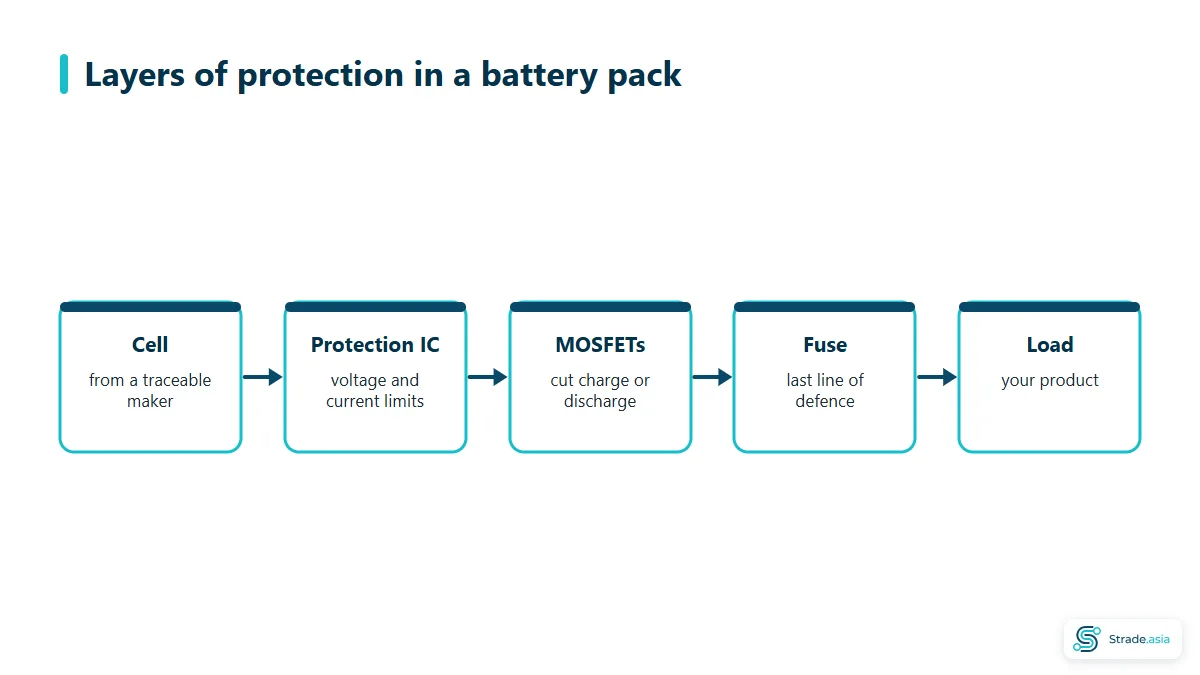
- Cell. A cell from a traceable maker, with a datasheet that states its voltage limits, current limits and temperature ranges for charge and discharge. The charging range is usually narrower than the discharge range.
- Protection IC. It monitors cell voltage and current and acts on overcharge, over-discharge, overcurrent and short circuit. Its thresholds must match the cell datasheet, not a generic setting.
- MOSFETs. Switched by the protection IC, they cut the charge path, the discharge path or both.
- Fuse. A last line of defence if the electronic protection fails, as described in our guide to choosing a fuse. Packs may also use thermal fuses or PTC devices.
- Charger. Whether inside the product or in an external adapter, the charger sets the charge voltage and current, and should stop charging outside the cell’s temperature range, usually by reading a thermistor in the pack. If the product charges from an external AC-DC adapter, check that adapter’s output regulation and safety approvals as well, along with rules such as Level VI efficiency.
Good designs make sure that no single fault leads to a hazard, for example by adding a secondary protection device that acts if the first one fails.
Standards and transport rules
- IEC 62133 sets safety requirements for portable sealed secondary cells and batteries, including lithium systems. Ask for test reports in the name of the exact cell and pack you buy.
- UN 38.3, part of the UN Manual of Tests and Criteria, sets tests that lithium cells and batteries must pass before they can be transported, including altitude simulation, thermal cycling, vibration, shock and external short circuit.
- Air transport. Since 1 April this year, international air rules no longer allow lithium-ion batteries shipped on their own to travel as cargo on passenger aircraft, and require them to be shipped at a reduced state of charge. Cargo-only routing means less capacity, higher freight cost and longer restock times, and forwarders check UN 38.3 test documents before they accept a booking. Batteries packed with or inside equipment follow different rules, so confirm routing and lead time with your forwarder early.
End-product safety standards add their own battery requirements, so the product’s safety file matters as well.
What buyers should check
- Traceable cells. Know the cell maker and model inside every pack, and qualify a second traceable cell early rather than accepting an unapproved swap when supply is tight. Unbranded or relabelled cells are a serious risk.
- Matching documents. IEC 62133 and UN 38.3 reports should name the actual cell and pack model, not a similar one.
- Protection design. Confirm that a protection circuit is fitted and that its thresholds match the cell datasheet.
- Pack construction. Look at insulation between cells and terminals, welds, wiring and protection from sharp edges.
- Incoming inspection. Check open-circuit voltage, swelling, dents, leakage, labels and date codes on each lot.
- Storage. Keep cells and packs cool and dry, at partial charge, away from flammable materials, and quarantine any damaged unit.
- Change control. Require notice of any change in cell maker, cell model or pack design, and re-test before approval.
For engineers choosing the protection IC and MOSFETs, the habits in our guide to reading a datasheet apply directly: check limits over the full temperature range, not just at 25 °C.
How Strade can help
Strade is an independent electronic component distributor with its own engineers, supplying factories in Vietnam and across Asia. Power products are our core product group. For protection ICs, MOSFETs and fuses in battery designs, our engineers can propose alternates with matching specifications, and your team decides. See our power products.
Send us your BOM for the protection and power parts in your battery design.