한국어
 Bahasa Indonesia
 ไทย
 中文 (中国)
 Tiếng Việt
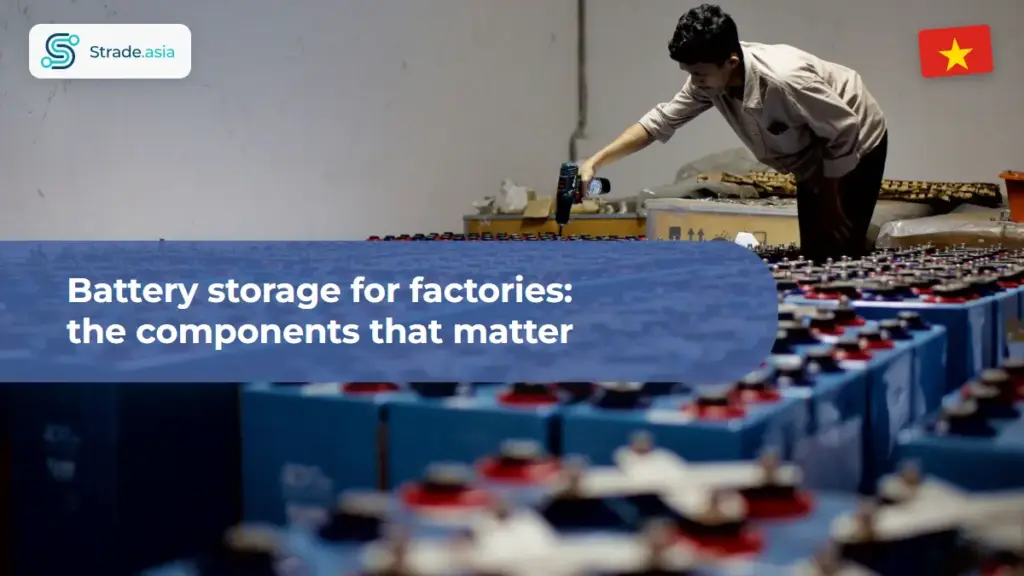
Many factories already have solar panels on their roofs. The next question is usually storage: a battery system that holds midday solar for the evening shift, moves consumption out of peak tariff hours, or keeps critical loads running through a short outage. A battery energy storage system (BESS) is often bought as a packaged cabinet or container, but it is built from components that someone has to specify, maintain and eventually replace. Knowing what is inside helps when comparing offers, planning spare parts and talking to the integrator.
The main blocks
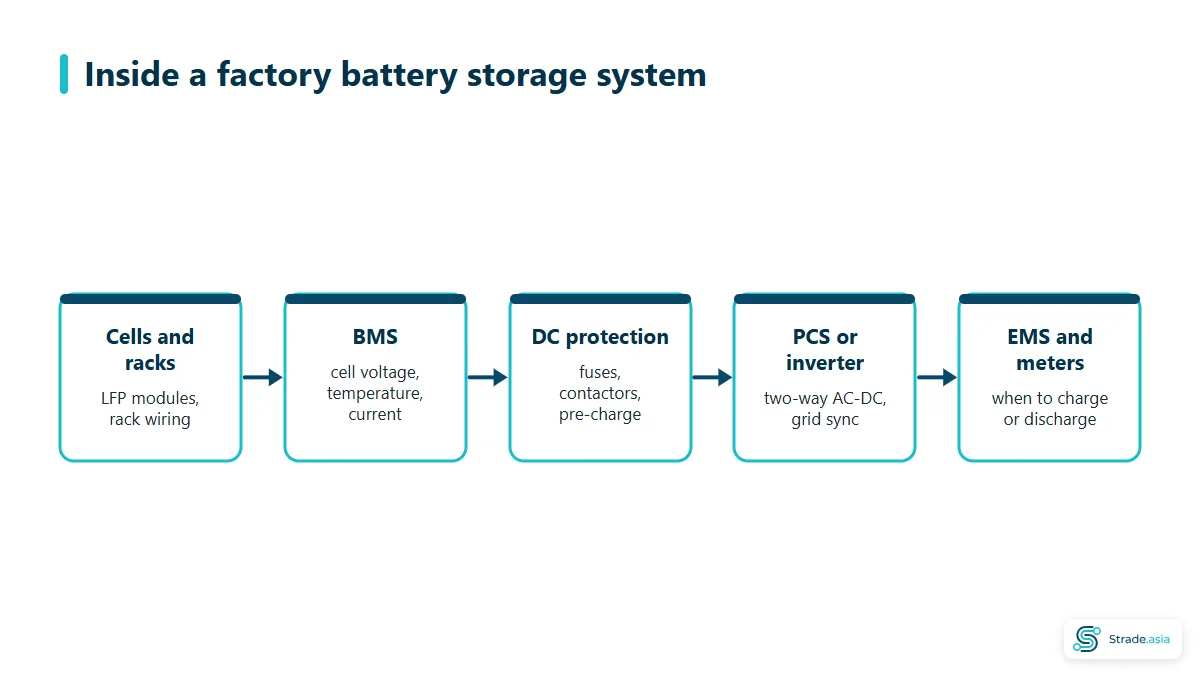
Cells and modules
Stationary systems mostly use lithium iron phosphate (LFP) cells, chosen for thermal stability and cycle life rather than energy density. Cells are grouped into modules and racks. Ask for the cell manufacturer and model, not only the system brand, the rated cycle life at a stated depth of discharge and temperature, and the warranty basis for remaining capacity.
Battery management system (BMS)
The BMS measures every cell voltage, temperatures and pack current, balances the cells, estimates state of charge and opens the contactors when anything leaves its safe limits. It also talks to the inverter and the site controller, usually over CAN or Modbus. Our article on battery management system basics covers these functions in more detail. BMS boards, current sensors and temperature sensors are the spares most worth keeping.
Power conversion system (PCS)
The PCS converts between the battery’s DC and the factory’s AC supply in both directions and synchronises with the grid. In smaller systems it is a hybrid inverter that also connects the solar array. Ask about rated power against the battery’s charge and discharge rate, efficiency at partial load, compliance with the grid-connection rules for your site, and whether it can feed critical loads on its own during an outage.
DC protection and switching
This is where component choice matters most, because a DC arc does not go out by itself at a zero crossing as an AC arc does:
- Fuses rated for DC at the full battery voltage, with a breaking capacity above the fault current a battery rack can deliver.
- DC contactors that the BMS opens on a fault, rated for the current they must break, not only the current they carry.
- Pre-charge circuits that limit inrush into the inverter’s input capacitors when the contactors close.
- DC disconnects or breakers for safe maintenance, and surge protection on the DC side.
- Insulation monitoring where the DC system is not earthed.
Our article on choosing a fuse for power circuits explains voltage rating and breaking capacity, which apply with even more force at battery voltages.
Cooling, fire safety and monitoring
Cells age faster when hot, so cabinets use air conditioning or liquid cooling, with smoke, heat and often gas detection, and suppression or ventilation designed around the risk of thermal runaway. An energy management system (EMS) decides when to charge and discharge, using meters on the grid connection, the solar array and key loads. Ask what data you can access and over which protocols.
Standards to ask for
Requirements differ by market and by insurer, but these names come up most often:
- IEC 62619: safety of secondary lithium cells and batteries for industrial applications, including stationary storage.
- UL 1973: batteries for stationary use.
- UL 9540: safety of the complete energy storage system, and UL 9540A: the test method for thermal runaway fire propagation, often requested by fire authorities and insurers.
- IEC 62477-1 or IEC 62109 for the power converter, depending on its type.
- UN 38.3 for transporting lithium cells and modules.
Ask for certificates and test reports that name the exact model supplied. Our earlier note on lithium-ion battery safety explains why cell quality and protection come first.
Questions before you sign
- Usable energy, not only nameplate capacity, and the depth of discharge it assumes.
- Cell origin and chemistry, and the warranty basis: cycles, years or remaining capacity.
- Charge and discharge power, and which loads the system can back up.
- DC protection design: fuse and contactor ratings, pre-charge, insulation monitoring.
- Cooling, fire detection and suppression, and the certificates behind them.
- A spare parts list with local availability: fuses, contactors, fans, sensors, BMS boards.
Storage also changes how you plan backup power for production lines: a system that can run critical loads on its own may cover some of what a UPS does today, but switchover time and power quality need checking first.
How Strade helps
Power products are Strade’s lead product group. For storage systems and their maintenance, we source DC fuses, contactors, current sensors, connectors, power semiconductors and the electronic parts on BMS and control boards, from manufacturers, their distributors and vetted open-market sources. When a specified part is hard to buy, our engineers propose alternates with matching ratings and the customer decides. Every lot is checked on receipt before it ships.
Building or maintaining a storage system? Send your part list for a quotation.