한국어
 Bahasa Indonesia
 ไทย
 中文 (中国)
 Tiếng Việt
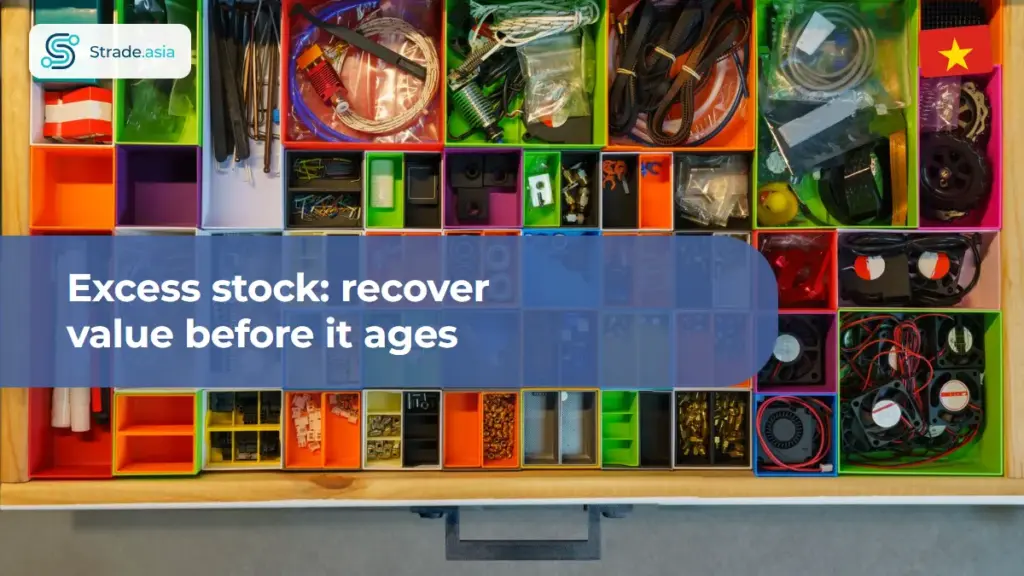
Every factory that buys components ends up with excess inventory it no longer needs. A customer cuts a forecast, a product is redesigned, or a minimum order quantity forces you to buy a full reel when the job needed far fewer. Buffer stock bought in a tight market, such as the current memory squeeze, can outlive the shortage. The parts sit in the store, tie up cash and slowly lose value as their date codes age. Writing them off is the easy option, but rarely the best one.
Why excess builds up
- Forecast changes. Orders placed against a forecast that later fell.
- Packaging minimums. Full reels or standard packs bought for small requirements.
- Engineering changes. A part replaced in a new board revision.
- Products that end early. A product or customer programme stopped before the stock was used.
- Shortage buying. Extra stock bought during allocation that is no longer needed once supply recovers.
Start with a clear list
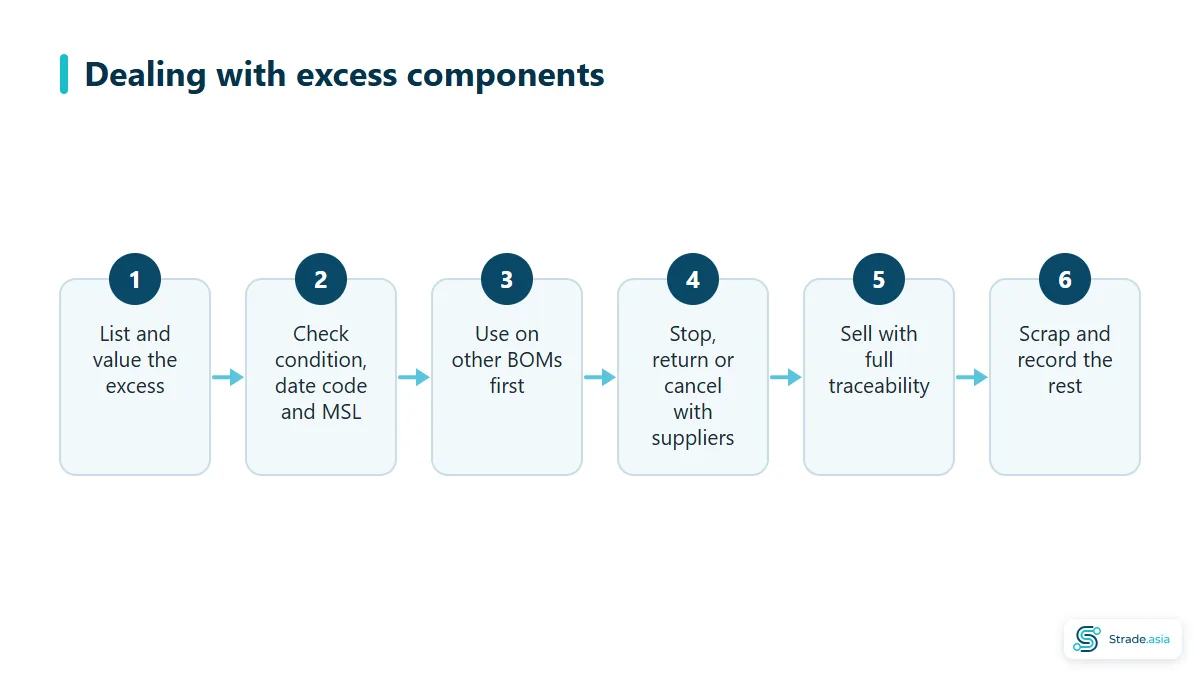
Before you decide anything, list each excess line with manufacturer part number, quantity, date code, packaging, storage history and the value at which it is held. Then separate:
- parts in original sealed packaging from opened reels and loose parts;
- moisture-sensitive parts still in sealed dry packs from those whose bags have been opened, as explained in our guide to MSL;
- recent date codes from older ones. Many buyers set a maximum date code age for incoming parts, so older stock is harder to use or sell. Our article on date codes shows how to read them.
The options, in order
- Use it elsewhere. Search every active BOM for the same manufacturer part number or an approved equivalent. Before moving stock onto another customer’s product, check who owns it and what the contract allows, especially for consigned stock or parts imported under a processing contract. If the part is approved for another internal part number, it may be usable directly. This recovers full value.
- Stop more arriving. As soon as excess is found, and before selling anything, check which open orders can be rescheduled or cancelled under the supplier’s terms. NCNR (non-cancellable, non-returnable) lines cannot, so know which ones they are.
- Return to the supplier. Some manufacturers and distributors accept returns of standard, unopened packs within a set period, usually with a restocking fee. Ask early: the window closes, and returned parts must be in original condition.
- Consignment. A distributor or reseller may agree to hold your excess and sell it on your behalf, paying you when it sells. You keep ownership until then, so agree the price floor, storage conditions and reporting.
- Sell with traceability. Brokers and other factories buy excess, but the price depends on proof of origin. Keep the original labels and packaging, the purchase invoice or certificate of conformance, and records of how the parts were stored. Parts without this history sell at a deep discount, if at all.
- Scrap and record. What cannot be used or sold should be scrapped properly, with a record of what was destroyed, so that it cannot return to the market as counterfeit stock.
Work through these options with purchasing, engineering and finance together. Engineering knows where a part can be reused, purchasing knows the supplier terms, and finance decides at what value a sale still makes sense.
Customs points in Vietnam
If the parts were imported duty-free for export production, under a processing contract or by an export processing enterprise, moving them out of the factory is also a customs matter. Selling them on the local market, transferring them to another company, re-exporting them or even scrapping them each has its own customs procedure and may bring import duty and VAT. Check with your customs team before you move or destroy the stock.
Prevent the next pile
- Buy to a rolling forecast, and review it monthly with suppliers.
- Ask for cut tape or re-reeled parts where a full reel is far more than you need; our packaging guide covers the options.
- Record NCNR terms at the time of order, and agree with customers who carries excess and obsolete stock before buying minimum order quantities or long-lead parts against their forecasts.
- Review excess every quarter, while the date codes are still recent.
How Strade can help
Strade is an independent electronic component distributor with its own engineers, supplying factories in Vietnam and across Asia. Most of our orders are bought to the customer’s request, which keeps quantities close to need. When a design changes, our engineers can check whether parts already on your shelves match the specifications of the new requirement. Send us your BOM, or read more about our supply chain services.