한국어
 Bahasa Indonesia
 ไทย
 中文 (中国)
 Tiếng Việt
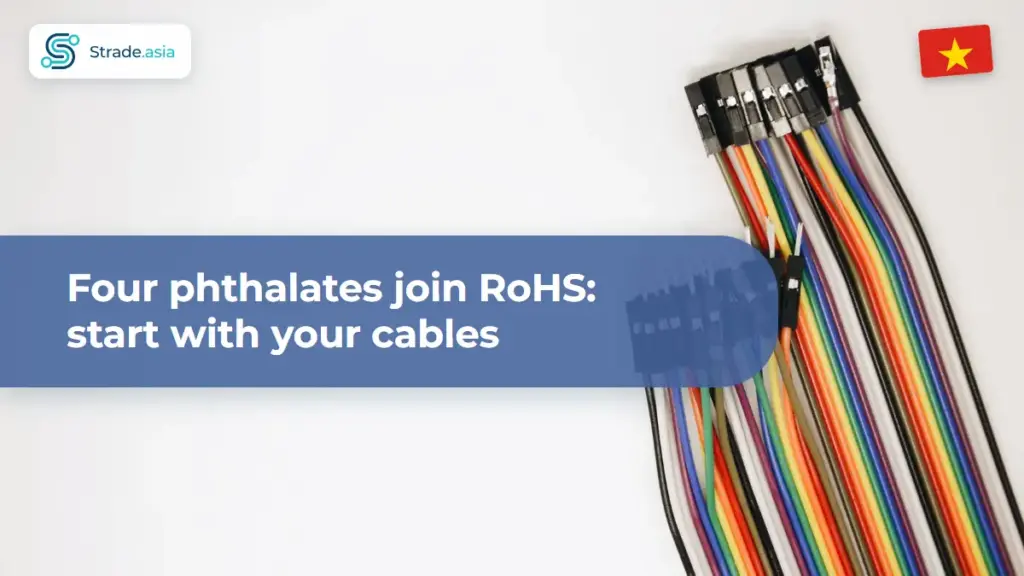
Factories in Vietnam that build electrical and electronic equipment for Europe, or parts that go into it, are used to RoHS. Lead, mercury, cadmium, hexavalent chromium, PBB and PBDE have been restricted for years, and most component suppliers declare compliance as a matter of routine. A change already written into EU law will add four phthalates to the RoHS list from July 2019, and they are different in kind: not metals or flame retardants in electronic parts, but plasticisers in soft plastics.
What changes
Commission Delegated Directive (EU) 2015/863 amends Annex II of the RoHS Directive (2011/65/EU) to add four phthalates:
- bis(2-ethylhexyl) phthalate (DEHP)
- butyl benzyl phthalate (BBP)
- dibutyl phthalate (DBP)
- diisobutyl phthalate (DIBP)
Each is limited to 0.1% by weight in homogeneous materials, the same limit that applies to lead, mercury, hexavalent chromium, PBB and PBDE. The restriction applies to most equipment placed on the EU market from 22 July 2019. For medical devices, including in vitro diagnostic devices, and for monitoring and control instruments, including industrial ones, it applies from 22 July 2021. Cables and spare parts for the repair, reuse, updating of functionalities or upgrading of capacity of equipment placed on the market before those dates are excluded. Member states had until the end of 2016 to bring the change into national law.
The same four substances are already on the REACH Candidate List of substances of very high concern, so some customers may already ask about them under REACH. RoHS turns that question into a limit that decides whether the product can be sold.
Where phthalates are found
Phthalates soften plastics, above all PVC. In electrical and electronic equipment, the places to look are:
- Cables and cords. PVC insulation and jackets on power cords, internal wiring, harnesses and cable assemblies are the main risk.
- Sleeving and tubing. PVC sleeves, grommets and flexible tubing.
- Connectors and overmoulds. Soft overmoulded parts, strain reliefs and some connector housings.
- Seals, gaskets and feet. Flexible plastic and rubber-like parts.
- Adhesives, coatings, inks and tapes. Some formulations use phthalates as plasticisers.
Most semiconductors and passive components are low risk, though parts with soft plastic sleeves, such as electrolytic capacitors with PVC sleeves, still deserve a check. The cable that ships with your product, however, is part of it: an external power supply with a PVC cord is in scope as much as the board inside it. If you buy adapters, remember the separate efficiency rules described in Efficiency Level VI.
What to prepare now
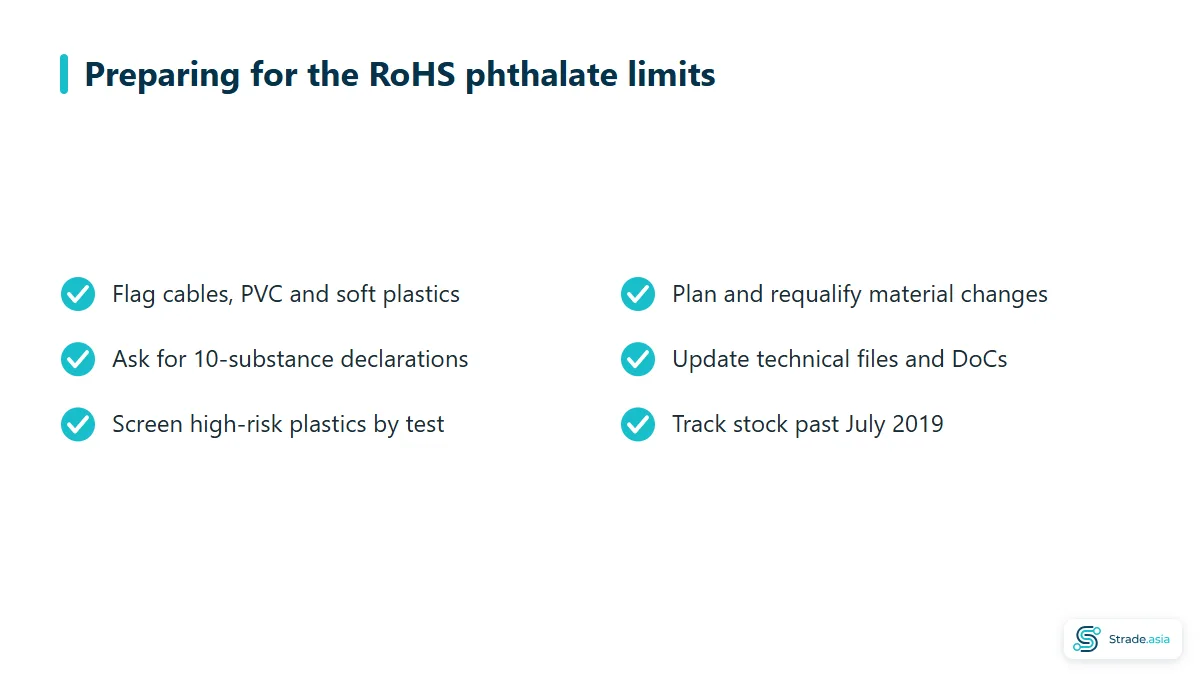
More than two years sounds like plenty of time, but cables and plastic parts often come from smaller suppliers, and changing a material takes longer than it seems. A sensible plan:
- List the at-risk parts. Go through each BOM for products sold in Europe and mark every cable, harness, plastic part and adhesive.
- Ask suppliers for updated declarations. A RoHS declaration that names only six substances does not cover phthalates. Ask for a declaration or material data covering all ten, or a date by which the supplier will provide one.
- Test where the risk is high. XRF screening, widely used for lead and cadmium, cannot detect phthalates. They need laboratory analysis, usually by GC-MS. Start with PVC parts from suppliers who cannot provide data.
- Plan material changes. Many cable makers already offer PVC compounds without these phthalates, or other materials. Changing a cable can affect flexibility, temperature rating and safety approvals, so leave time to requalify.
- Update your own documents. Technical files, declarations of conformity and supplier agreements should refer to the amended Annex II.
- Track stock and cut-over dates. The deadline applies when equipment is placed on the EU market, not when it leaves a factory in Vietnam. Allow for sea transit, customer cut-off dates and stock on shelves, and track lots and date codes so you know which batches the new declarations cover.
Treat this like any other supplier qualification, with evidence recorded for each part, as we described for approved manufacturer lists.
How Strade can help
Strade is an independent distributor of electronic components with its own engineers, supplying factories in Vietnam and across Asia. CoC, C/O and CQ documents travel with the goods when the source provides them, and we can ask manufacturers for RoHS and material declarations for the parts we supply. For origin and compliance paperwork, see our origin and compliance services, or send us your BOM and we will check the declarations available for the parts on it.