한국어
 Bahasa Indonesia
 ไทย
 中文 (中国)
 Tiếng Việt

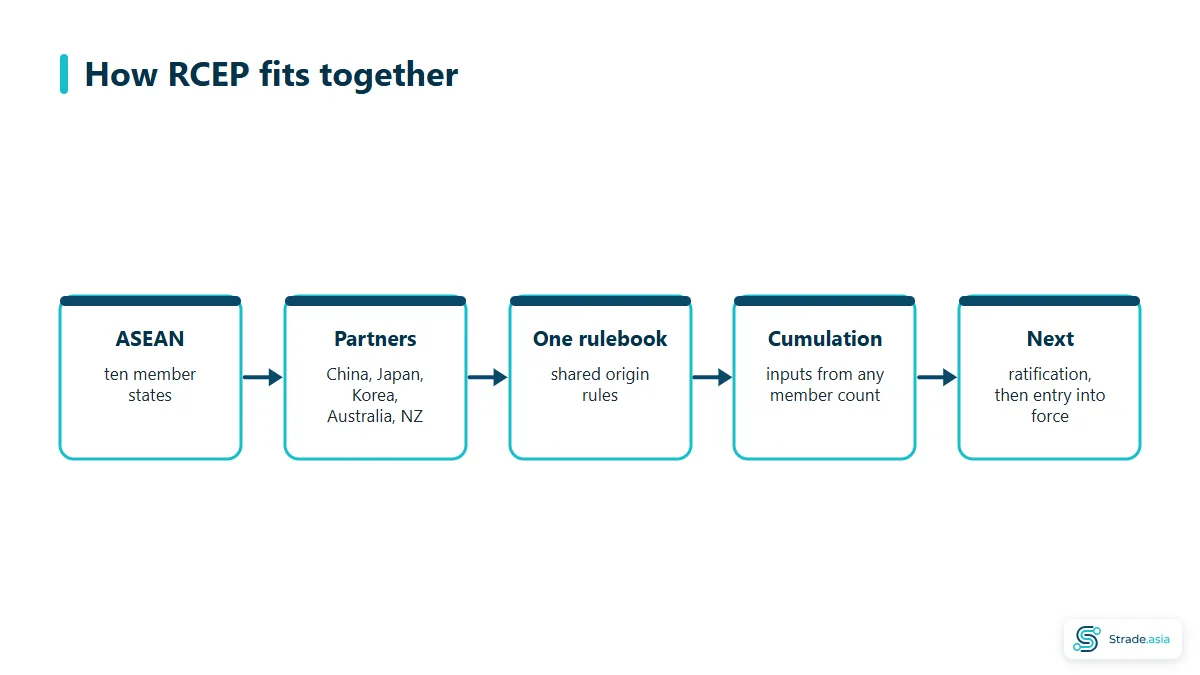
On 15 November, fifteen countries in the Asia-Pacific signed the Regional Comprehensive Economic Partnership (RCEP). The signing took place online during the ASEAN Summit hosted by Vietnam as ASEAN Chair this year. The parties are the ten ASEAN member states, China, Japan, South Korea, Australia and New Zealand. India took part in the negotiations, which began in 2012, but stepped back last year; the agreement leaves the door open for it to join later.
RCEP is not yet in force. Each country must first ratify it, and it will enter into force once enough signatories, from both ASEAN and the partner countries, have done so. For now, nothing changes at the border. But electronics makers in Vietnam should start to understand what it could change.
Why RCEP matters for electronics
ASEAN already has separate free trade agreements with each of the five partners, and Vietnam also has bilateral agreements with Japan and Korea. Electronics makers use them every day: Form E for trade with China, Form AK with Korea, Form AJ with Japan, and others. Each has its own rules of origin and its own certificate.
RCEP brings these markets under one agreement for the first time. It is also the first free trade agreement that links China, Japan and South Korea together. For supply chains that buy components from Japan, Korea and China, assemble in Vietnam or elsewhere in ASEAN, and sell across the region, that is significant. A common case in Vietnam is a power supply or control board built from Japanese capacitors, Korean memory and Chinese magnetics, then sold to customers in China, Japan and Southeast Asia.
One set of origin rules, with cumulation
Two features stand out for electronics:
- One rulebook. A single set of rules of origin and product-specific rules applies across all fifteen countries. For many products, origin can be shown either by a regional value content test or by a change of tariff classification.
- Cumulation. Materials originating in any RCEP party count as originating when used in another party. A Vietnamese product made with originating components from Japan, Korea or China could therefore find it easier to qualify than under an agreement that counts only Vietnamese inputs and those of one partner.
This matters because a typical electronics BOM in Vietnam, including at export processing enterprises, draws parts from several of these countries. Under the separate ASEAN agreements, parts from one partner may count as non-originating when the product is exported to another. Under RCEP, they may count toward origin.
What it will not change
- Existing agreements stay. RCEP adds an option; it does not replace ACFTA, AKFTA, AJCEP, the CPTPP or the EVFTA. Exporters will choose the agreement with the best duty rate and the easiest rule for each product.
- Tariffs fall over time. Each country has its own schedule, some apply different rates to different partners, and many cuts are phased in over years. For some products, an existing agreement will remain the better choice for a long time.
- Many components are already duty-free. As with other agreements, the gain for electronics depends on the product. Much of the benefit may come from the origin rules rather than from lower rates on components.
What to prepare
- Map your BOM by country of origin. Note which components come from RCEP countries and which from outside, such as the US, Europe or Taiwan.
- Keep supplier origin records. Cumulation only helps if you can prove where inputs come from, the same discipline needed under the CPTPP rules of origin and the EVFTA. Parts shipped through a hub outside RCEP, such as Hong Kong, will also have to meet the transit rules to keep their status.
- Compare agreements product by product as the schedules are studied in detail and entry into force approaches.
- Watch ratification in Vietnam and in your main markets.
- Review sourcing plans. If you are spreading suppliers across countries, as discussed in dual sourcing across countries, origin under RCEP could become one more factor in the choice.
How Strade can help
Strade is an independent electronic component distributor with its own engineers, supplying factories in Vietnam and across Asia. We state the country of origin on our documents and supply CoC and C/O when the source provides them. Our origin and compliance services cover export documents and HS code review for agreements such as ACFTA (Form E), CPTPP and EVFTA.
To check the origin of the parts in your BOM, send us your BOM.