한국어
 Bahasa Indonesia
 ไทย
 中文 (中国)
 Tiếng Việt
Many electronics and electrical factories in Vietnam operate as export processing enterprises (EPEs). An EPE is treated as being outside Vietnam’s domestic customs territory for many purposes: goods it brings in from abroad for production are generally not subject to import duty, and goods that move between an EPE and the inland market are handled as exports and imports. That status has clear benefits for exporters, but it also means a delivery of components to an EPE carries more paperwork than a delivery to an ordinary inland factory.
For buyers at EPEs, and for the suppliers serving them, getting that paperwork right is what keeps parts moving through the gate on time.
Basic customs rules for an EPE
- Every movement in or out is declared. Goods entering an EPE, from abroad or from inland Vietnam, go through customs procedures. The EPE is under customs supervision and reports on the materials it brings in and uses.
- Sales from inland count as exports. When a company in the inland area sells goods to an EPE, the sale is treated like an export from Vietnam and an import into the EPE, handled as an on-the-spot export and import with declarations on both sides. The sale can qualify for 0% VAT when the conditions, including the contract, the customs declaration and payment through a bank, are met.
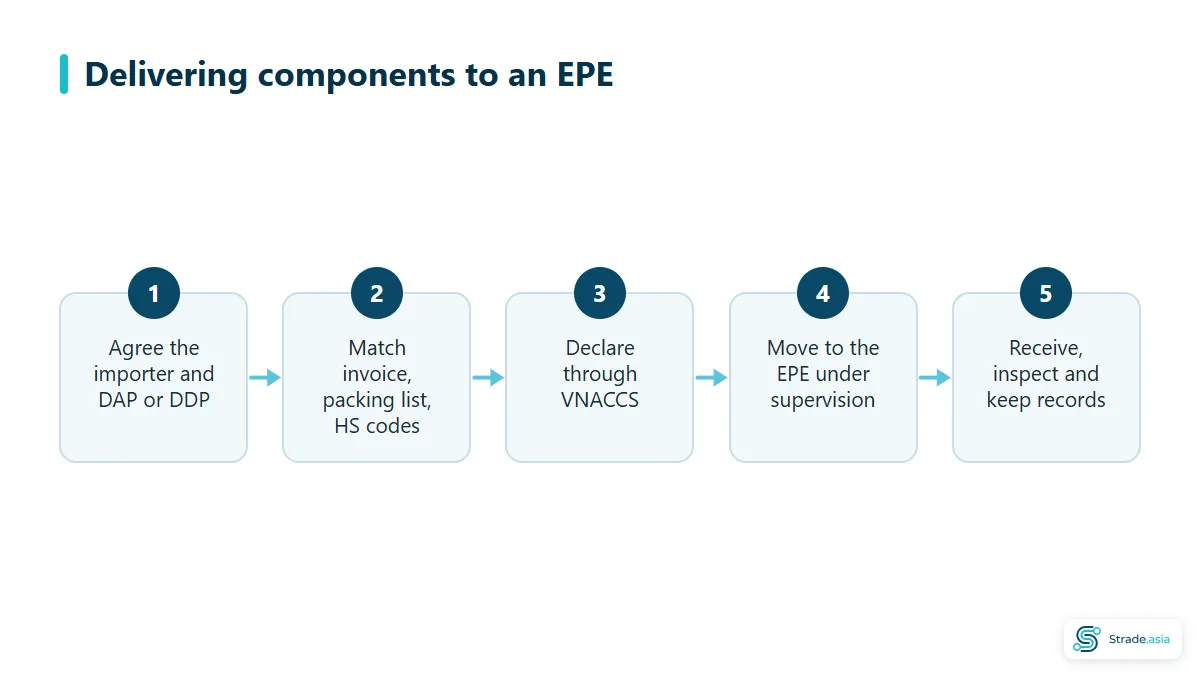
- Declarations are electronic. They are filed through the VNACCS/VCIS system, which assigns each declaration to a green, yellow or red channel: release without checks, a document check, or a document check plus physical inspection.
The exact procedure depends on how the sale is structured and on whether the items are production materials or other goods, such as consumables, spare parts or test equipment, so the customs team of the EPE and the supplier should agree on it before the first order.
Choosing DAP or DDP
The trade term decides who handles each step. Under the Incoterms 2020 rules:
- DAP means the seller delivers to the EPE, ready for unloading, and the buyer handles import clearance. This is common when a supplier abroad ships directly, since the EPE acts as importer and files its own declaration.
- DDP means the seller also handles import formalities and pays any duties and taxes. For deliveries to an EPE, this works when the seller has a Vietnamese entity able to act as importer and to complete the procedures for supplying an EPE. Even then, the EPE files its own declaration for the goods it receives, so that they enter its materials records under customs supervision.
Whichever term is used, name the place precisely (the EPE’s own address, not just the industrial park) and agree who pays for local handling.
Documents to prepare
- Commercial invoice showing each line’s part number, description, quantity (in the unit the EPE uses in its materials records, usually pieces rather than reels), unit price, currency and country of origin.
- Packing list that matches the invoice line by line, with carton numbers and net and gross weights.
- HS code for each line, agreed between supplier, forwarder and the EPE’s customs team. Inconsistent codes are a common cause of delay.
- Transport document: air waybill or bill of lading.
- C/O when it is needed. Because goods entering an EPE generally do not pay import duty, a preferential C/O matters less for duty and more for proving the origin of materials when the EPE exports its own products under trade agreements. See our note on CPTPP rules of origin.
- CoC and test reports where the source provides them.
Labels on reels and cartons should show the same part numbers and quantities as the documents; our guide to component labels and barcodes explains what to check.
Paperwork lead time
Customs clearance for an EPE often takes longer to arrange than the freight. Goods may move from the port or airport to the EPE under customs supervision and be cleared at the customs office that manages the EPE. Plan for:
- Draft documents sent to the EPE’s customs team before the goods ship.
- Time to correct and confirm HS codes and descriptions.
- The declaration filed when the goods arrive, with time allowed for a document check or inspection.
- Records kept for the EPE’s reporting on materials used.
For new projects, it helps to agree on this flow early, as part of setting up production in Vietnam.
How Strade can help
Strade is an independent electronic component distributor with its own engineers, supplying factories in Vietnam and across Asia. We deliver on DDP or DAP terms to factories and export processing enterprises and prepare the customs documents. We also support origin paperwork, including C/O under trade agreements and HS code review. Read more about how we work with manufacturers.
To get a quote delivered to your EPE, send us your BOM or part list.