한국어
 Bahasa Indonesia
 ไทย
 中文 (中国)
 Tiếng Việt
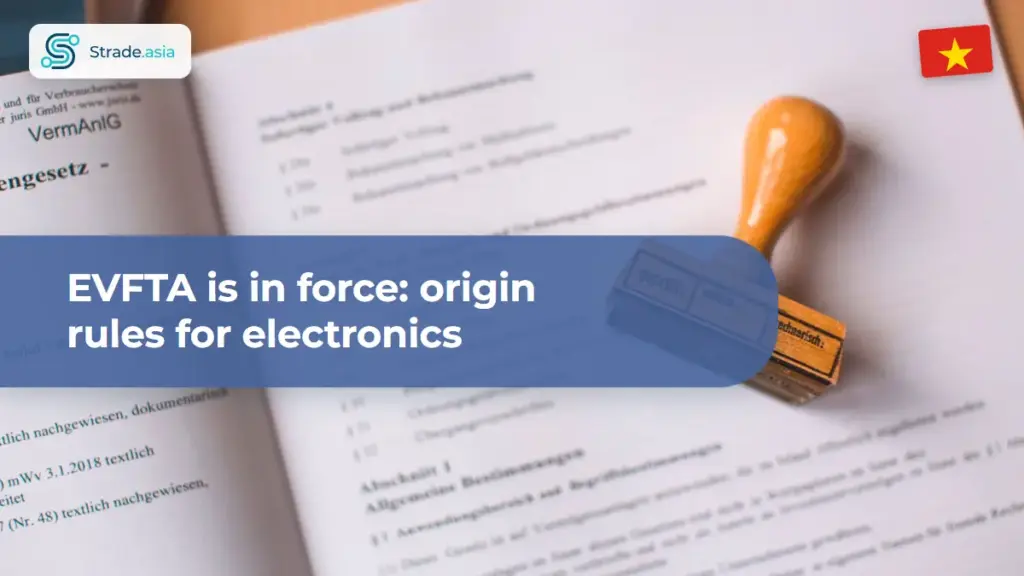
The EU-Vietnam Free Trade Agreement (EVFTA) entered into force on 1 August 2020. It was signed in Hanoi in June last year, approved by the European Parliament in February and ratified by Vietnam’s National Assembly in June. When it was signed, we looked at what the EVFTA could change for electronics. Now that it applies, the practical question for factories is how to qualify for preferential duty, and what evidence to keep.
What the EVFTA changes for electronics
The EU is removing customs duties on a large part of its tariff lines for goods from Vietnam from the first day, with most of the rest phased out over a set period. Vietnam is cutting its duties on EU goods over a longer schedule. Many electronic components and finished electronics already enter the EU duty-free under WTO commitments, so the gain for electronics varies: it is greater for some electrical equipment, appliances, cables and assemblies where EU duties still apply.
Preference is not automatic. Goods must meet the agreement’s rules of origin, and the importer must hold valid proof of origin. Exporters that already ship to the EU under the EU’s Generalised Scheme of Preferences (GSP) can keep using it for a transition period, so compare the duty rate and origin rule under each scheme product by product.
Proof of origin: EUR.1 and REX
- Exports from Vietnam to the EU. Vietnamese exporters can apply for a certificate of origin on form EUR.1, issued by the organisations authorised by the Ministry of Industry and Trade, which has issued detailed rules for EVFTA origin. Small consignments below a value threshold set in the agreement can use an origin declaration by the exporter, and self-certification by approved exporters is foreseen.
- Imports from the EU to Vietnam. EU exporters do not use EUR.1 under the EVFTA. They make out a statement on origin on the invoice or another commercial document. Above the value threshold, the exporter must be registered in the EU’s Registered Exporter (REX) system, and the registration number must appear on the statement.
Vietnamese buyers of EU components should ask their suppliers whether a statement on origin will be provided, so that the lower EVFTA rate can be claimed on import. Parts bought from distributor stock in a third country, such as Singapore or Hong Kong, may not qualify, because they still need valid EU proof of origin and must meet the non-alteration rule.
Product-specific rules
Each product’s origin is judged against a rule for its HS heading, listed in an annex to the origin protocol. For many electrical and electronic products, the rule allows either a change of tariff heading from the non-originating materials, or a limit on the value of non-originating materials as a share of the ex-works price. Some products have stricter or different rules, so always read the rule for your exact heading.
For a typical electronics assembly made in Vietnam, many components are imported from China, Japan, Korea or Taiwan and count as non-originating. Whether the finished product qualifies then depends on the option the rule offers, on the value added in Vietnam and on what those imported components cost.
Two other principles matter:
- Bilateral cumulation. Materials originating in the EU count as originating when used in Vietnam, and the reverse.
- Non-alteration. Goods must reach the EU without being changed on the way; transit or splitting under customs control in a third country is allowed.
As with the CPTPP rules of origin, everything starts from the BOM: which parts come from where, and what they cost.
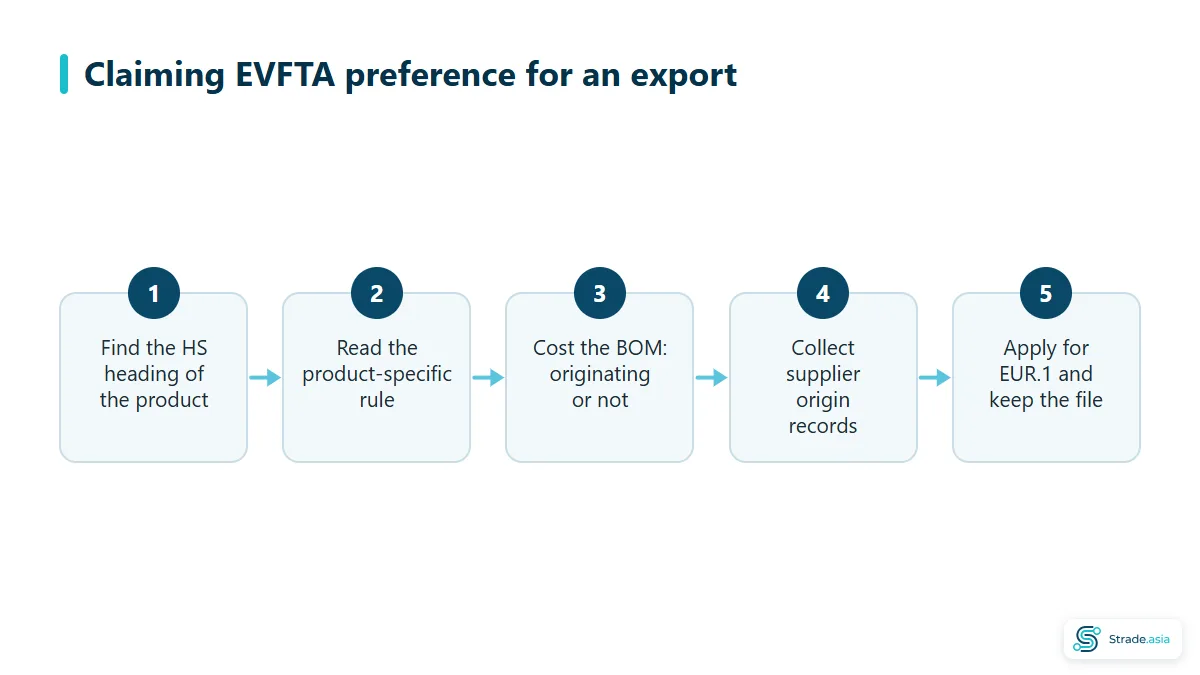
What electronics makers should do
- Confirm the HS heading of each product you export to the EU, with your customs broker.
- Read the product-specific rule for that heading and decide which option you will use.
- Cost the BOM. Separate originating materials from non-originating ones, using purchase prices. Components without origin evidence count as non-originating.
- Ask suppliers for origin information. Country of origin per line on the invoice is the minimum; for parts made in Vietnam, ask for a supplier declaration, and for EU-made parts you want to count under bilateral cumulation, keep the EU exporter’s statement on origin.
- Apply for EUR.1 for each shipment that needs it, or set up the right declaration route.
- Keep the file. Store the BOM, costing, purchase invoices, supplier declarations and production records for the period required, ready for verification.
For export processing enterprises, the same records support the materials reports that customs already requires; see delivering components to export processing enterprises.
How Strade can help
Strade is an independent electronic component distributor with its own engineers, supplying factories in Vietnam and across Asia. We state the country of origin on our documents and supply CoC and C/O when the source provides them. Our origin and compliance services cover export documents and HS code review for trade agreements such as CPTPP and EVFTA.
To check origin information for the parts in your BOM, send us your BOM.