한국어
 Bahasa Indonesia
 ไทย
 中文 (中国)
 Tiếng Việt
On 20 October, a fire broke out at the semiconductor plant of Asahi Kasei Microdevices (AKM) in Nobeoka, in Miyazaki Prefecture, Japan. Production at the site has stopped, and it is too early to say when or how it will resume. What buyers and engineers can do now is check their exposure to the affected parts, and to other single-fab ICs on their BOMs, before channel stock runs down.
AKM is well known for audio converters, the ADCs, DACs and codecs used in professional, home and car audio, and for magnetic and current sensors and other mixed-signal ICs used in consumer, industrial and automotive products. Many of these parts have no pin-compatible equivalent from another maker.
Why a single fab matters
For many specialised analog and mixed-signal ICs, all wafers come from one fab. Unlike standard logic or discrete parts, these devices depend on a process tuned for the product, and moving them to another fab takes requalification and time. When that fab stops, stock in the channel is the only supply until production resumes somewhere. A transfer is not only a technical task: parts from a new fab must be characterised against the original datasheet, and customers who approved the original part may need to approve the change too.
We saw the same pattern after the Kumamoto earthquakes in 2016, and again this year as closures and lockdowns stopped single sites in several countries. A second source is only real if it comes from a different fab, as we discussed in dual sourcing across countries.
Signs to expect in the market
When a single-source part loses its fab, buyers usually see:
- Orders not confirmed, or confirmed without a date.
- Distributors putting affected part families on allocation and limiting quantities per customer.
- Open-market prices rising quickly for the affected part numbers.
- More offers from unfamiliar brokers, including old date codes, refurbished parts and counterfeits.
That last point matters. In a sudden shortage, suspect stock moves fast. Inspect every lot: labels, date codes, packaging, marking and, for high-value or critical parts, X-ray or functional testing of samples.
What to do now
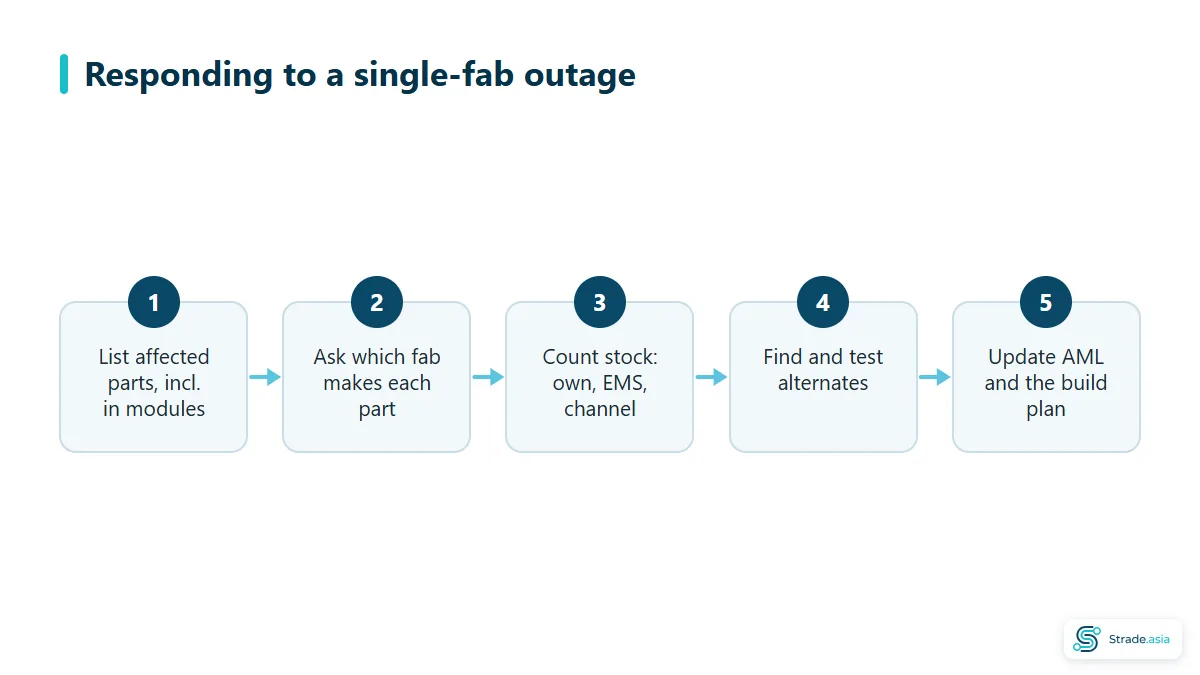
- List affected parts. Search your BOMs and AML for the maker’s part numbers, including parts inside modules, sub-assemblies or crystal oscillators you buy. Ask those suppliers whether they use them.
- Ask about the source fab. For each part, ask the supplier which fab makes it and whether any other site is qualified. Some products of an affected maker may come from other fabs or foundries.
- Count stock. Add your own inventory, stock at your EMS partner, shipped orders and confirmed channel stock. Compare the total with your build plan to see how long you are covered.
- Look for alternates. Engineering should check functional alternates from other makers now, because lead times for those parts can stretch quickly when many buyers switch at once. A different package or pinout may need a board change, and audio or sensor parts may need tuning and new firmware settings. These changes take longer than swapping a resistor.
- Plan the change. Decide which products move first, what testing is needed and whether customers must approve. Update the AML and treat the change like a product change notice; our guide to handling PCN and EOL notices covers the process.
Learn from it for next time
After the immediate work, review the rest of the BOM for the same exposure:
- Mark parts that come from one maker and one fab.
- Record the fab and assembly site where the supplier will share them.
- For critical single-fab parts, consider a design that can accept an alternate, or a buffer stock sized to the time needed to qualify one.
- Review the list when change notices arrive or when the market tightens.
This takes engineering time, but it turns a surprise into a plan.
How Strade can help
Strade is an independent electronic component distributor with its own engineers, supplying factories in Vietnam and across Asia. We buy from manufacturers, their distributors and vetted open-market suppliers, and every lot is inspected on receipt, with X-ray or sample testing for sensitive parts or on request. When a part is short or discontinued, our engineers can propose an alternate with matching specifications, and your team decides. Read more about our supply chain services.
If your BOM includes parts affected by the fire, send us the part numbers and we will check stock and alternates.