한국어
 Bahasa Indonesia
 ไทย
 中文 (中国)
 Tiếng Việt

As the year closes, an unexpected strain has appeared in the semiconductor market. In December, Volkswagen said that a shortage of certain electronic components could affect its vehicle production in China, North America and Europe in the first part of next year. Several large automotive suppliers have also warned that they cannot get all the chips they need. The parts in question are mostly not advanced processors, but microcontrollers, power management ICs, sensors and other components made on mature processes.
For buyers at factories in Vietnam making industrial equipment, power supplies, appliances or controls, this matters because many of these parts share production lines with the components on their own BOMs.
How the market got here
In spring, car plants in many countries stopped for weeks, and carmakers and their suppliers cut or postponed chip orders. At the same time, as we noted in remote work demand and component availability, demand for laptops, webcams, networking gear and servers rose quickly. Chipmakers and foundries filled the released capacity with those orders.
In the second half of the year, car sales recovered faster than most forecasts, led by China. Demand for notebooks, game consoles, 5G phones and data-centre equipment stayed strong as well. Over the same period, capacity on older 200 mm wafer lines, which make many power management ICs, display drivers, discrete devices and microcontrollers, has been reported as tight, as has assembly and test capacity at some subcontractors, and some foundries are reported to have raised prices.
When automotive orders came back, the capacity was already committed. New wafer starts take months to become finished, tested parts, and the car industry carries little stock between chipmaker and assembly line. That is why the warnings came so quickly.
It is too early to say how long this will last or how far it will spread. But buyers should not wait to find out.
What it means for industrial buyers
Automotive and industrial products use many of the same part families: MCUs, voltage regulators, MOSFETs and gate drivers, CAN and LIN transceivers, op amps and sensors. When suppliers have to choose, carmakers with long-term agreements and large volumes may be served first. Some suppliers may put part families on allocation, sharing out limited output on the basis of order history and forecasts, or ask for new orders to be non-cancellable and non-returnable (NCNR).
Single-fab parts add to the risk. The October fire at a Japanese chip plant, covered in single-source risk after a fab fire, had already cut supply of some audio and sensor ICs.
Planning 2021 component purchases
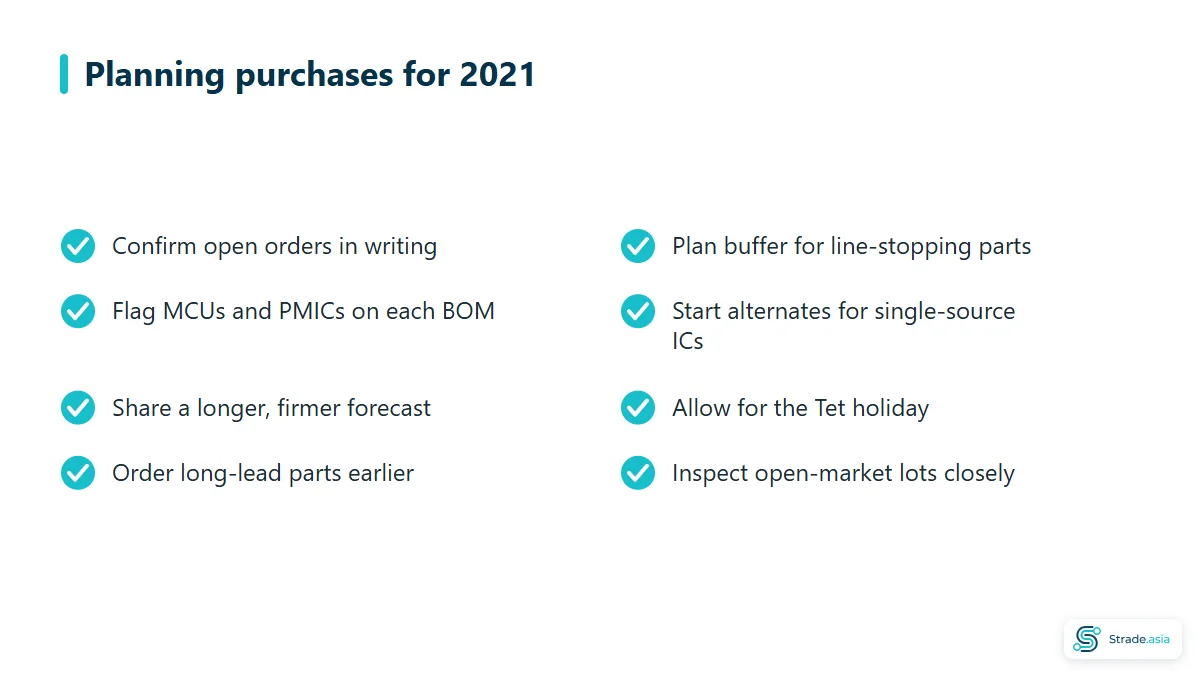
- Confirm open orders now. Ask each supplier for a current ship date on every open line, in writing.
- Flag exposed parts. On each BOM, mark MCUs, power management ICs and other semiconductors that are single-source or also used in cars.
- Extend your forecast. Share a longer, firmer forecast for 2021 with suppliers. Customers with clear forecasts are easier to serve when capacity is short.
- Order long-lead parts earlier. Where lead times are rising, place orders now for builds in the first half of the year instead of waiting for the usual reorder point.
- Plan buffer stock for critical parts. For the few parts that would stop a line, extra stock costs less than a stoppage. See buffer stock and consignment.
- Start alternates early. Ask engineering to identify and test alternates for exposed parts while there is still time. Microcontrollers need the earliest start, because firmware may have to change.
- Allow for the Lunar New Year. Tet and Chinese New Year fall in mid-February, when factories, freight and customs in the region slow down. Parts needed for February and March builds should be ordered in early January at the latest.
- Inspect open-market stock carefully. Tight markets attract poor and counterfeit stock. Check labels, date codes and packaging on every lot, and test samples of critical parts.
How Strade can help
Strade is an independent electronic component distributor with its own engineers, supplying factories in Vietnam and across Asia. Most of our orders are bought to the customer’s request, and many are urgent. We source semiconductors from manufacturers, their distributors and vetted open-market suppliers, and every lot is inspected on receipt. When a part is short, our engineers can propose an alternate with matching specifications for your team to approve.
To check availability and alternates for your 2021 builds, send us your BOM.