
 한국어
 Bahasa Indonesia
 ไทย
 中文 (中国)
 Tiếng Việt

A year ago, memory was the supply worry most buyers carried into the new year. It still is, and passive components have now joined it. Lead times for some MLCCs have lengthened, as we noted in MLCC lead times start to stretch, and buyers report longer quotes on some other passive lines too. For factories in Vietnam setting budgets and schedules for 2018, the safer assumption is that some lines will stay tight for at least part of the year, and the plan should make sure that tight supply does not stop production.
Where the market stands
- Memory. DRAM and NAND stayed tight through 2017, as described in memory supply in 2017. New capacity is coming, but nobody can say with confidence when supply will catch up. Treat memory as a constrained category until suppliers’ quotes show otherwise.
- Passives. Some MLCC lead times have stretched as phones and cars use more of them and makers focus on smaller, higher-value parts. Watch other passive lines as well.
- Everything else. Most other lines are available, but a long lead time in one category can still hold up a whole build: a board cannot ship with one capacitor missing.
Start with risk, not spend
Most purchasing plans are organised by spend. For 2018, organise them by risk as well. For each BOM line, note:
- the number of approved manufacturers;
- the current quoted lead time against your planning lead time;
- whether the part belongs to a tight category, such as memory or MLCCs;
- any open product change or end-of-life notices;
- the cost of a line stoppage if it runs out.
Lines with a single source, long lead times and a high stoppage cost go to the top of the list, whatever their unit price.
Tools for a tight year
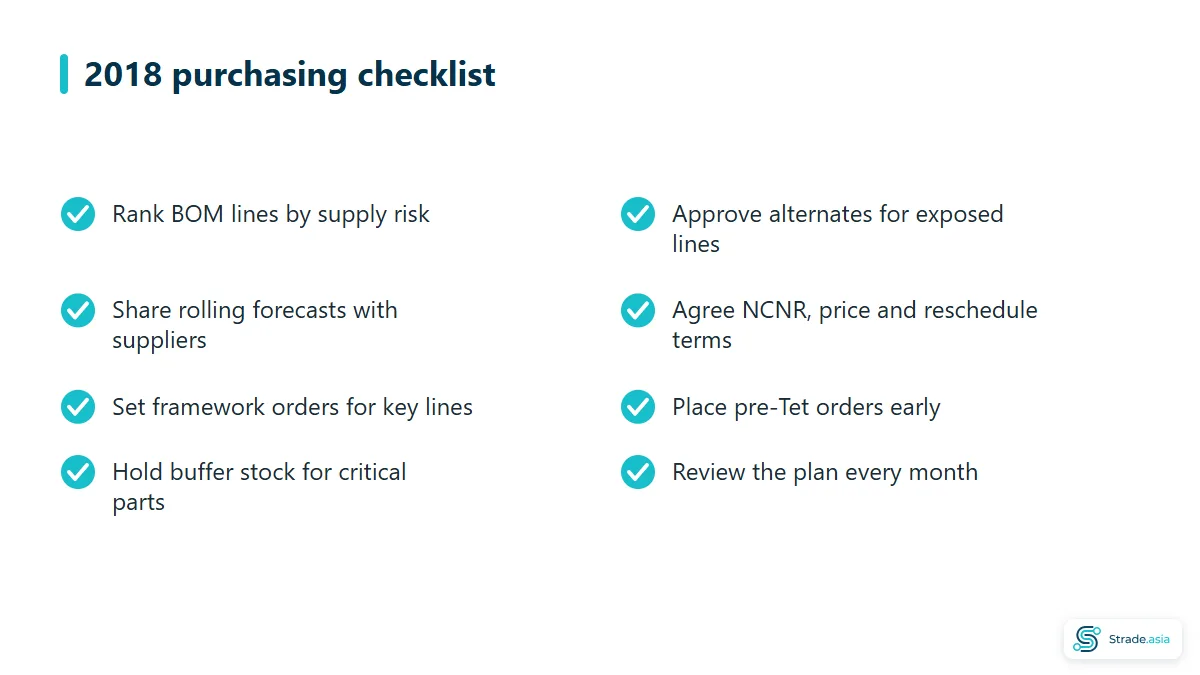
- Rolling forecasts. Give key suppliers a forecast covering the coming months and update it every month. In a tight market, suppliers serve first the customers whose demand they can see.
- Framework orders. For high-volume or exposed lines, agree annual quantities with scheduled releases. They secure supply while letting you adjust timing. Agree in advance what can be rescheduled or cancelled, and which lines are non-cancellable, non-returnable (NCNR).
- Buffer stock. Hold extra stock only for parts that are both exposed and critical. A buffer costs less than a stoppage, but it becomes excess inventory if demand falls, and aged or moisture-sensitive stock can fail customer date code limits, so set clear levels, store it correctly and review it regularly.
- Approved alternates. Qualify second sources now, while there is time to test, using the steps in our guide to approved manufacturer lists. For MLCCs, compare effective capacitance under DC bias, not only the nominal value.
- Price terms. In a rising market, quotes are valid for shorter periods. Agree how prices will be set for framework releases, and allow some contingency in product costing.
Mind the calendar
Tet falls on 16 February 2018, the same day as the Lunar New Year in China and much of Asia. Air freight space tightens in the weeks before the holiday, factories, forwarders and customs slow down around it, and supplier lead times quoted in January often slip past it. Place orders for February and March deliveries early, and confirm that shipments will arrive and clear customs before the holiday begins.
Review every month
A plan made in December will be wrong in some details by March. Review the exposed lines every month with suppliers and engineering, and update forecasts, buffer levels and alternates as quotes change. Keep a short list of the lines that could stop each product, so that everyone knows where to look first when a delivery slips.
How Strade can help
Strade is an independent electronic component distributor with its own engineers, supplying factories in Vietnam and across Asia. Most of our orders are bought to the customer’s request, and many are urgent. We source from manufacturers, their distributors and vetted open-market suppliers, inspect every lot on receipt, and propose alternates with matching specifications when parts are short. Send us your BOM for next year, or read about our supply chain services.


