
 한국어
 Bahasa Indonesia
 ไทย
 中文 (中国)
 Tiếng Việt
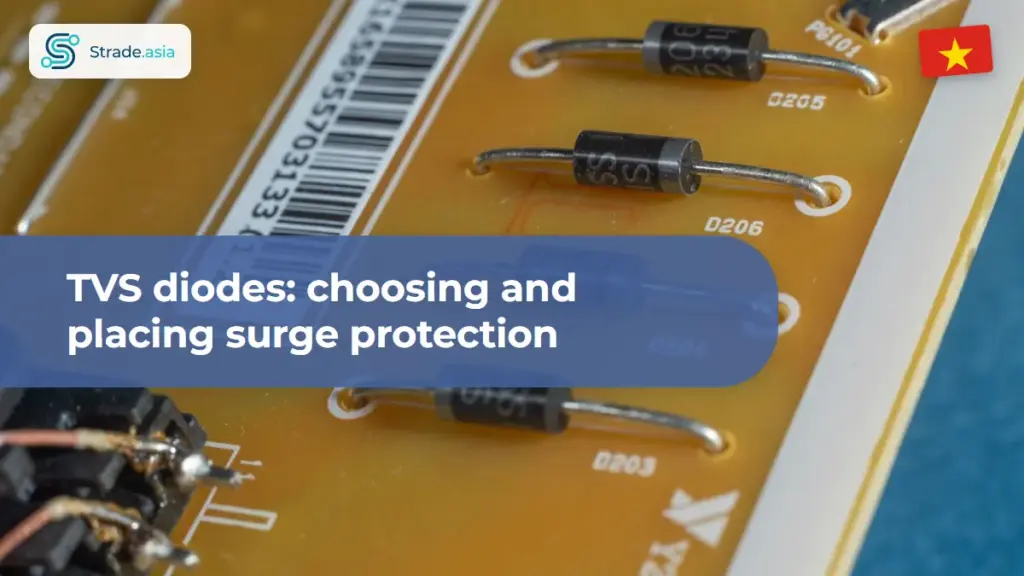
Every cable that enters a product can carry a transient into it: a static discharge from an operator’s finger, a burst of fast pulses when a contactor switches nearby, a surge from lightning or from switching a heavy load. Industrial equipment in Vietnam meets all of these, often in plants with long cable runs and frequent thunderstorms. Transient voltage suppressor (TVS) diodes are the most common way to protect the electronics behind those cables.
Where transients come from
- Electrostatic discharge (ESD). Very fast, high-voltage, low-energy pulses from people or objects. Product immunity is tested to IEC 61000-4-2. This differs from the handling precautions in ESD control in the receiving area, which protect parts before they are assembled.
- Electrical fast transients. Repetitive bursts from switching inductive loads, tested to IEC 61000-4-4.
- Surge. Slower, higher-energy pulses from lightning and power switching, tested to IEC 61000-4-5.
- Inductive kickback. Motors, solenoids and relay coils inside the product itself.
How a TVS diode works
A TVS diode is a silicon avalanche device built to carry large pulse currents. In normal operation it draws only a small leakage current. When the voltage across it rises past its breakdown voltage, it conducts and clamps the voltage, diverting the transient current to ground. It responds very fast, which suits it to ESD and fast transients.
Key datasheet parameters
- Reverse standoff voltage (VRWM). The highest voltage the TVS can see continuously without conducting significantly. Choose it at or above the maximum normal voltage on the line, including tolerance and ripple.
- Breakdown voltage (VBR). The voltage at which the diode starts to conduct, specified at a small test current. It sits above VRWM, with a tolerance.
- Clamping voltage (VC). The voltage across the TVS while it carries its rated peak pulse current. This is what the protected circuit sees, and it must stay below that circuit’s absolute maximum ratings.
- Peak pulse current (IPP) and power (PPP). The pulse the TVS can absorb. These ratings depend on the waveform: values for a 10/1000 µs pulse cannot be compared directly with values for an 8/20 µs pulse. Compare parts on the same waveform, ideally the one your test standard uses, and check the derating curve: pulse ratings are usually given at 25 °C and fall at the temperatures found inside hot enclosures.
- Capacitance. Larger TVS diodes have more capacitance, which can distort fast data signals. Lines such as USB or Ethernet need low-capacitance protection arrays designed for them.
Clamping voltage is always well above standoff voltage. A part that stays off at normal voltage may still clamp too high for a sensitive IC, so check VC at the expected current, not VBR.
Unidirectional or bidirectional?
A unidirectional TVS clamps in one direction and conducts like an ordinary forward-biased diode in the other. It suits DC rails and signals that stay on one side of ground. A bidirectional TVS clamps in both directions and suits AC lines and signals that swing above and below ground, such as RS-485 buses. Check the full voltage range of the line, including common-mode swings, before choosing.
Placement and layout
- Place the TVS close to the connector, so the transient is diverted before it spreads across the board.
- Keep the path to ground short and wide. At ESD speeds, even a short length of trace adds enough inductance to raise the voltage the circuit sees, and on surge-rated inputs the trace must also carry the peak current.
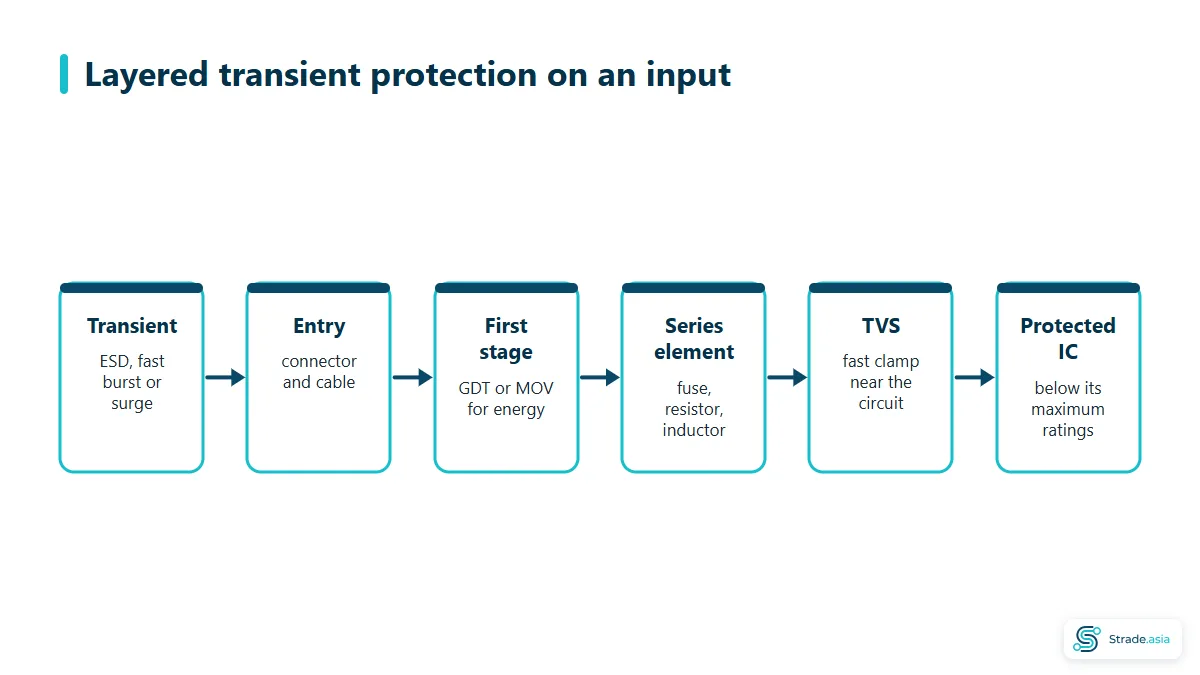
- Protect in layers. On mains or long outdoor lines, a gas discharge tube or metal oxide varistor absorbs most of the energy, a series element limits the current, and the TVS clamps what is left near the circuit.
- Plan for failure. A TVS stressed beyond its rating usually fails short. Put a fuse or other current limit upstream, chosen as described in choosing a fuse for power circuits, so a failed diode does not become a fire risk.
Checking a substitute
When the specified TVS is short, an alternate should match the standoff voltage (a higher standoff usually means a higher clamping voltage too), match or exceed the peak pulse rating on the same waveform, be of the same unidirectional or bidirectional type, and keep clamping voltage, leakage current and capacitance no higher. Package, footprint and cathode marking must fit as well. Parts with the same package and power class from different makers are often close, but compare the datasheets line by line before adding one to your approved manufacturer list.
How Strade can help
Strade is an independent electronic component distributor with its own engineers, supplying factories in Vietnam and across Asia. Our engineers compare TVS diodes on the parameters that matter and propose alternates with matching specifications for your team to approve. Browse our semiconductor range or send us your BOM.


