한국어
 Bahasa Indonesia
 ไทย
 中文 (中国)
 Tiếng Việt

In the past few weeks, a run of carmakers has announced production cuts for a reason that has little to do with car sales. Volkswagen warned in December that a shortage of electronic components would affect its output in China, Europe and North America in the first quarter. Since then Ford, Nissan, Honda and others have said they will slow or pause some lines because they cannot get enough chips. Most of the parts in question are not advanced processors but microcontrollers, power management ICs and other components made on older, well-established processes.
For buyers at factories in Vietnam that make industrial equipment, power supplies or appliances, this is more than car industry news. The same fabs make many of the parts on your BOM.
How the squeeze built up
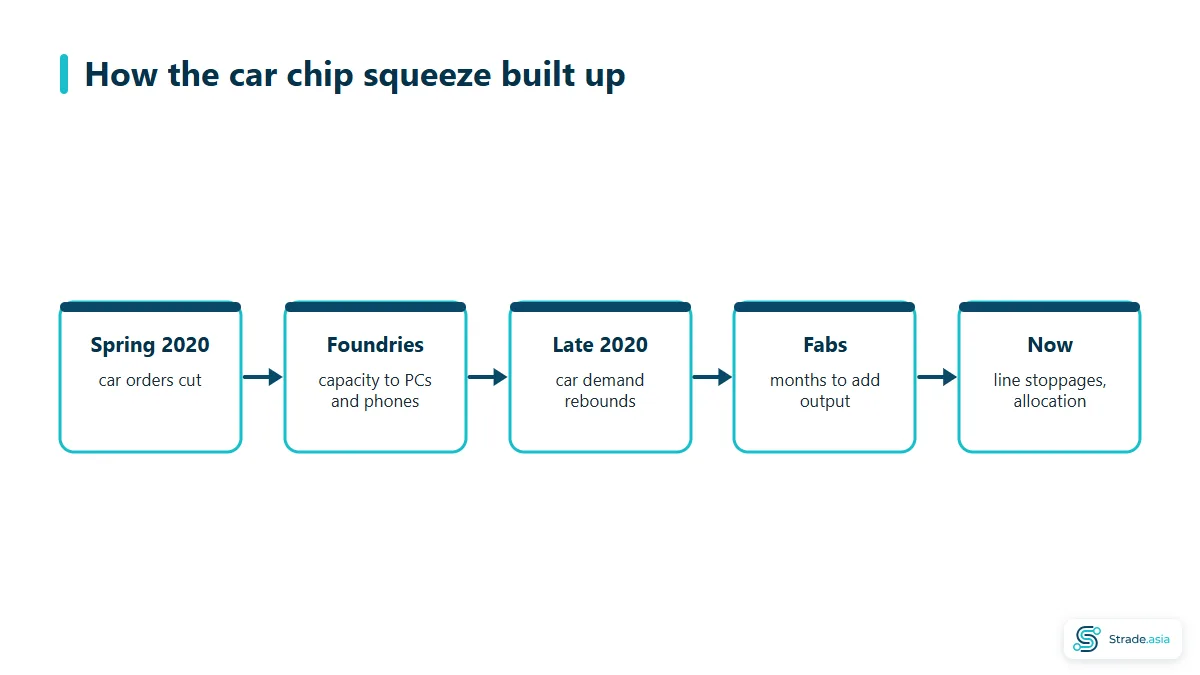
The roots go back to spring 2020. As car plants closed and showrooms emptied, carmakers and their tier-one suppliers cut or cancelled chip orders. At the same time, people working and studying from home bought laptops, monitors, webcams, routers and game consoles in large numbers. Foundries and chipmakers filled the freed capacity with those orders.
In the second half of 2020, car demand recovered faster than most forecasts, led by China. When the automotive orders came back, the capacity they had released was already booked, and new wafer starts take months to become finished parts. We described the first signs of this in automotive chip supply tightens.
Why it will not be fixed quickly
Several features of the industry make this shortage slow to clear:
- Long production cycles. A wafer takes months to pass through a fab and then through assembly and test, so wafers started today become finished parts well into the year.
- Mature processes. Many automotive and industrial chips use older process nodes. Little new capacity has been built on these nodes for years, because investment has gone to leading-edge technology.
- Lean inventory. The car industry runs just-in-time, with little stock between chipmaker, module maker and assembly plant. A gap anywhere reaches the line quickly.
- Qualification. Automotive parts are qualified for each vehicle programme, typically to AEC-Q100 and through PPAP approval, so a carmaker cannot simply switch to another chip or another fab.
Carmakers, and in some cases their governments, are now asking chipmakers and foundries to give priority to automotive orders. That may help car plants, but capacity is finite: priority for one industry means longer waits for others.
What it means for your factory
The microcontrollers, voltage regulators, MOSFETs, sensors and interface chips in a car are close cousins of the ones in an inverter, a motor drive or a smart meter, and often come off the same production lines. Since late last year, quoted lead times for many of these parts have lengthened, and some suppliers have moved to allocation, sharing out limited output among customers based on order history and forecasts. If the term is new, our guide to allocation explains how it works.
Demand from the work-from-home boom has not gone away either, as we noted in remote work demand and component availability. Industrial buyers are now competing with two strong sources of demand at once.
What buyers can do now
- Confirm open orders in writing. Ask each supplier for a current ship date on every open line, not just the ones you think are at risk.
- Find your exposed parts. Mark MCUs, power management ICs and other single-source semiconductors on each BOM, and check which of them come from suppliers that also serve the car industry.
- Extend your forecast. Give suppliers a longer and firmer view of demand. In a tight market, customers with visible forecasts tend to be served first.
- Hold buffer stock where it counts. For the few parts that would stop a line, extra stock costs far less than a stoppage. See buffer stock and consignment for the options.
- Start on alternates now. Ask engineering to identify second sources while there is still time to test them. Pin-compatible parts are the easiest; microcontrollers, with their firmware, need the earliest start.
- Inspect open-market stock carefully. Shortages attract poor and counterfeit stock. Check date codes, labels and packaging on every lot, and test samples of critical parts.
How Strade can help
Strade is an independent electronic component distributor with its own engineers, supplying factories in Vietnam and across Asia. Most of our orders are bought to the customer’s request, and many are urgent. We source from manufacturers, their distributors and vetted open-market suppliers, and every lot is inspected on receipt, with X-ray or sample testing for sensitive parts or on request. When a part is short, our engineers can propose an alternate with matching specifications for your team to approve.
If some of your semiconductor lines are already stretching, send us your BOM or the affected part numbers and we will check availability and alternates.