
 한국어
 Bahasa Indonesia
 ไทย
 中文 (中国)
 Tiếng Việt
Multilayer ceramic capacitors are the most numerous components on most boards and usually the least discussed. They are cheap, standard and available from several manufacturers, so purchasing rarely worries about them. That is changing. Over recent months, buyers and distributors have reported longer lead times for some MLCCs, and some suppliers have become more careful about how they share out output. For factories in Vietnam with dozens or hundreds of MLCC lines across their BOMs, it is time to look at them more closely.
Why supply is tightening
- Phones use more of them. Each new smartphone generation packs more functions into the same space and uses more MLCCs, mostly in very small case sizes.
- Cars use more electronics. Driver assistance, infotainment, engine and body control all add MLCCs, many of them automotive-grade, in larger case sizes or with higher voltage ratings.
- Makers are shifting capacity. Leading manufacturers are concentrating investment on small case sizes and high-capacitance parts, where demand is growing fastest. Capacity for older, larger case sizes and general-purpose values is not growing at the same pace.
- New capacity takes time. Adding MLCC output needs materials, equipment and qualification, which takes longest for automotive customers, whose qualification cycles are long.
When lead times start to rise, customers order more and earlier, and that extra ordering stretches lead times further. It is too early to say how long the tightness will last, but buyers who act now have more options than those who wait.
How it reaches factory buyers
Large phone and car electronics makers buy MLCCs under long-term agreements with big forecasts, so manufacturers plan around them first. Factories that buy smaller quantities through distributors, often at short notice, are more likely to see longer quotes, shorter quote validity, full-reel minimums and partial deliveries. Because MLCCs cost so little, a shortage is easy to overlook until one missing capacitor stops a line that has every other part in stock.
Which MLCC lines to look at first
Based on where demand and capacity are moving, the lines most likely to be affected are:
- high-capacitance values in each case size, especially in X5R and X7R dielectrics, where demand from phones and compact designs is strongest;
- larger case sizes and high-voltage parts, where some makers are moving capacity to smaller parts;
- automotive-grade parts qualified to AEC-Q200;
- any MLCC approved from only one manufacturer.
What to do now
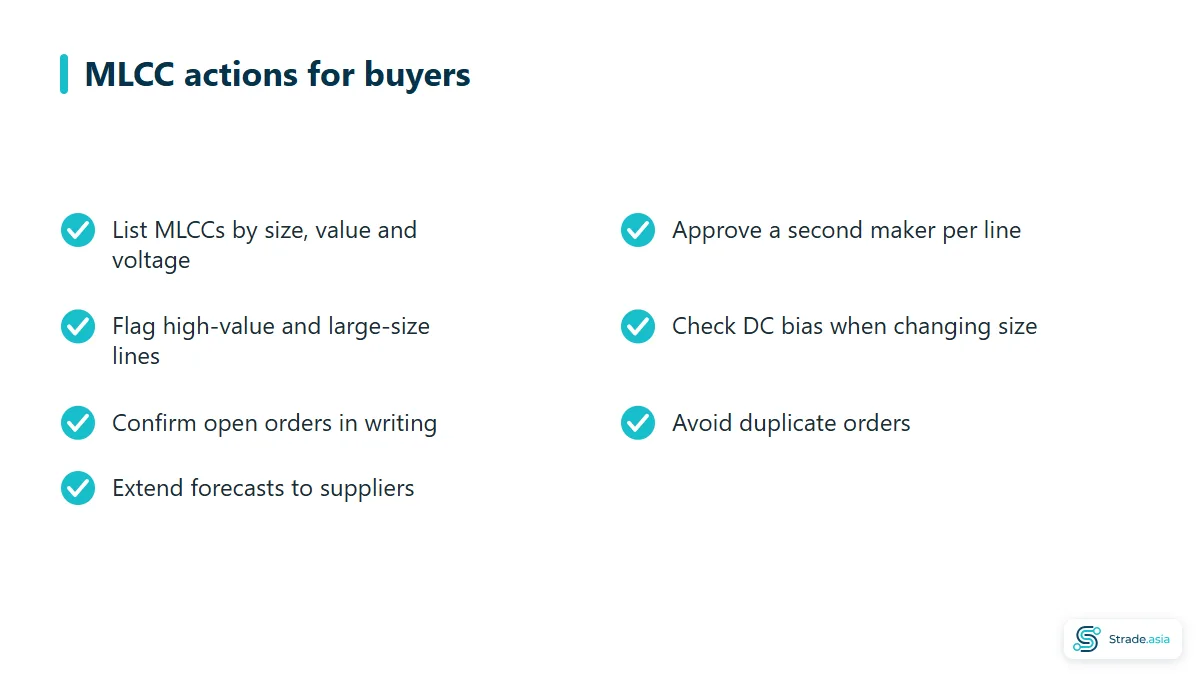
- Map your MLCCs. List every line with case size, capacitance, voltage, dielectric, approved makers and annual use.
- Flag the exposed lines from the list above, starting with those used in your highest-volume products.
- Confirm open orders. Ask for confirmed ship dates in writing, not only quoted lead times.
- Extend your forecast. Give suppliers a longer, firmer view of demand, so your needs are visible when output is shared out.
- Approve a second manufacturer for every important line, following the steps in our guide to approved manufacturer lists.
- Avoid duplicate orders. Placing the same need with several suppliers inflates demand and leaves you with surplus when supply returns, a problem covered in excess component inventory.
Alternates need an engineering check
MLCCs look interchangeable, but they are not always. Class 2 dielectrics such as X5R and X7R lose capacitance as the DC bias voltage rises, and the loss is generally greater in smaller case sizes with thinner dielectric layers. A smaller part with the same nominal value may give much less capacitance at your working voltage, while a higher voltage rating in the same case size can sometimes be easier to find and lose less capacitance under DC bias. When an alternate is proposed, compare:
- effective capacitance at the operating voltage and temperature, from the manufacturer’s curves or online tools;
- voltage rating and dielectric;
- case size and height against the footprint;
- grade, such as AEC-Q200 for automotive use.
Note also that X7R is specified up to 125 °C and X5R only up to 85 °C, so a move from X7R to X5R needs a check of the real operating temperature.
Watch the open market
Shortages draw poor-quality and counterfeit stock into the market, even for passive parts. Check labels, packaging and date codes on every lot, as described in reading component labels and barcodes.
How Strade can help
Strade is an independent electronic component distributor with its own engineers, supplying factories in Vietnam and across Asia. We source from manufacturers, their distributors and vetted open-market suppliers, and inspect every lot on receipt. When an MLCC is short, our engineers can propose alternates with matching specifications, including the effective capacitance at your working voltage, for your team to approve. Send us your MLCC lines or browse our passive components.


