한국어
 Bahasa Indonesia
 ไทย
 中文 (中国)
 Tiếng Việt
Memory buyers ended 2016 facing rising prices, and the new year has not brought relief. Market trackers such as DRAMeXchange, part of TrendForce, reported that contract prices for DRAM rose through the second half of 2016, and they expect further increases in the first quarter of 2017. NAND flash has followed a similar path. For factories in Vietnam that build industrial controllers, meters, networking equipment or consumer devices, this shows up as higher quotes, shorter quote validity and longer lead times, even for modest quantities.
The increases noted in DRAM and NAND prices turn up have carried into the first quarter, normally a quieter time, and supply of both DRAM and NAND is still tight.
What is driving the DRAM and NAND squeeze
Several forces are pulling in the same direction:
- More memory per phone. Smartphones take a large and growing share of DRAM output and are a major user of NAND, which pulls capacity away from PC and industrial parts. New models carry more DRAM and more base storage than the generation before, and across hundreds of millions of phones a small increase per device takes a large share of output.
- Servers and data centres. Cloud providers keep expanding, and each server uses a large amount of DRAM. Solid-state drives are also replacing hard disks in many servers and notebooks, adding to NAND demand.
- Slow additions to DRAM capacity. For several years DRAM makers have grown output mainly by moving to finer process nodes rather than building new fabs. Each step is now harder and adds less output per wafer, so supply grows more slowly than it used to.
- The 3D NAND transition. NAND makers are moving from planar to stacked 3D NAND. In the long run this adds capacity, but converting lines and raising yields takes time, and during the change output has grown less than demand.
The memory market is also concentrated. A handful of manufacturers produce most of the world’s DRAM and NAND, so their capacity plans decide supply for everyone. Wider consolidation in semiconductors, which we covered in what mergers mean for your BOM, leaves buyers with fewer places to turn.
How it reaches industrial buyers
Large phone and PC makers buy memory under long-term contracts and are served first. Industrial customers usually buy smaller quantities through distributors, often at spot prices, and they feel a shortage early:
- Allocation. Some suppliers share out limited output among customers based on order history and forecasts. A customer with no forecast on file may be quoted a long lead time, or no date at all.
- Short quote validity. Quotes may be valid for days rather than weeks, some suppliers set the price at shipment rather than at order, and more memory lines are booked on NCNR (non-cancellable, non-returnable) terms.
- Legacy parts. As makers move capacity to high-density mobile and server products, older generations and low-density parts become harder to find. Industrial designs often use exactly these parts.
- eMMC and managed NAND. Embedded storage in modules and controllers draws on the same NAND supply, and its lead times have lengthened too.
What buyers can do now
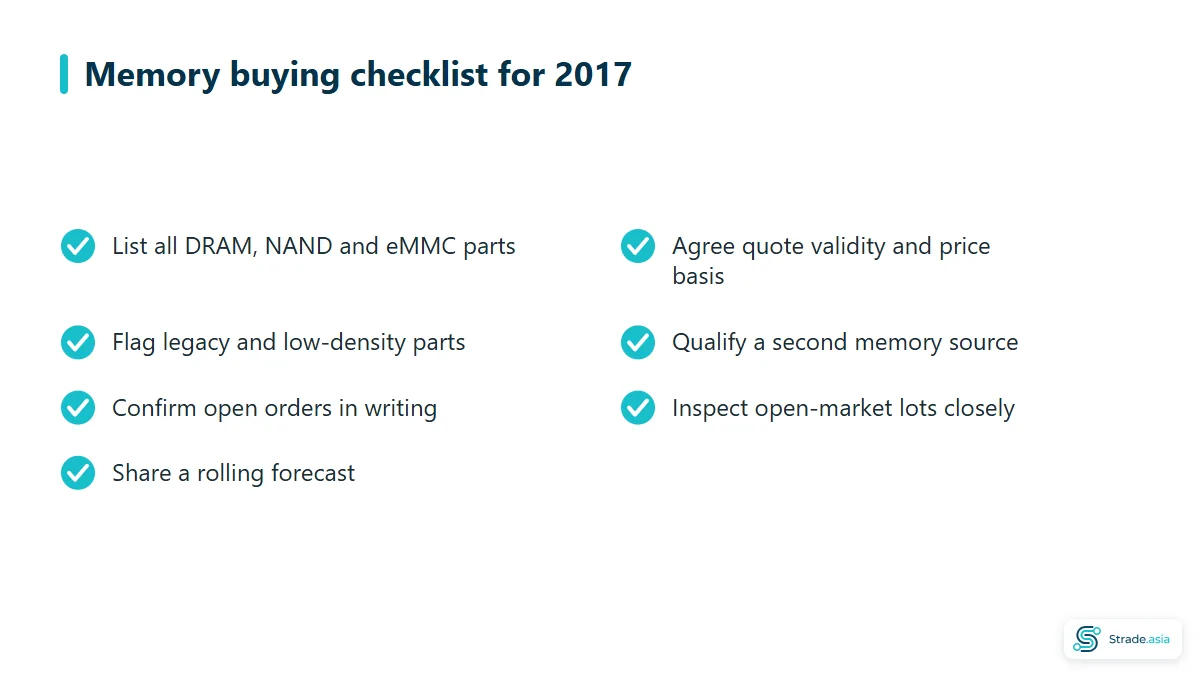
- Map your exposure. List every DRAM, NAND, eMMC and memory card on each BOM, with annual volume and current supplier.
- Flag legacy and low-density parts. These carry the highest risk of long lead times and end-of-life notices.
- Confirm open orders. Ask for a ship date in writing on every open line.
- Share a rolling forecast. In a tight market, suppliers serve first the customers whose needs they can see.
- Agree price terms. Ask how long each quote is valid and whether the price is fixed at order or at shipment.
- Qualify a second source. Many memory parts have compatible equivalents from another manufacturer, but package pinout, supply voltage, speed grade and timing, and for NAND or eMMC also page size, ECC and firmware support, must be checked before you switch.
- Inspect open-market stock carefully. Shortages bring old, pulled and remarked stock into the market. Check labels, packaging, date codes and the dry pack required by the moisture sensitivity level on every lot.
Nobody can say with confidence when supply will catch up. New 3D NAND capacity is on the way, but DRAM makers have so far been cautious about adding fabs. Planning for tight memory supply through 2017 is the safer assumption.
How Strade can help
Strade is an independent distributor of electronic components, semiconductors included, with its own engineers, serving factories in Vietnam and across Asia. We source from manufacturers, their distributors and vetted open-market suppliers, and inspect every lot on receipt. When a memory part is short, our engineers can propose an alternate with matching specifications for your team to approve. Send us your memory part numbers and we will check availability and alternates, or browse our semiconductor range.