한국어
 Bahasa Indonesia
 ไทย
 中文 (中国)
 Tiếng Việt

After falling through 2015 and early 2016, DRAM and NAND flash contract prices have turned upward in the second half of this year. Buyers in Vietnam and across Asia are seeing longer lead times, tighter allocation, and firmer quotes entering the fourth quarter. Short-term buying habits that worked in an oversupplied market now create line-stop risk, so procurement and engineering teams need longer rolling forecasts, wider purchase-order horizons, and early checks on industrial memory parts.
Why DRAM and NAND Supply Tightened
Two shifts have hit the memory market together this year. In DRAM, major suppliers shifted wafer capacity away from standard PC and general-purpose memory toward higher-margin mobile DRAM and server lines. Because many OEMs kept lean stocks while prices fell earlier in the year, capacity reallocation and seasonal build demand pushed DRAM contract prices up and drained channel inventory.
NAND flash tightened as manufacturers moved fabrication lines from planar 2D NAND to 3D NAND. During the conversion, planar output drops temporarily while equipment changes over and new process yields ramp. At the same time, new smartphones carry higher onboard DRAM and flash storage densities, absorbing mobile DRAM, eMMC, and NAND capacity. When flagship handset builds pull heavily on fabs, smaller factories feel the squeeze first through stretched delivery schedules and rising spot quotes.
Why Industrial Memory Buyers Face Extra Risk
Consumer electronics teams usually buy high-volume mobile or PC memory on short design cycles. Factories building industrial controllers, networking gear, medical devices, metering equipment, and automotive subsystems depend on lower-density DDR2 or DDR3, industrial-temperature SDRAM, SLC or industrial MLC NAND, and fixed eMMC firmware revisions that require formal qualification before any change.
As fabs prioritize flagship mobile packages and migrate lines toward 3D NAND, older planar densities and wide-temperature grades receive lower priority. That brings three risks to factory BOMs:
- Tighter allocation and longer lead times: Suppliers prioritize forecasted contract demand over ad-hoc orders, pushing unscheduled industrial builds to the back of the queue.
- Die shrinks and product change notices: Process migrations or eMMC controller updates can force timing or firmware re-validation. Tracking memory roadmaps takes the same discipline used to manage BOM impact after semiconductor mergers.
- Higher landed cost on urgent fills: Waiting until stock runs low exposes buyers to rising spot premiums and express air freight to keep assembly lines running.
Resetting Forecasts, Horizons and Buffer Stock
In a falling market, delaying orders lowers unit cost. In a tightening market, waiting pushes delivery dates out and raises prices. Buyers should adjust their purchasing horizon now rather than waiting for year-end allocation notices.
Start by extending rolling forecasts and firm purchase-order coverage with suppliers. Even when end-customer schedules shift, sharing visibility on memory part numbers helps distributors protect allocation on critical packages. Next, segment your memory BOM by risk using the same framework as a single-site and single-source risk audit. Standard commercial parts with approved alternates can stay on regular replenishment, while sole-source industrial-temperature ICs, legacy densities, and specific eMMC revisions need earlier coverage and confirmed roadmaps.
Before bringing in extra buffer stock, verify warehouse readiness. Most DRAM, NAND, and eMMC parts ship in moisture-sensitive BGA packages. Early inventory only protects production when receiving and stores follow moisture sensitivity level (MSL) handling and storage rules, keep dry-pack barrier bags sealed, and track floor life before reflow.
What Buyers and Engineers Should Do This Month
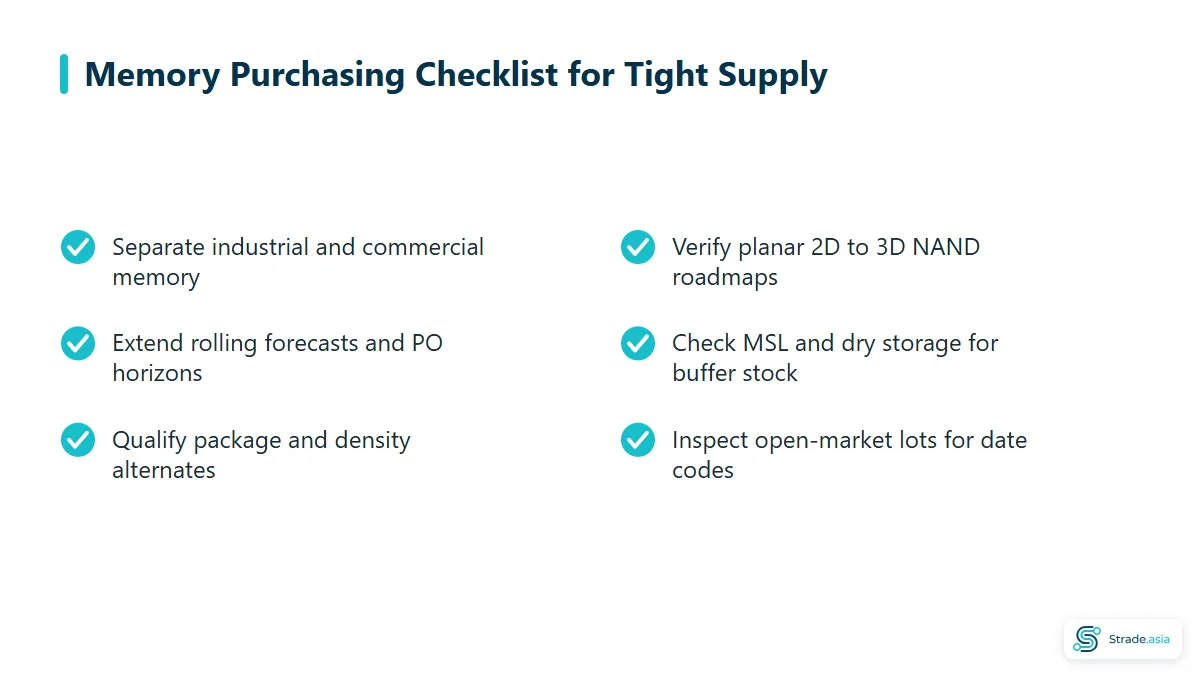
- Audit active memory BOMs: Flag legacy DDR2, low-density DDR3, planar SLC or MLC NAND, industrial-temperature grades, and single-source eMMC parts.
- Extend forecasts and PO horizons: Move critical memory lines off spot buying and place scheduled orders now to cover both fourth-quarter builds and the weeks around the Lunar New Year, and expect shorter quote validity and more NCNR terms as supply tightens.
- Check 2D-to-3D migration plans: Ask suppliers whether planar NAND or eMMC part numbers face die transitions, controller changes, or end-of-life notices.
- Qualify alternates early: Work with engineering to approve compatible densities, packages, or second-source vendors while evaluation samples remain available.
- Tighten checks on open-market lots: Tight memory markets attract pulled and remarked stock, so inspect open-market deliveries in an ESD-controlled receiving area: verify labels, date codes, packaging and dry-pack condition, and add X-ray or sample testing on high-risk lots before releasing parts to production.
Sourcing Support for Tight Memory Markets
Strade Asia is an independent distributor of electronic components with its own engineers, supplying factories in Vietnam and across Asia with semiconductors, passive components, connectors, and power products. When memory lines tighten or face discontinuation, Strade buys from manufacturers, manufacturers’ distributors, and vetted open-market sources, and its engineers propose specification-matched alternates for your team to decide. Every lot is checked on receipt for part number, label, date code, packaging, and visual condition, with X-ray or sample testing for sensitive parts or on request, plus anti-static packing and moisture control to the MSL. CoC, C/O, and CQ accompany the goods when the source provides them, with DDP or DAP delivery and customs documents prepared for factories and export processing enterprises. Send your BOM (Excel, CSV, or PDF) or enter part lines to request a quotation.