한국어
 Bahasa Indonesia
 ไทย
 中文 (中国)
 Tiếng Việt
In the space of a few weeks in December, two large semiconductor acquisitions closed. NXP completed its purchase of Freescale, and Intel completed its acquisition of Altera. Avago’s agreement to buy Broadcom, announced in May, is still going through approvals, and in November ON Semiconductor agreed to buy Fairchild. Earlier in 2015, Infineon completed its purchase of International Rectifier, and Cypress merged with Spansion. For a bill of materials, a wave of mergers like this brings slow-moving risks: discontinued parts, site transfers and changes of distributor.
For buyers and engineers at factories in Vietnam, these deals can read like financial news from far away. They are closer than that. The companies involved make microcontrollers, MOSFETs, power management ICs, interface chips and memory that sit on BOMs for power supplies, motor drives, meters and consumer products. A merger changes how those parts are made, named, sold and supported, and the changes arrive gradually, often long after the headlines.
How a merger reaches your BOM
- Overlapping product lines. When both companies sell similar microcontrollers, MOSFETs or regulators, the combined company rarely keeps every family. It chooses which to develop and which to retire, and retired families eventually receive end-of-life (EOL) notices with a last-time-buy date.
- Fewer production sites. New owners often consolidate fabs and assembly plants to cut cost. Moving a part to another site triggers a product change notification (PCN), and can change the country of origin on customs and certificate-of-origin paperwork as well as marking, packing, lead finish or moisture sensitivity level.
- Divestments. Regulators may require a buyer to sell part of the business before approving a deal. NXP sold its RF power business as a condition of the Freescale merger. Parts in a divested line move to a new owner with its own name, website and sales channel.
- Names and documents. Datasheets, labels, part number prefixes and websites are brought under the new brand over time. The silicon may be identical, but your approved manufacturer list and ERP item master can quietly fall out of date.
- Distribution channels. The merged company reviews its distribution agreements. A distributor that carried one brand may not carry the other, and pricing, minimum order quantities and lead times can be renegotiated. When the merged companies move to a single ordering system, shipments can pause for a short time.
What a merger does not mean
A merger does not make parts disappear overnight. Most makers follow established procedures for change and discontinuation notices, such as JEDEC’s JESD46 for product and process changes and JESD48 for product discontinuance, which give customers notice and time to respond. The real risk is missing the notices, or acting on them too late: a last-time-buy window that nobody reads, or an alternate that nobody started testing.
Map your BOM exposure
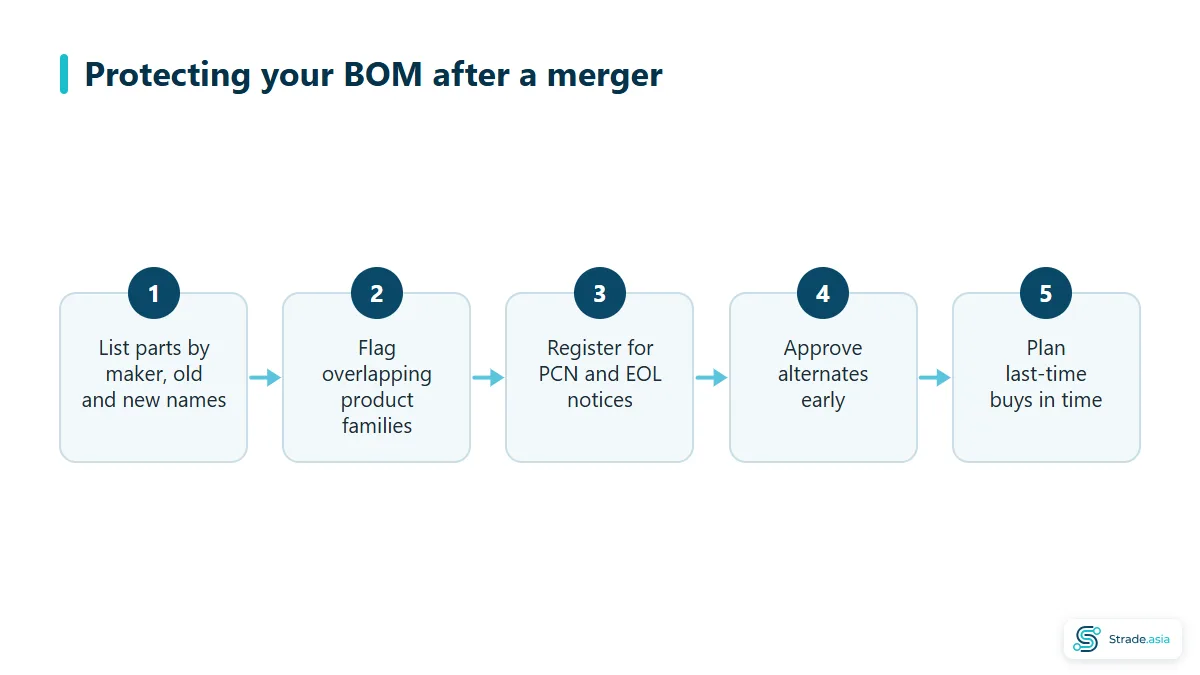
- List parts by manufacturer. Include the merging companies under both old and new names, and include parts bought through contract manufacturers.
- Flag overlap. Where the two companies sold competing families, mark those parts as at risk of rationalisation, even if no notice has arrived.
- Check lifecycle status. Note which parts are active, not recommended for new designs, or already announced for EOL.
- Make sure notices reach a person. Register for PCN and EOL notices with each maker, and ask your suppliers to forward any they receive for your parts. Name someone responsible for reading them.
- Approve alternates early. Qualification is far easier while the original part is still available to compare against. Start with the parts that would stop a line.
- Keep records linked. When part numbers or brand names change, link the old and new numbers in your item master instead of creating unrelated records.
- Plan last-time buys properly. If an EOL notice arrives, calculate demand for the remaining life of the product, including service and spare parts, before the window closes.
Questions to ask your suppliers
Distributors and manufacturer representatives often hear about roadmap decisions before formal notices go out. It is worth asking directly. Which of my parts are in families where the merged company has overlapping products? Has the maker announced any site transfers that affect my parts? Will the distribution arrangements for this brand change? Which pin-compatible alternates exist if a family is retired?
None of these questions needs a crisis to justify it. Asked at the start of the year, as part of a normal BOM review, they turn a merger from a surprise into a planning item.
How Strade can help
Strade is an independent electronic component distributor with its own engineers, supplying factories in Vietnam and across Asia. We source from manufacturers, their distributors and vetted open-market suppliers, and inspect every lot on receipt. When a part faces a change or end-of-life notice, our engineers can propose alternates with matching specifications, and your team decides. Read more about our supply chain services.
If you want a second view of your exposure, send us your BOM and we will check lifecycle status and possible alternates for the affected parts.